


Cognitive biases in clinical decision-making in prehospital critical care; a scoping review
- PMID: 40462148
- PMCID: PMC12135565
- DOI: 10.1186/s13049-025-01415-1
Cognitive biases in clinical decision-making in prehospital critical care; a scoping review
Abstract
Purpose: Every day, critical care providers in the prehospital setting respond to time sensitive and outcome-critical emergencies, often in unfamiliar environments with little or no prior knowledge about the patient. In these demanding situations, they must make multifactorial clinical decisions that may be critical for the patient's life and future health. Errors in this complex decision-making have identified as a significant cause of patient harm and, consequently, there is increasing research focus upon clinical decision-making and risk mitigation in prehospital critical care. Cognitive biases have been identified as a common cause of these systematic errors in the hospital environment and these studies inspired the aim of this article to map current evidence and investigate, "What cognitive biases affects clinical decision-making in prehospital critical care".
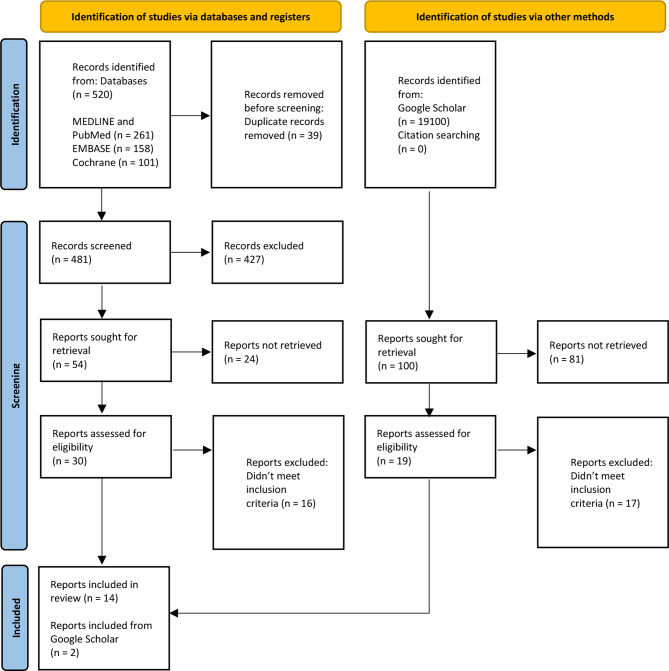
Materials and methods: A scoping review was conducted following Joanna Briggs Institute`s framework, by searching OVID MEDLINE and PubMed, EMBASE, and Cochrane for articles, no restrictions were set for type of article. Articles describing cognitive biases and clinical decision-making in pre-, and in-hospital critical care were included. Additionally, a search in Google scholar was conducted using keywords identified in included articles.
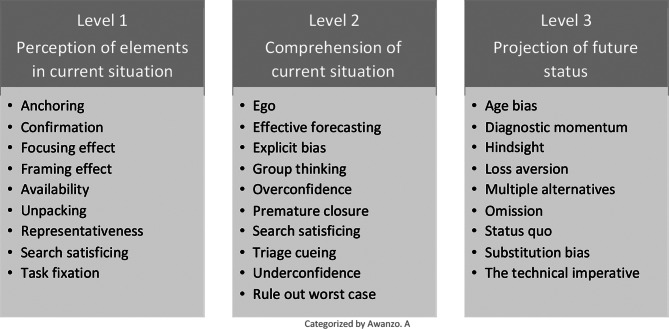
Results: Five hundred unique articles were identified through the search, of which 16 articles examining cognitive biases and clinical decision making in critical care were included, with only two articles focussed exclusively on prehospital critical care. Twenty-eight unique cognitive biases were identified in these articles. The most identified cognitive biases were, anchoring bias, framing effect, availability bias, confirmation bias, overconfidence bias, premature closure, and omission bias. Twelve articles described contributing factors for cognitive biases and these were categorized into 3 main categories. The main categories identified were lack of unbiased feedback, social behaviour and beliefs, and time pressure. Eleven articles proposed mitigation factors, which were categorized into 3 categories, consisting of feedback and follow-up, organizational culture, and education and training.
Conclusions: This scoping review has identified several cognitive biases that affect clinical decision-making, as well as research gaps in both pre- and in-hospital critical care. Identified evidence suggest that both clinicians and organisations are affected by cognitive biases in clinical decision-making in critical care. Future research should aim to establish how these cognitive biases affect clinical decisions in prehospital critical care, and what measures may mitigate the consequent errors, may reduce patient harm, and improve outcomes.
Keywords: Clinical decision-making; Cognitive biases; Critical care; Prehospital; Scoping review.
© 2025. The Author(s).
Conflict of interest statement
Declarations. Ethics approval and consent to participate: Not applicable. Consent for publication: Not applicable. Competing interests: The authors declare no competing interests.
Figures
References
-
- Hugelius K, Becker J. Common Challenges in the Prehospital Management of Mass-Casualty Incidents: A Systematic Integrative Review. Prehospital and Disaster Medicine [Internet]. 2024 Aug [cited 2025 Feb 6];39(4):301–9. Available from: https://www.cambridge.org/core/journals/prehospital-and-disaster-medicin... - PubMed
-
- Gawande A. The checklist manifesto: how to get things right. 1st ed. New York: Metropolitan Books; 2010. p. 209.
-
- Helsedirektoratet. Årsrapport 2017 Meldeordningen for uønskede hendelser i spesialisthelsetjenesten [Internet]. Oslo: Helsedirektoratet; 2018 May [cited 2023 Apr 30]. Available from: shorturl.at/huEQW.
-
- Perona M, Rahman MA, O’Meara PP, Judgement. Decision-Making and Cognitive Processing: A Review of the Literature. Australasian Journal of Paramedicine [Internet]. 2019 Jan [cited 2023 Mar 26];16:1–12. Available from: http://journals.sagepub.com/doi/10.33151/ajp.16.586
-
- WHO. who.int. 2019 [cited 2023 Apr 30]. Patient safety. Available from: https://www.who.int/news-room/fact-sheets/detail/patient-safety
Publication types
MeSH terms
LinkOut - more resources
Full Text Sources
Medical
