


Acute Impact of Different Reperfusion Duration Following Blood Flow Restriction on Bar Velocity during the Bench Press Exercise
- PMID: 40463310
- PMCID: PMC12127942
- DOI: 10.5114/jhk/194471
Acute Impact of Different Reperfusion Duration Following Blood Flow Restriction on Bar Velocity during the Bench Press Exercise
Abstract
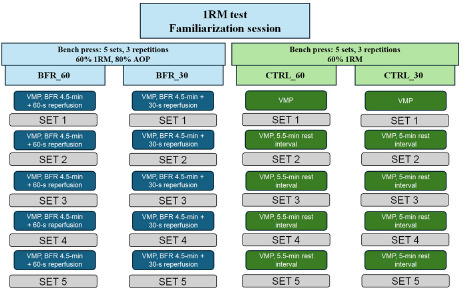
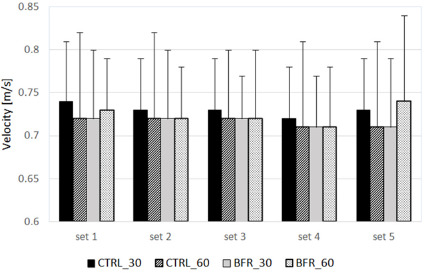
The main goal of this study was to evaluate the effects of different reperfusion duration following intra-conditioning blood flow restriction (BFR) on bar velocity during the bench press exercise and muscle viscoelastic properties of the triceps brachii. Eleven resistance trained males (age: 24.3 ± 4.9 years; body mass: 85.5 ± 13.2 kg; bench press 1RM: 123.6 ± 25.4 kg; training experience: 6.8 ± 5.1 years) volunteered for the study. During the experimental sessions participants performed 5 sets of 3 repetitions of the bench press exercise with a load of 60% 1RM under four different conditions: two BFR (80% AOP) and two control conditions. For the BFR conditions, cuffs were applied before each set for 4.5 min and released 30 or 60 s before the start of the set as reperfusion. Under the control conditions, BFR was not applied and the total duration of rest intervals amounted to 5 min and 5.5 min. Measurements of viscoelastic properties were conducted at baseline and immediately after completion of each set of the bench press exercise. The two-way ANOVA showed no significant condition × set interaction for mean and peak bar velocity (p = 0.93; p = 0.787; accordingly), and no main effect of condition for mean and peak bar velocity (p = 0.57; p = 0.417; accordingly). The Friedman's test showed no differences in oscillation frequency (p = 0.156), stiffness (p = 0.368), and the logarithmic decrement of tissue oscillation (p = 0.644). The results of this study indicate that BFR during rest intervals does not acutely influence mean and peak bar velocity, as well as mechanical properties of the triceps brachii regardless of the duration of reperfusion.
Keywords: athletic performance; ischemia; myotonometric assessment; occlusion; stiffness.
Copyright: © Academy of Physical Education in Katowice.
Conflict of interest statement
The authors declare no conflict of interest.
Figures

References
-
- Bailey, L., Samuel, D., Warner, M. B., & Stokes, M. (2013). Parameters representing muscle tone, elasticity and stiffness of biceps brachii in healthy older males: symmetry and within-session reliability using the MyotonPRO. Journal of Neurological Disorders, 1(1), 1–7. 0.9783/9780812208221.1
-
- Bichowska-Pawęska, M., Gaweł, D., Trybulski, R., Jarosz, J., Łosińska, K., Fostiak, K., & Vieria, J. G. (2024). The effect of a single cycle of ischemia on bar velocity during bench press exercise. Baltic Journal of Health and Physical Activity, 16(1), 10. 10.29359/BJHPA.16.1.10 - DOI
-
- Cè, E., Longo, S., Limonta, E., Coratella, G., Rampichini, S., & Esposito, F. (2020). Peripheral fatigue: new mechanistic insights from recent technologies. European Journal of Applied Physiology, 120(1), 17–39. 0.1007/s00421-019-04264-w - PubMed
LinkOut - more resources
Full Text Sources