


Crop evapotranspiration and water productivity in Loess Plateau: A case study of Shanxi province based on SEBAL model
- PMID: 40465576
- PMCID: PMC12136368
- DOI: 10.1371/journal.pone.0325350
Crop evapotranspiration and water productivity in Loess Plateau: A case study of Shanxi province based on SEBAL model
Abstract
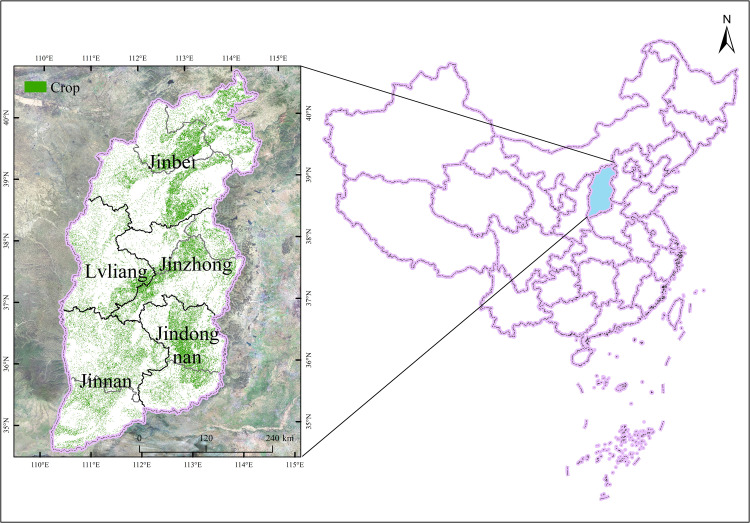
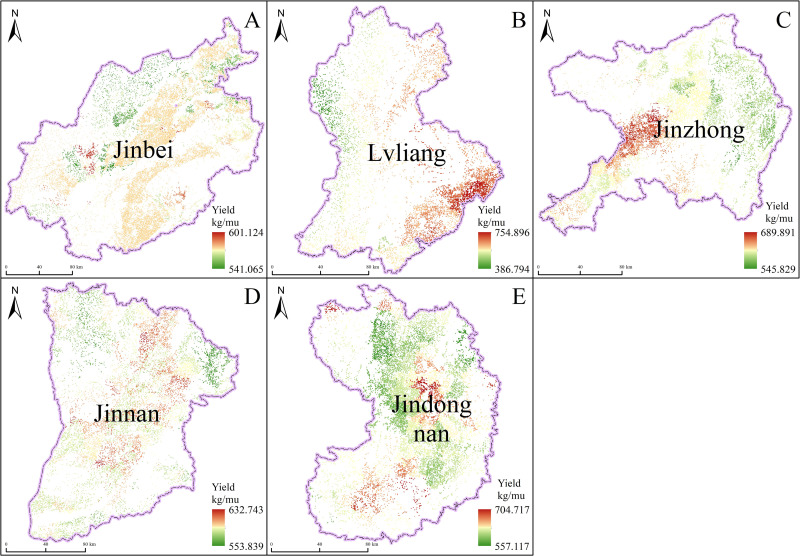
This study focuses on Shanxi Province, located in the typical rain-fed agricultural region of the Loess Plateau, where farmland water reserves are limited and water scarcity is a significant challenge. To achieve stable and high grain yields while addressing these constraints, the primary focus must be on reducing agricultural water use while balancing productivity with water conservation, provided that sufficient irrigation sources are available. The research utilized Landsat 8 satellite data and meteorological information to simulate crop evapotranspiration (ET) in Shanxi using the SEBAL model. Based on the simulated ET values and field survey data of crop yields, the study calculated crop water productivity (WP). It then analyzed the relationship between WP and natural factors such as elevation, air temperature, and precipitation. Key findings include: Crop ET in Shanxi generally increased from northeast to southwest, with simulation results closely aligning with FAO Penman-Monteith equation calculations (relative error of no more than 5%). Crop yields ranged from 386.794 to 754.896 kg/mu, with WP varying significantly across regions-from 0.824 kg/m3 in the Jindongnan district to 2.532 kg/m3 in the Jinnan district. Regional variations in crop WP were influenced by elevation, annual temperature, and precipitation patterns. Notably, the linear correlation between WP and these factors was weaker in the Lvliang mountainous area. These findings emphasize the importance of implementing appropriate field management practices (e.g., optimized irrigation scheduling, soil moisture management) to improve both crop yields and WP.
Copyright: © 2025 Bai et al. This is an open access article distributed under the terms of the Creative Commons Attribution License, which permits unrestricted use, distribution, and reproduction in any medium, provided the original author and source are credited.
Conflict of interest statement
The authors have declared that no competing interests exist.
Figures



References
-
- Patra S, Poddar R, Brestic M, Acharjee P, Bhattacharya P, Sengupta S. Prospects of hydrogels in agriculture for enhancing crop and water productivity under water deficit condition. Int J Polym Sci. 2022;2022.
-
- Wang H, Wang N, Quan H, Zhang F, Fan J, Feng H, et al. Yield and water productivity of crops, vegetables and fruits under subsurface drip irrigation: a global meta-analysis. Agric Water Manag. 2022;269:107645. doi: 10.1016/j.agwat.2022.107645 - DOI
-
- Mukherjee S, Dash PK, Das D, Das S. Growth, yield and water productivity of tomato as influenced by deficit irrigation water management. Environ Process. 10:10.
-
- Zhang C, Xie Z, Wang Q, Tang M, Feng S, Cai H. AquaCrop modeling to explore optimal irrigation of winter wheat for improving grain yield and water productivity. Agric Water Manag. 2022;266:107580. doi: 10.1016/j.agwat.2022.107580 - DOI
-
- Xiao C, Ji Q, Zhang F, Li Y, Fan J, Hou X, et al. Effects of various soil water potential thresholds for drip irrigation on soil salinity, seed cotton yield and water productivity of cotton in northwest China. Agric Water Manag. 2023;279:108172. doi: 10.1016/j.agwat.2023.108172 - DOI
MeSH terms
Substances
LinkOut - more resources
Full Text Sources
Research Materials
