


Virtual Life Story Club Intervention to Improve Loneliness and Apathy in Community-Dwelling Older Adults: Protocol for a Mixed Methods Feasibility Study
- PMID: 40466100
- PMCID: PMC12177422
- DOI: 10.2196/70518
Virtual Life Story Club Intervention to Improve Loneliness and Apathy in Community-Dwelling Older Adults: Protocol for a Mixed Methods Feasibility Study
Abstract
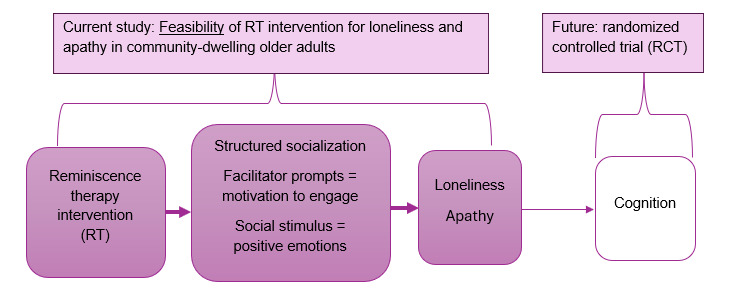
Background: Reminiscence therapy is a noninvasive, nonpharmacological intervention that has been shown to improve cognition, mood, functional status, quality of life, and apathy in older adults. Group reminiscence therapy combines structured social engagement and recounting of personal stories that address both social connection (a risk factor for cognitive decline) and cognition. Life Story Club is an established, nonprofit organization that provides virtual group reminiscence therapy for older adults to reduce loneliness and promote a sense of belonging and has not been formally studied.
Objective: This study aims to explore the feasibility of a Life Story Club intervention to improve loneliness and apathy in community-dwelling older adults.
Methods: A prospective, single-arm, single-center, pilot study will be conducted to compare loneliness and apathy in 50 lonely individuals without dementia at baseline who receive a virtual group reminiscence therapy intervention. The intervention will be delivered weekly over 12 weeks. Loneliness will be assessed with the UCLA Loneliness Scale and apathy will be assessed with the Apathy Evaluation Scale before and after the intervention. Feasibility will be assessed using quantitative and qualitative measures including feasibility of screening and enrollment, acceptability, and program satisfaction. Qualitative interviews will be conducted with a subset of 30 individuals to explore acceptability, barriers, and facilitators of the intervention.
Results: The proposed study is funded by a pilot grant from the Institute for Clinical and Translational Research at Albert Einstein College of Medicine. Recruitment and data collection are planned for July 2025.
Conclusions: This study will provide evidence for the feasibility of virtual group reminiscence therapy for community-dwelling older adults to reduce loneliness and apathy. Our approach is both innovative and pragmatic because we will leverage an existing community-based service, with an established infrastructure and track record within the community to deliver the intervention. As such, the proposed research has the potential for broad implications for community-based research and aligns with multiple translational science principles.
International registered report identifier (irrid): PRR1-10.2196/70518.
Keywords: apathy; cognition; community-dwelling; loneliness; reminiscence therapy.
©Chava Pollak, Helena M Blumen, Lily Zhou, Jennifer Wong, Ying Jin, Atul Bhattiprolu, Sophie Anfang, Mirnova E Ceïde. Originally published in JMIR Research Protocols (https://www.researchprotocols.org), 04.06.2025.
Conflict of interest statement
Conflicts of Interest: None declared.
Figures
References
-
- Rajan KB, Weuve J, Barnes LL, McAninch EA, Wilson RS, Evans DA. Population estimate of people with clinical Alzheimer's disease and mild cognitive impairment in the United States (2020-2060) Alzheimers Dement. 2021 Dec;17(12):1966–1975. doi: 10.1002/alz.12362. https://europepmc.org/abstract/MED/34043283 - DOI - PMC - PubMed
-
- Clarke DE, Ko JY, Lyketsos C, Rebok GW, Eaton WW. Apathy and cognitive and functional decline in community-dwelling older adults: results from the Baltimore ECA longitudinal study. Int Psychogeriatr. 2010 Aug;22(5):819–29. doi: 10.1017/S1041610209991402. https://linkinghub.elsevier.com/retrieve/pii/S1041-6102(24)02734-0 S1041-6102(24)02734-0 - DOI - PMC - PubMed
-
- Fitts W, Weintraub D, Massimo L, Chahine L, Chen-Plotkin A, Duda JE, Hurtig HI, Rick J, Trojanowski JQ, Dahodwala N. Caregiver report of apathy predicts dementia in Parkinson's disease. Parkinsonism Relat Disord. 2015 Aug;21(8):992–5. doi: 10.1016/j.parkreldis.2015.06.009. https://europepmc.org/abstract/MED/26117435 S1353-8020(15)00257-6 - DOI - PMC - PubMed
-
- Lanctôt Krista L, Agüera-Ortiz Luis, Brodaty H, Francis PT, Geda YE, Ismail Z, Marshall GA, Mortby ME, Onyike CU, Padala PR, Politis AM, Rosenberg PB, Siegel E, Sultzer DL, Abraham EH. Apathy associated with neurocognitive disorders: Recent progress and future directions. Alzheimers Dement. 2017 Jan;13(1):84–100. doi: 10.1016/j.jalz.2016.05.008.S1552-5260(16)30282-5 - DOI - PubMed
-
- Lohner V, Brookes RL, Hollocks MJ, Morris RG, Markus HS. Apathy, but not depression, is associated with executive dysfunction in cerebral small vessel disease. PLoS One. 2017;12(5):e0176943. doi: 10.1371/journal.pone.0176943. https://dx.plos.org/10.1371/journal.pone.0176943 PONE-D-16-41715 - DOI - PMC - PubMed
MeSH terms
Grants and funding
LinkOut - more resources
Full Text Sources
Research Materials
Miscellaneous
