


Unraveling Obesity and Multiple Myeloma: Insights from Epidemiology and Molecular Mechanisms
- PMID: 40468124
- PMCID: PMC12137537
- DOI: 10.1007/s13679-025-00644-w
Unraveling Obesity and Multiple Myeloma: Insights from Epidemiology and Molecular Mechanisms
Abstract
Purpose of review: The global incidence of obesity has risen dramatically in recent decades, with consequent detrimental health effects. Extensive studies have demonstrated that obesity significantly affects the risk, prognosis, and progression of various cancers, including multiple myeloma (MM). As an established modifiable risk factor for both MM and its precursor stages -monoclonal gammopathy of unknown significance (MGUS) and smoldering MM (SMM)- the association between obesity and disease onset has become a compelling area of research. This review presents a comprehensive overview of the current epidemiological evidence linking obesity to MM, emphasizing its role in disease pathogenesis and patient outcomes. It also offers insights into the molecular mechanisms underlying this deleterious association, and discusses therapeutic strategies targeting obesity-driven contributions to MM.
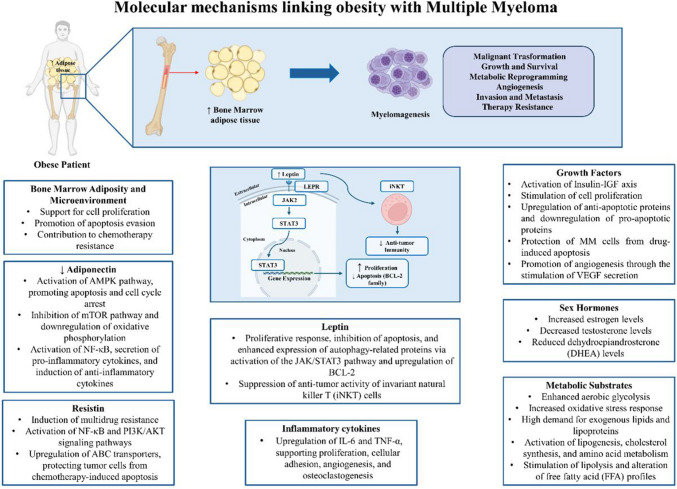
Recent findings: Emerging epidemiological evidence suggests that obesity not only influences MM development but also alters its biological behavior, impacting myelomagenesis, and clinical outcomes. Biologically, multiple pathways exist through which adipose tissue may drive MM onset and progression. Obesity fosters a state of chronic inflammation, where dysfunctional adipocytes and fat-infiltrating immune cells release proinflammatory cytokines, growth factors, adipokines, and fatty acids, contributing to the proliferation and expansion of MM. Additionally, communications between MM cells and adipocytes within the bone marrow are crucial in MM biology. Collectively, the discoveries described in this review underscore the necessity for broader preclinical and clinical investigations to better characterize the complex interplay between obesity and MM, and to determine whether lifestyle interventions can impact MM incidence and clinical outcomes, particularly in high-risk populations.
Keywords: Adipokines; Body mass index; Bone marrow microenvironment; Monoclonal gammopathy of unknown significance; Multiple myeloma; Obesity; Smoldering multiple myeloma.
© 2025. The Author(s).
Conflict of interest statement
Declarations. Ethics Approval: Not applicable. Consent to Participate: Not applicable. Consent for Publication: Not applicable. Conflict of interest: The authors have no conficts of interest to declare. Human and Animal Rights and Informed Consent: This article does not contain any studies with human or animal subjects performed by any of the authors.
Figures
References
-
- Callander NS, Baljevic M, Adekola K, Anderson LD, Campagnaro E, Castillo JJ, et al. NCCN guidelines® insights: multiple myeloma, version 3.2022. J Natl Compr Canc Netw. 2022;20:8–19. - PubMed
-
- Bray F, Laversanne M, Sung H, Ferlay J, Siegel RL, Soerjomataram I, et al. Global cancer statistics 2022: GLOBOCAN estimates of incidence and mortality worldwide for 36 cancers in 185 countries. CA Cancer J Clin. 2024;74:229–63. - PubMed
-
- Brigle K, Rogers B. Pathobiology and diagnosis of multiple myeloma. Semin Oncol Nurs. 2017;33:225–36. - PubMed
Publication types
MeSH terms
Grants and funding
LinkOut - more resources
Full Text Sources
Medical
Research Materials
