


Multilevel analysis of late antenatal care booking and its predictors among pregnant women in extremely high and very high maternal mortality sub-Saharan African countries: evidence from recent demographic and health surveys data
- PMID: 40468242
- PMCID: PMC12139056
- DOI: 10.1186/s12884-025-07789-5
Multilevel analysis of late antenatal care booking and its predictors among pregnant women in extremely high and very high maternal mortality sub-Saharan African countries: evidence from recent demographic and health surveys data
Abstract
Background: Late booking of antenatal care is a major contributing factor to the high rate of maternal deaths. Despite the World Health Organization's recommendation for pregnant women to begin their first antenatal care visit within 12 weeks of gestation, delays in initiating antenatal care are common in sub-Saharan Africa. Therefore, this study intended to examine the prevalence of late antenatal care booking and its predictors in extremely high (over 1,000 maternal deaths per 100,000 live births) and very high (between 500 and 1,000 maternal deaths per 100,000 live births) maternal mortality sub-Saharan African countries.
Methods: Our analysis utilized secondary data from the most recent Demographic and Health Surveys conducted between 2014 and 2022. A weighted sample of 74,552 women who had given birth within five years preceding the survey and had antenatal care visits for their last child were included. A multilevel mixed-effect logistic regression model was fitted. Statistical significance was declared at a p-value less than 0.05.
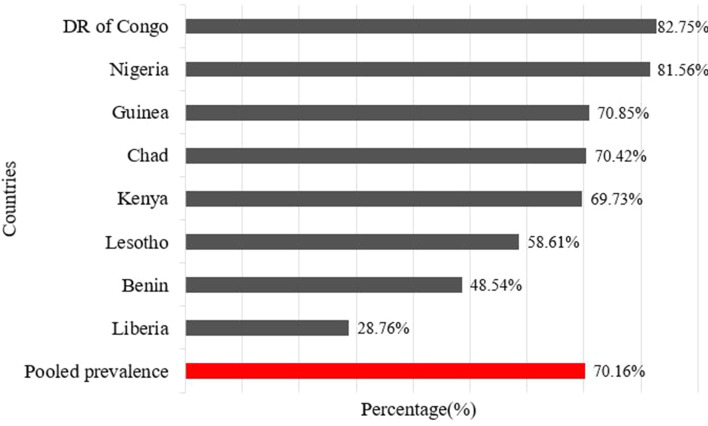
Results: The pooled prevalence of late antenatal care booking in extremely high and very high maternal mortality sub-Saharan African countries was 70.16% (95% CI: 69.83,70.49). Poor wealth quantile (AOR = 1.71, 95%CI: 1.60,1.82), low community media exposure (AOR = 1.70, 95%CI: 1.63,1.78), grand multiparous (AOR = 1.66, 95%CI:1.52,1.81), no media exposure (AOR = 1.59, 95%CI, 1.52,1.67), married (AOR = 1.53, 95%CI: 1.44,1.63), middle wealth quantile (AOR = 1.41, 95%CI: 1.33,1.51), not autonomous of house-hold decision-making (AOR = 1.28, 95%CI: 1.22,1.34), multiparous (AOR = 1.27, 95%CI, 1.18,1.35), secondary education (AOR = 1.24, 95%CI: 1.16,1.34), family size of 5+ (AOR = 1.24, 95%CI:1.15,1.33), rural residence (AOR = 1.22, 95%CI: 1.15,1.30), big problem of distance (AOR = 1.20, 95%CI: 1.14,1.26), Not working (AOR = 1.17, 95%CI: 1.11,1.23), partner's no formal education (AOR = 1.17, 95%CI:1.08,1.27), age 15-24 years (AOR = 1.16, 95%CI:1.07,1.25), female household head (AOR = 0.85, 95%CI: 0.80,0.91) were significant predictors of late antenatal care booking.
Conclusions: This study revealed that on average, seven in ten pregnant women in extremely high and very high maternal mortality sub-Saharan African countries booked antenatal care late. Both individual and community-level factors influenced late antenatal care booking. The study recommends empowering women, improving rural healthcare access, and promoting comprehensive ANC education and community-based interventions to address late ANC booking in extremely high and very high maternal mortality SSA countries.
Keywords: Antenatal care; DHS; Late booking; Multilevel analysis; Predictor factors; SSA.
© 2025. The Author(s).
Conflict of interest statement
Declarations. Ethical approval and consent to participate: The study did not involve information gathering from the study participants. Participants’ consent is inapplicable because the data is secondary and is available in the public domain. All procedures were applied per the Helsinki declarations. More details regarding DHS data and ethical standards are available online at ( http://www.dhsprogram.com ). Consent for publication: Not applicable. Competing interests: The authors declare no competing interests.
Figures
References
-
- Okonji OC, Nzoputam CI, Ekholuenetale M, Okonji EF, Wegbom AI, Edet CK. Differentials in maternal mortality pattern in Sub-Saharan Africa countries: evidence from demographic and health survey data. Women. 2023;3(1):175–88.
-
- Organization WH, UNICEF, UNFPA. Trends in maternal mortality 2000 to 2020: estimates by WHO. World Bank Group and UNDESA/Population Division: World Health Organization; 2023.
MeSH terms
LinkOut - more resources
Full Text Sources
Medical
Research Materials
