


The Effect of Well-Being and Exercise Intensity on Enjoyment in Soccer Players
- PMID: 40469868
- PMCID: PMC12131140
- DOI: 10.52082/jssm.2025.292
The Effect of Well-Being and Exercise Intensity on Enjoyment in Soccer Players
Abstract
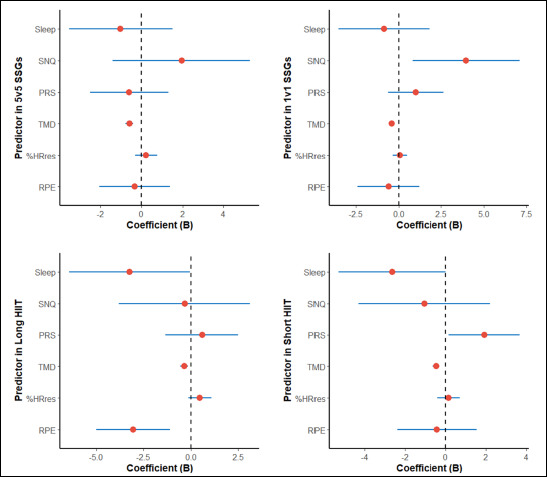
This study examined the relationship between well-being, exercise intensity, and enjoyment in soccer players. Seventy-seven players participated in this study. Participants performed the 30-15 Intermittent Fitness Test and took part in four training formats: 5v5 and 1v1 small-sided games (SSGs), long HIIT, and short HIIT. Enjoyment was measured using the Physical Activity Enjoyment Scale (PACES), well-being was assessed with the Nordic Musculoskeletal Questionnaire (SNQ), Profile of Mood States (POMS), Total Mood Disturbance (TMD), sleep duration, and Perceived Recovery Status (PRS). Exercise intensity was measured with heart rate (HR) and rate of perceived exertion (RPE). TMD predicted enjoyment across all training formats (β = -0.68 to -0.36, p < 0.001). Sleep duration predicted enjoyment in long HIIT (β = -.21, p < 0.05), SNQ predicted enjoyment in 1v1 SSGs (β = 0.29, p < 0.05), PRS predicted enjoyment in short HIIT (β = 0.20, p < 0.05), and RPE predicted enjoyment in long HIIT (β = -0.30, p < 0.01). The regression models were statistically significant across all conditions, indicating that 33% to 49% of the variance in enjoyment was explained by well-being and intensity. This study showed that TMD was the strongest predictor of enjoyment. Lower sleep duration and higher RPE reduced enjoyment in long HIIT. In 1v1 SSGs, greater SNQ was associated with higher enjoyment, while in short HIIT, a higher PRS resulted in higher enjoyment. However, potential confounding factors such as individual fitness levels, baseline mood, and training experience may have influenced these findings. Coaches should consider mood, sleep, recovery, and exertion when planning training to enhance enjoyment.
Keywords: Psychological factors; perceived exertion; recovery; team sports; training load.
© Journal of Sports Science and Medicine.
Figures
References
-
- Achten J., Jeukendrup A.E. (2003) Heart Rate Monitoring. Sports Medicine 33, 517-538.https://doi.org/10.2165/00007256-200333070-00004 10.2165/00007256-200333070-00004 - DOI - PubMed
-
- Agostinho M.F., Philippe A.G., Marcolino G.S., Pereira E.R., Busso T., Candau R.B., Franchini E. (2015) Perceived Training Intensity and Performance Changes Quantification in Judo. The Journal of Strength & Conditioning Research 29, 1570-1577.https://doi.org/10.1519/JSC.0000000000000777 10.1519/JSC.0000000000000777 - DOI - PubMed
-
- Alarcón-Gómez J., Chulvi-Medrano I., Martin-Rivera F., Calatayud J. (2021) Effect of High-Intensity Interval Training on Quality of Life, Sleep Quality, Exercise Motivation and Enjoyment in Sedentary People with Type 1 Diabetes Mellitus. International Journal of Environmental Research and Public Health 18, 12612.https://doi.org/10.3390/ijerph182312612 10.3390/ijerph182312612 - DOI - PMC - PubMed
-
- Alnawwar M.A., Alraddadi M.I., Algethmi R.A., Salem G.A., Salem M.A., Alharbi A.A. (2023) The Effect of Physical Activity on Sleep Quality and Sleep Disorder: A Systematic Review. Cureus 15(8), e43595.https://doi.org/10.7759/cureus.43595 10.7759/cureus.43595 - DOI - PMC - PubMed
-
- Antonio J. (2023) Psychological Factors Affecting Athletes’ Motivation and Performance in Competitive Sports in Mexico. International Journal of Physical Education, Recreation and Sports 1, 13-23.https://doi.org/10.47604/ijpers.2141 10.47604/ijpers.2141 - DOI
MeSH terms
LinkOut - more resources
Full Text Sources
Medical