Transformed Visual Working Memory Representations in Human Occipitotemporal and Posterior Parietal Cortices
- PMID: 40473470
- PMCID: PMC12243946
- DOI: 10.1523/ENEURO.0162-25.2025
Transformed Visual Working Memory Representations in Human Occipitotemporal and Posterior Parietal Cortices
Abstract
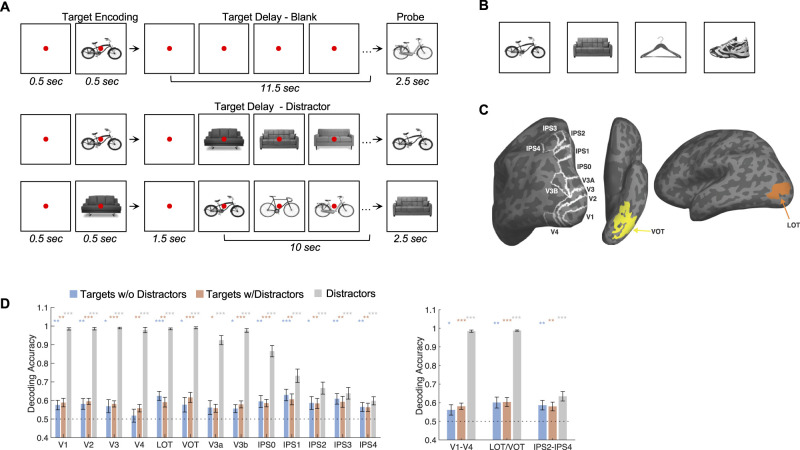
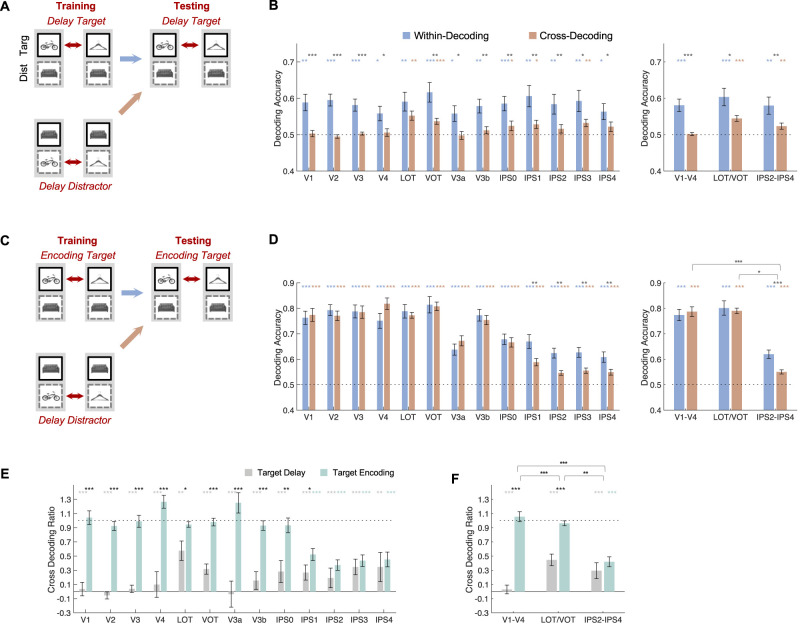
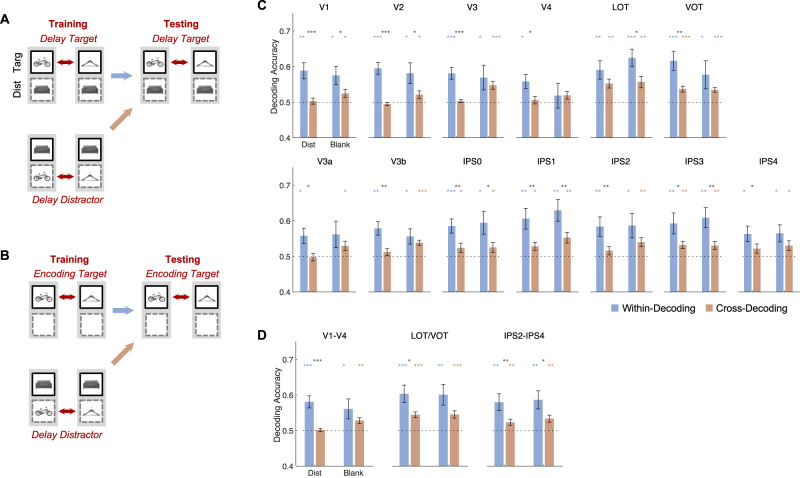
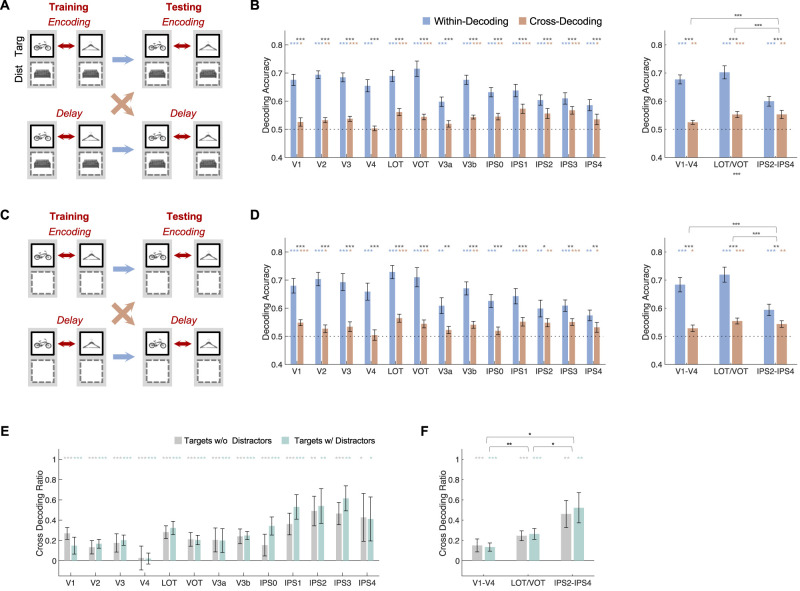
Recent fMRI studies reported transformed representations between perception and visual working memory (VWM) in the human early visual cortex (EVC). This is inconsistent with the still widely cited original proposal of the sensory account of VWM, which argues for a shared perception-VWM representation based on successful cross-decoding of the two representations. Although cross-decoding was usually lower than within-VWM decoding and consistent with transformed VWM representations, this has been attributed to experimental differences between perceptual and VWM tasks: once they are equated, the same representation is expected to exist in both. Including human participants of both sexes, this study compared target and distractor representations during the same VWM delay period for the same objects, thereby equating experimental differences. Even with strong VWM representations present throughout the occipitotemporal cortex (OTC, including EVC) and posterior parietal cortex (PPC), fMRI cross-decoding revealed significant representational differences between distractors (perception) and targets (VWM) in both regions. Similar differences existed between target encoding (perception) and delay (VWM), being greater in OTC than PPC, indicating more invariant target representations in PPC than OTC. As only part of the sensory input is usually task-relevant, sustaining sensory input in VWM without selection/refinement/consolidation is both taxing and unnecessary. Transformed representations, mediated by task goals and associative areas coding task-relevant information (e.g., PPC), can easily account for these and other recent findings. A task-driven transformed account of VWM thus better captures the nature of VWM representation in the human brain (including EVC) than the sensory representations originally proposed by the sensory account of VWM.
Keywords: fMRI; occipitotemporal cortex; posterior parietal cortex; vision; visual object representation; visual short-term memory; visual working memory.
Copyright © 2025 Xu.
Conflict of interest statement
The author declares no competing financial interests.
Figures
References
-
- Adam KC, Rademaker RL, Serences JT (2022) Evidence for, and challenges to, sensory recruitment models of visual working memory. In: Visual memory (Brady TF, Bainbridge WA, eds), pp 5–25. Routledge.
-
- Benjamini Y, Hochberg Y (1995) Controlling the false discovery rate: a practical and powerful approach to multiple testing. J R Stat Soc B 57:289–300. 10.1111/j.2517-6161.1995.tb02031.x - DOI
MeSH terms
Grants and funding
LinkOut - more resources
Full Text Sources
Research Materials