. 2025 Jun 5;12(1):941.
doi: 10.1038/s41597-025-05189-0.

Psilocybin's acute and persistent brain effects: a precision imaging drug trial

Affiliations

Psilocybin's acute and persistent brain effects: a precision imaging drug trial

Subha Subramanian et al. Sci Data. .

Erratum in

Abstract

Psilocybin (PSIL) is a psychedelic drug and a promising experimental therapeutic for many psychiatric conditions. Precision functional mapping (PFM) combines densely repeated resting state fMRI sampling and individual-specific network mapping to improve signal-to-noise ratio (SNR) and effect size in brain imaging research. We present a randomized cross-over study in which PFM was used to characterize acute and persistent effects of psilocybin or methylphenidate (MTP) on brain networks. Seven healthy volunteers (mean age 34.1 years, SD = 9.8; n = 3 females, n = 6 Caucasians) underwent (1) extensive baseline imaging, (2) imaging beginning 60-90 minutes after drug exposure, and (3) longitudinal imaging for up to two weeks after drug exposure. Four individuals also participated in an open-label PSIL replication protocol over 6 months later. This dataset includes resting state (using advanced high-resolution multi-echo fMRI), task fMRI, structural, and diffusion basis spectral imaging as well as assessments of subjective experience. We are releasing this unique dataset as a resource for neuroscientists to study the acute and persistent effects of PSIL and MTP on brain networks.


Conflict of interest statement

Competing interests: Within the last two years, author JSS was an employee of Sumitomo Pharma America and received consulting fees from Longitude Capital. Author GEN has served as principal or co-investigator on studies funded by Alkermes, Inc., LB Pharmaceuticals and COMPASS Pathways, and has received research support from Usona Institute (drug only). She has served as a paid consultant for Carelon and Alkermes, Inc. AZS is a consultant for Soraneuroscience, LLC. NUFD is a co-founder of Turing Medical Inc, and may benefit financially if the company is successful in marketing FIRMM motion monitoring software products and may receive royalty income based on FIRMM technology developed at Washington University School of Medicine (WUSOM) and licensed to Turing Medical Inc.

Figures
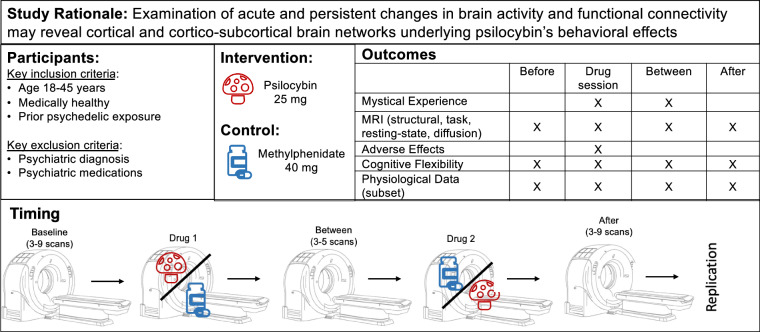
Fig. 1
Fig. 1
Graphical abstract: PICOT (Participants, Intervention, Control, Outcomes, Timing). This study recruited healthy adults with previous psychedelic exposure. Participants were enrolled in a cross-over study design using a precision functional mapping (PFM) approach. Key inclusion and exclusion criteria are listed, see methods section for complete list of criteria. Outcomes included subjective experiences, cognitive flexibility, and extensive MRI (including structural, task-based, resting state, and diffusion). MRI sequences were performed before the first drug, during the first and second drug, between the first and second drug, and after the second drug. A subset of participants also wore pulse oximeter and respiratory belt during MRIs for physiological assessments. Four out of seven participants completed the replication protocol.
Fig. 2
Fig. 2
Mystical Experiences Questionnaire (MEQ30) results. Data presented are mean and standard deviations of measurement in all seven participants. Participants were asked to look back on their drug experience on the same day of receiving PSIL or MTP and rate the degree to which they experienced criteria across five factors (transcendence, positive mood, ineffability, mystical) from a scale of 0 to 5. A score of 0 indicates did not experience at all, and a score of 5 is given to extremely experienced (more than any other time in their life). Asterisks: *p < 0.05, two-tailed t-test.
Fig. 3
Fig. 3
Comparison of head motion to prior psychedelic fMRI datasets. Average head motion (framewise displacement, FD in millimeters) for each scan off (a) and on (b) psychedelic drug was compared between our dataset and prior psychedelic fMRI studies,. In a/b, the dotted line at 0.2 mm represents a stringent cutoff for exclusion of a session. Sessions with average FD of 0.2 mm or lower are considered usable. Lower and upper quartiles of box-plots were calculated as follows: Q1−1.5 × IQR, Q3 + 1.5 × IQR, respectively. Asterisks indicate significant (* p < 0.05, **p < 0.005, unpaired t-test, two tailed) difference in head motion compared to two other highly cited datasets,. (c) The totality of resting state data (usable and unusable) on psychedelic in minutes.
Fig. 4
Fig. 4
Physiological data within and across participants based on drug condition. Heart rate (HR, beats per minute) and respiratory rate (RR, breaths per minute) for each participant based on drug condition for each participant (including replication visits). Empty circles represent physiological measures averaged across all baseline sessions for a participant, red dots represent physiological measures during PSIL, blue dots are physiological measure on MTP, and gray dots represent averages for between and after sessions. To determine if a given condition differed significantly from baseline, a linear mixed effects model was used. HR = 199 observations, MTP-baseline Estimate (95% CI) = 16.7 bpm (11.0, 20.3), t(196) = 6.6, Puncorr = 3.12 × 10−10; PSIL-baseline Estimate (95% CI) = 21.1 bpm (16.6, 25.6), t(196) = 9.2, puncorr = 4.04 × 10−17). No significant difference in HR was observed between MTP and PSIL (puncorr = 0.399). *p < 0.001, uncorrected.
Fig. 5
Fig. 5
Whole brain network similarity matrix and intra-subject data reliability. Each row and column represent brain networks (average FC matrix) from one participant in one study condition (baseline, Drug 1, between, Drug 2, after) and each edge represents similarity of functional networks between a pair of conditions. Networks from the replication protocol are shown at the end of the matrix. The diagonal represents the similarity between all scans within the same classification (e.g., all baseline scans for P1). Note: for MTP and PSIL sequences, fMRI comparisons are among resting state scans acquired during that same ‘on drug’ MRI sequence. To the right, a visualization of data structure demonstrates two sources of similarity – ‘within participant’ and ‘within class’ (e.g. brain networks from two participants’ PSIL condition). For example, Participant 1’s whole brain functional networks without and on drug sessions are similar when compared to themselves vs. Participant 4 (see solid black squares in chart). When Participant 1 came back for replication, their whole brain functional networks on PSIL were highly correlated to their replication session on PSIL six months later (see dotted box in chart). Participant 2 was excluded, given a large degree of unusable data (framewise head displacement > 0.2 mm).
Fig. 6
Fig. 6
Quality and signal metrics for PSIL PFM dataset. Each dot represents a resting state scans are shown on the x-axis and red vertical bars depict participants’ scans on PSIL. (a) Cortical infraslow power (0.009–0.06hz). Drug exposure had no correlation with cortical infraslow power. (b) Head motion (also in Fig. 3). (c) Newman’s modularity. Overall, modularity was lower on PSIL (LME model P = 1.8754*10−9) and returned to baseline level after. (LME model P = 0.68).

References

    1. Carhart-Harris, R. et al. Trial of Psilocybin versus Escitalopram for Depression. N Engl J Med384(15), 1402–1411 (2021). - PubMed
    1. Davis, A. K. et al. Effects of Psilocybin-Assisted Therapy on Major Depressive Disorder: A Randomized Clinical Trial. JAMA Psychiatry78(5), 481–489 (2021). - PMC - PubMed
    1. Goodwin, G. M. et al. Single-Dose Psilocybin for a Treatment-Resistant Episode of Major Depression. N Engl J Med387(18), 1637–1648 (2022). - PubMed
    1. Raison, C. L. et al. Single-Dose Psilocybin Treatment for Major Depressive Disorder: A Randomized Clinical Trial. JAMA330(9), 843–853 (2023). - PMC - PubMed
    1. Griffiths, R. R. et al. Psilocybin produces substantial and sustained decreases in depression and anxiety in patients with life-threatening cancer: A randomized double-blind trial. J Psychopharmacol30(12), 1181–1197 (2016). - PMC - PubMed

LinkOut - more resources
