


Shifting narrative perspective and construal level shape emotional response and enhance eudaimonic well-being
- PMID: 40473749
- PMCID: PMC12141604
- DOI: 10.1038/s41598-025-01946-8
Shifting narrative perspective and construal level shape emotional response and enhance eudaimonic well-being
Abstract
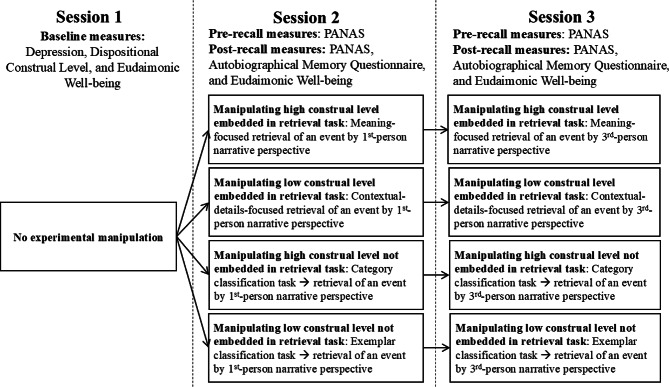
Understanding how people process and reflect upon past negative experiences is critical for promoting eudaimonic well-being. This study examined how psychological distance and construal level during autobiographical memory retrieval jointly influence post-recall affect and eudaimonic well-being. Participants retrieved negative autobiographical events initially from a 1st-person perspective and subsequently, on a separate day, from a 3rd-person perspective, thereby increasing psychological distance. During each retrieval, participants elaborated either at a high construal level (reflecting on the event's broader meaning and life implications) or a low construal level (focusing on contextual details, such as location). After each retrieval, participants evaluated mnemonic characteristics of the recalled events, post-recall affective responses, and current eudaimonic well-being. Baseline measures included depression symptoms, dispositional construal level, and initial eudaimonic well-being. Results showed that high-level construal, compared to low-level construal, enhanced subjective vitality and search for meaning in life, while reduced negative post-recall affect. Shifting from a 1st-person to a 3rd-person perspective decreased emotional intensity and further increased meaning-seeking. Notably, beneficial effects of high construal level on eudaimonic well-being were more pronounced when recalling from the 1st-person (vs. 3rd-person) perspective. These findings offer new insights into Construal Level Theory and offer practical implications for expressive writing and well-being intervention.
Keywords: Autobiographical memory; Construal level; Eudaimonic well-being; Narrative perspective; Positive and negative affect; Psychological distance.
© 2025. The Author(s).
Conflict of interest statement
Declarations. Competing interests: The authors declare no competing interests. Declaration of competing interest: On behalf of all authors, the corresponding author states that there is no conflict of interest.
References
-
- Houle, I. & Philippe, F. L. Is the negative always that bad? Or how emotion regulation and integration of negative memories can positively affect well-being. J. Pers.88, 965–977 (2020). - PubMed
-
- Leahy, F., Ridout, N. & Holland, C. Memory flexibility training for autobiographical memory as an intervention for maintaining social and mental well-being in older adults. Memory26, 1310–1322 (2018). - PubMed
-
- Van Boven, L., Kane, J., McGraw, A. P. & Dale, J. Feeling close: emotional intensity reduces perceived psychological distance. J. Personal. Soc. Psychol.98, 872 (2010). - PubMed
-
- Demiray, B. & Janssen, S. M. The self-enhancement function of autobiographical memory. Appl. Cogn. Psychol.29, 49–60 (2015).
MeSH terms
Grants and funding
LinkOut - more resources
Full Text Sources
Miscellaneous
