


Synergistic integration of VSe2 and CuS nanostructures for advanced energy storage applications
- PMID: 40473762
- PMCID: PMC12141592
- DOI: 10.1038/s41598-025-95088-6
Synergistic integration of VSe2 and CuS nanostructures for advanced energy storage applications
Abstract
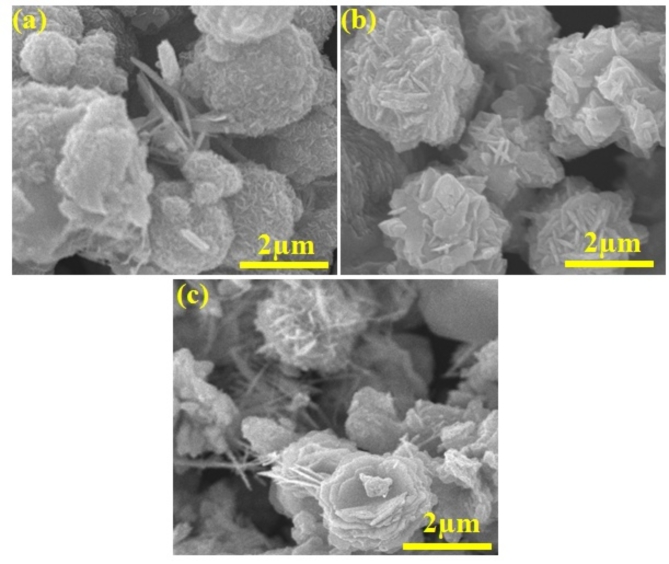
The demand for sustainable energy storage has driven advancements in supercapacitors, known for their high-power density and rapid charge cycles. However, challenges like limited energy density and material stability must be addressed for practical applications. In this study, VSe2/CuS nanocomposites were synthesized using a simple wet chemical method and investigated as electrode materials for supercapacitors. X-ray diffraction (XRD) analysis confirmed the phase purity of the materials while scanning electron microscopy (SEM) revealed spherical and flake-like morphology. The synergy between VSe2's high electrical conductivity and CuS's pseudocapacitive properties enhances charge storage and electrochemical performance. The VSe2/CuS electrode exhibited a high specific capacitance of 853.9 F/g at 1 A/g, outperforming individual VSe2 (395.6 F/g) and CuS (471.6 F/g). The VSe2/CuS||AC device demonstrated a specific capacitance of 147.6 F/g, excellent rate capability, and 88.3% capacitance retention over 10,000 cycles at 10 A/g. These findings highlight the potential of VSe2/CuS nanocomposites as high-performance electrode materials, advancing the development of next-generation energy storage technologies.
Keywords: Cyclic stability; Hydrothermal technique; Power density; VSe2/CuS composites.
© 2025. The Author(s).
Conflict of interest statement
Declarations. Competing interests: The authors declare no competing interests.
Figures




References
-
- Deshmukh, M. K. G. et al. Renewable energy in the 21st century: A review. Mater. Today: Proc.80, 1756–1759 (2023).
-
- Flórez-Orrego, D. et al. Renewable and non-renewable exergy costs and CO2 emissions in the production of fuels for Brazilian transportation sector. Energy88, 18–36 (2015).
-
- Al-Shetwi, A. Q. Sustainable development of renewable energy integrated power sector: Trends, environmental impacts, and recent challenges. Sci. Total Environ.822, 153645 (2022). - PubMed
-
- Sonkar, P. K. & Ganesan, V. Nanomaterials for Sustainable Energy Applications (CRC Press, 2023).
Grants and funding
LinkOut - more resources
Full Text Sources
