


Examining the work-life balance of Australian orthopaedic surgeons
- PMID: 40474085
- PMCID: PMC12139088
- DOI: 10.1186/s12875-025-02880-4
Examining the work-life balance of Australian orthopaedic surgeons
Abstract
Background: Work-life balance (WLB) and preference for work location among Australian orthopaedic surgeons have been a focal point of research and policy discussions in Australia. This study, therefore, aimed to investigate the factors influencing work-life balance among Australian orthopaedic surgeons, and to develop strategies to improve their health and well-being.
Methods: An online survey of 288 Australian Orthopaedic Association (AOA) orthopaedic surgeons was conducted, with data collected during October and November 2021 and was weighted to reduce gender bias. Based on the survey question "What is the main factor that has influenced your choice in your current working location/employment?" three binary outcome variables were considered: (1) work-life balance (WLB), (2) capacity to undertake the surgeons' preferred area of practice in orthopaedic surgery, and (3) availability of a public appointment and/or achieving a desired private/public mix (public job). Outcome variables were analysed using bivariate and multiple survey logistic regression after adjusting for sampling weights and potential confounding factors.
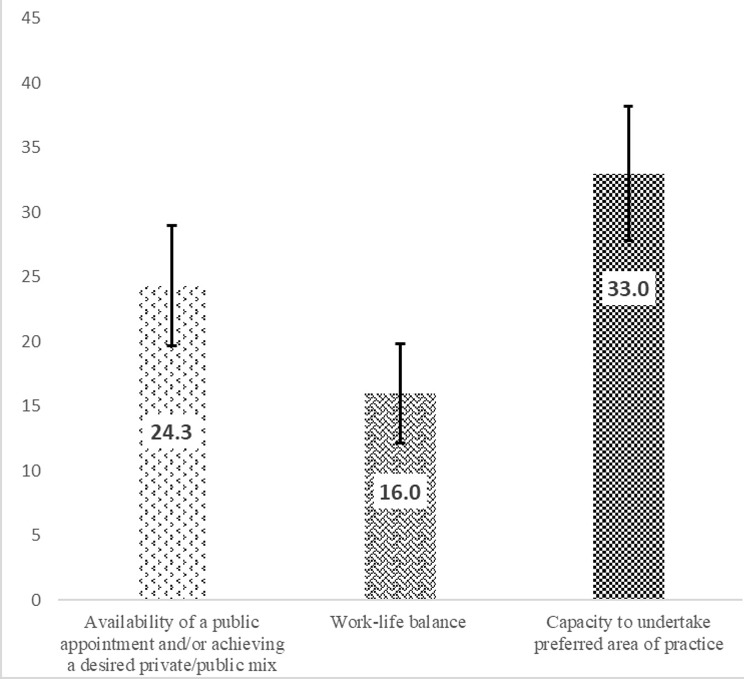
Results: The prevalence of WLB was 16% (95% confidence interval (CI): 12.2-20.7), whereas the prevalence of capacity to undertake the surgeons' preferred area of practice in orthopaedic surgery was 33% (95%CI: 27.8-38.7), and the availability of a public appointment or the desired mix of private and public work was reported at 24.3% (95%CI: 19.7-29.6). Multivariate analyses revealed that WLB was the most commonly selected reason for practice location among outer metropolitan/regional orthopaedic surgeons. Primary decision-making factors varied based on training location, amount of work conducted in the public sector, and state. Surgeon age, gender, and being trained overseas were not related to practice location choice.
Conclusions: Our research indicates that maintaining a healthy work-life balance would allow orthopaedic surgeons in inner regional Australia to work in any location. The growing and accepted use of telehealth, supported by government funding, will be demonstrated on the location of practice by orthopaedic surgeons and other clinicians.
Keywords: Australia; Healthcare workforce; Orthopaedic surgeons; Regional locations; Survey; Work-life balance.
© 2025. The Author(s).
Conflict of interest statement
Declarations. Ethics approval and consent to participate: The study was submitted and approved by the Australian Orthopaedic Association Board and the data was provided to the researchers deidentified. Informed consent was obtained from all survey respondents. Competing interests: The authors declare no competing interests.
Figures
References
-
- Gorman D. Developing health care workforces for uncertain futures. Acad Med. 2015;90(4):400–3. - PubMed
-
- Greer T, et al. The WWAMI targeted rural underserved track (TRUST) program: an innovative response to rural physician workforce shortages. Acad Med. 2016;91(1):65–9. - PubMed
-
- Biggs A. Rural health workforce. In: Library PA, editor. Budget review 2018-19 index. Editor: Parliament of Australia: Canberra; 2018.
-
- Kirkman JM, et al. Could adoption of the rural pipeline concept redress Australian optometry workforce issues? Clin Experimental Optometry. 2019;102(6):566–70. - PubMed
MeSH terms
LinkOut - more resources
Full Text Sources