


Bevacizumab in ovarian cancer therapy: current advances, clinical challenges, and emerging strategies
- PMID: 40474872
- PMCID: PMC12138263
- DOI: 10.3389/fbioe.2025.1589841
Bevacizumab in ovarian cancer therapy: current advances, clinical challenges, and emerging strategies
Abstract
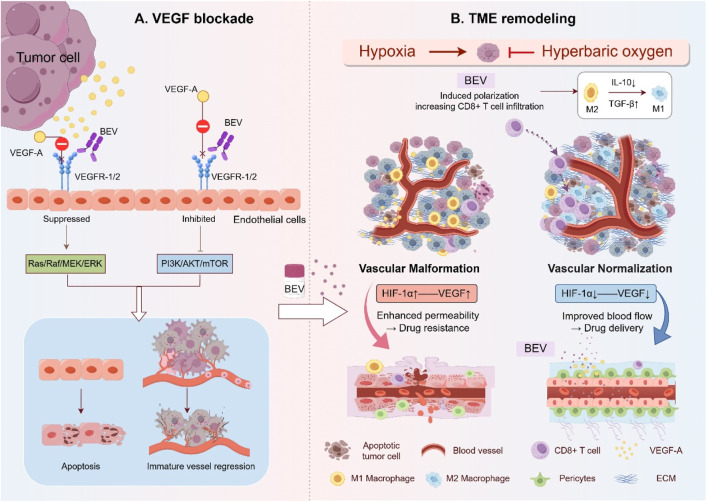
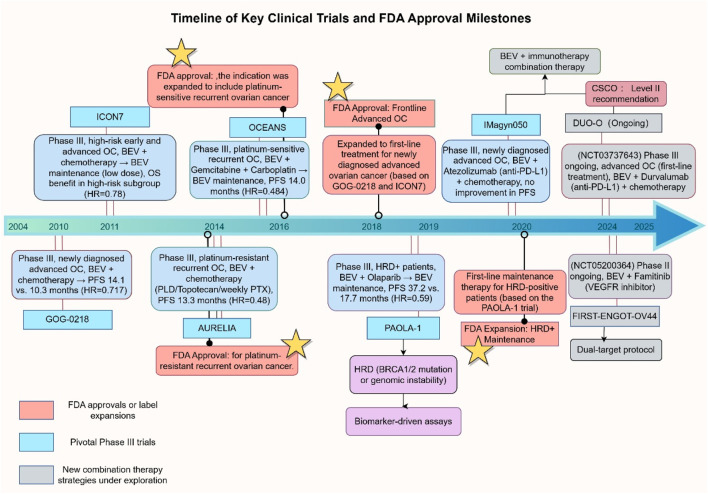
Bevacizumab targets the vascular endothelial growth factor signaling pathway, inhibiting tumor angiogenesis and reshaping the tumor microenvironment, positioning it as a cornerstone in ovarian cancer management. Its mechanisms of action include blocking VEGF-A-induced endothelial cell proliferation, promoting vascular normalization, alleviating hypoxic conditions, and reversing immunosuppression. Key phase III clinical trials, including GOG-0218, AURELIA, and PAOLA-1, have demonstrated that Bevacizumab significantly extends progression-free survival in the maintenance treatment of newly diagnosed advanced ovarian cancer, platinum-sensitive or resistant recurrent disease, and HRD-positive patients, with a median PFS of up to 37.2 months. However, its impact on overall survival remains limited, and challenges such as drug resistance, treatment-related toxicities, and high costs persist. Future advancements will hinge on multidisciplinary innovation, including dual-targeting approaches such as VEGF/Ang-2 bispecific antibodies, combination immunotherapies, intelligent nanodrug delivery systems, and AI-driven dynamic biomarker stratification. The use of biosimilars and adaptive platform trials offers promise in reducing costs and improving accessibility. These technological innovations mark a shift in ovarian cancer treatment from traditional chemotherapy to precision medicine, presenting new opportunities to improve long-term patient survival.
Keywords: bevacizumab; drug resistance; nanodrug delivery; ovarian cancer; tumor angiogenesis.
Copyright © 2025 Zhang, Zhu, Bao, Ao, Mao, Qiu, Zhang, Chen, Zhu and Gao.
Conflict of interest statement
The authors declare that the research was conducted in the absence of any commercial or financial relationships that could be construed as a potential conflict of interest.
Figures
References
-
- Aghajanian C., Blank S. V., Goff B. A., Judson P. L., Teneriello M. G., Husain A., et al. (2012). OCEANS: a randomized, double-blind, placebo-controlled phase III trial of chemotherapy with or without bevacizumab in patients with platinum-sensitive recurrent epithelial ovarian, primary peritoneal, or fallopian tube cancer. J. Clin. Oncol. 30 (17), 2039–2045. 10.1200/jco.2012.42.0505 - DOI - PMC - PubMed
-
- Alqaisi H. A., Cohn D. E., Chern J. Y., Duska L. R., Jewell A., Corr B. R., et al. (2025). Randomized phase II study of bevacizumab with weekly anetumab ravtansine or weekly paclitaxel in platinum-resistant/refractory high grade ovarian cancer (NCI trial). Clin. Cancer Res. 31 (6), 993–1001. 10.1158/1078-0432.ccr-24-3128 - DOI - PMC - PubMed
-
- Ambreen S., Umar M., Noor A., Jain H., Ali R. (2025). Advanced AI and ML frameworks for transforming drug discovery and optimization: with innovative insights in polypharmacology, drug repurposing, combination therapy and nanomedicine. Eur. J. Med. Chem. 284, 117164. 10.1016/j.ejmech.2024.117164 - DOI - PubMed
Publication types
LinkOut - more resources
Full Text Sources
Miscellaneous
