


The relationship between health and migration: exploring social capital and mobility preferences in China's urbanization process
- PMID: 40475199
- PMCID: PMC12139667
- DOI: 10.3389/fpubh.2025.1575893
The relationship between health and migration: exploring social capital and mobility preferences in China's urbanization process
Abstract
Purpose: Health status is a key determinant of life outcomes, including economic performance, educational attainment, and social integration. However, its impact on migration preferences remains underexplored. This study investigates whether health status significantly influences migration decisions in China, with a particular focus on the role of social capital and class mobility expectations.
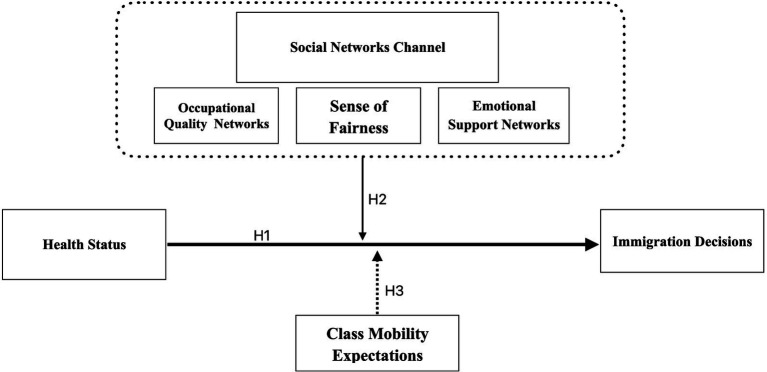
Methods: This study utilizes data from the China Labor Dynamics Survey (CLDS) collected between 2012 and 2018. Multiple regression analyses were conducted to assess the relationship between self-reported health, occupational quality, social capital, and migration decisions. The mediating role of social networks and the moderating effect of class mobility expectations were also examined.
Results: The analysis reveals that individuals with better health are more likely to migrate, especially in pursuit of improved employment opportunities in urban areas. Social networks mediate the relationship between health and migration by providing resources and support that facilitate mobility. Furthermore, class mobility expectations moderate this relationship: healthier individuals with positive prospects tend to stay in their current location, while those who have experienced upward mobility are more likely to migrate.
Conclusion: This study highlights the significant role of health status in migration decisions and emphasizes the importance of social networks and class mobility expectations. Policies aimed at improving health and strengthening social support systems could enhance social equity and mobility, particularly in developing countries.
Keywords: China; class mobility; health status; migration; social networks.
Copyright © 2025 Mei, You and Jun.
Conflict of interest statement
The authors declare that the research was conducted in the absence of any commercial or financial relationships that could be construed as a potential conflict of interest.
Figures
References
-
- Ettman CK, Cohen GH, Galea S. Health, society, and migration: the social determinants of health in immigrant populations. Annu Rev Public Health. (2022) 43:419–39. doi: 10.1146/annurev-publhealth-052521-040001 - DOI
-
- Cameron L, Worswick C. Migration, health, and economic welfare: evidence from longitudinal data. Curr Psychol. (2023) 43:999–1012. doi: 10.1007/s12144-022-02716-7 - DOI
-
- Amoah PA. Social capital, health, health inequalities and well-being: a critical review and future directions In: Handbook on Inequality and Social Capital (2024). 117–30. doi: 10.4337/9781802202373.00017 - DOI
-
- Luo Q, Chen X, Zhao L, Hu Q, Du J, Shao S. Association between social capital and utilization of essential public health services among elderly migrants: a multilevel logistic study based on the 2017 China migrant dynamic survey (CMDS). BMC Public Health. (2024) 24:1252. doi: 10.1186/s12889-024-18726-0, PMID: - DOI - PMC - PubMed
MeSH terms
LinkOut - more resources
Full Text Sources
