


Change of force and lever arm of the hip abductors after subtrochanteric de-/rotational osteotomy
- PMID: 40476013
- PMCID: PMC12138280
- DOI: 10.1002/jeo2.70274
Change of force and lever arm of the hip abductors after subtrochanteric de-/rotational osteotomy
Abstract
Purpose: Previous studies have shown that rotational osteotomy of the femur reliably corrects anatomical torsion but may result in a ±1 cm antero-posterior shift of the greater trochanter (GT) per 10° of torsional correction. It is unclear whether an inadvertent displacement of the GT following surgical treatment of femoral maltorsion affects the hip abductors in a clinically relevant manner and needs to be addressed by compensatory digastric trochanteric osteotomy. The aim of this study was to investigate the influence of rotational subtrochanteric osteotomy on hip abductor force generation using three-dimensional (3D) surface models.
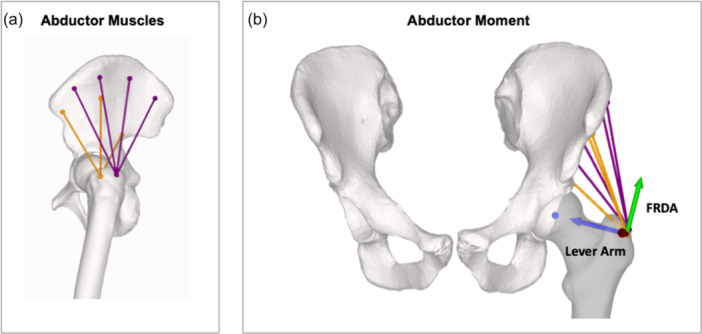
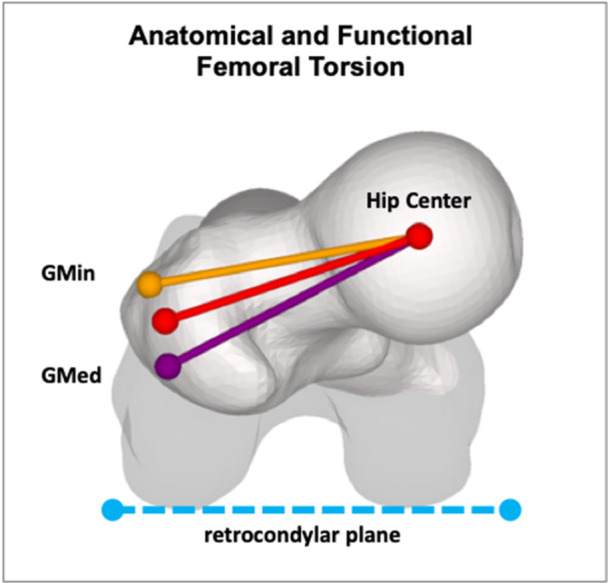
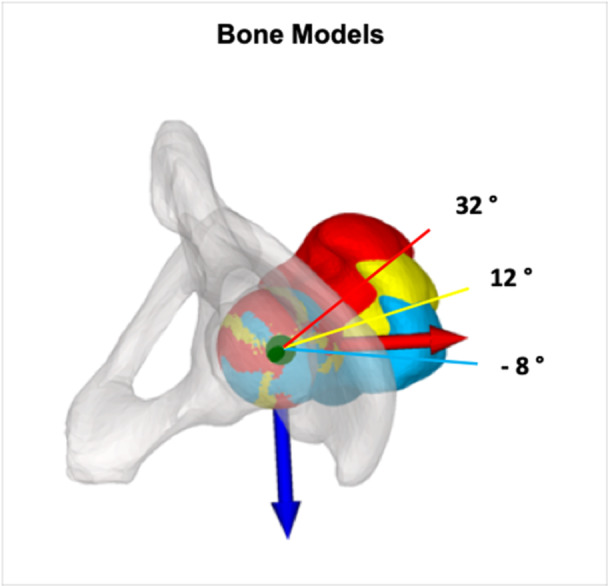
Methods: A 3D statistical shape model (SSM) of a hip/femur was used. From a baseline value of 12°, the SSM was derotated/rotated in 10° increments, creating five different scenarios of anatomical femoral torsion: 32°, 22°, 12° (baseline), 2°, -8° (corresponding to 8° of retro torsion). The origins and insertions of the gluteus medius (GMed) and minimus (GMin) muscles were created. The hip abductor moment was defined as the muscle force (of the hip abductor muscles) multiplied by the force ratio in the direction of abduction (FRDA) multiplied by the lever arm. All values were measured, whereas muscle strength was defined as the length of the muscle fibres in relation to their optimal length.
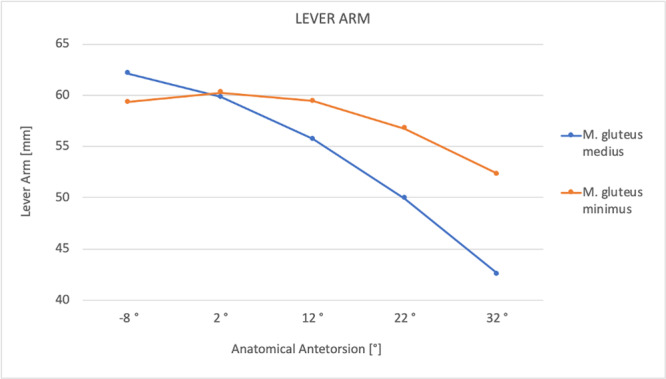
Results: Results indicated minimal changes in muscle length (±1.2%) and FRDA (1.7% to -7%) for GMed und GMin across all scenarios. However, lever arm demonstrated variations (21% to -10%), with an increase observed for derotational osteotomies and a decrease for rotational osteotomies.
Conclusion: Subtrochanteric osteotomy in the management of femoral maltorsion affects the hip abduction moment solely through the altered lever arm. A 20° derotation for increased femoral torsion (FT) corresponds to a 20% increase in abduction force of the GMed (improved lever arm), whereas a 20° rotation for decreased FT reduces the abduction force by 10%.
Level of evidence: Level III, diagnostic.
Keywords: 3D analysis; abductor force; subtrochanteric osteotomy.
© 2025 The Author(s). Journal of Experimental Orthopaedics published by John Wiley & Sons Ltd on behalf of European Society of Sports Traumatology, Knee Surgery and Arthroscopy.
Conflict of interest statement
The authors declare no conflicts of interest.
Figures
References
-
- Batailler C, Weidner J, Wyatt M, Dalmay F, Beck M. Position of the greater trochanter and functional femoral antetorsion: which factors matter in the management of femoral antetorsion disorders? Bone Joint J. 2018;100–B:712–719. - PubMed
-
- Dimitriou D, Meisterhans M, Geissmann M, Borpas P, Hoch A, Rosner J, et al. The effect of experimentally induced gluteal muscle weakness on joint kinematics, reaction forces, and dynamic balance performance during deep bilateral squats. J Orthop Res. 2024;42:164–171. - PubMed
-
- Flack NAMS, Nicholson HD, Woodley SJ. The anatomy of the hip abductor muscles. Clin Anat. 2014;27:241–253. - PubMed
LinkOut - more resources
Full Text Sources
Research Materials
Miscellaneous
