How is maternal, newborn, and child health addressed in Heat Health Action Plans? A scoping review and content analysis
- PMID: 40476574
- PMCID: PMC12143117
- DOI: 10.7189/jogh.15.04157
How is maternal, newborn, and child health addressed in Heat Health Action Plans? A scoping review and content analysis
Abstract
Background: Newborns, children, and pregnant and postpartum populations are among the most at risk from exposure to extreme heat. Heat Health Action Plans (HHAPs) are promoted by the World Health Organization to manage public health risks of heat. Still, limited research exists on how well current HHAPs address the needs of women and children in the context of increasingly frequent heat events.
Methods: We identified national and subnational HHAPs published between January 2004 and July 2024 using various search channels. We extracted content to assess whether and how HHAPs included actions and indicators related to pregnant, postpartum, or breastfeeding individuals; newborns; and children.
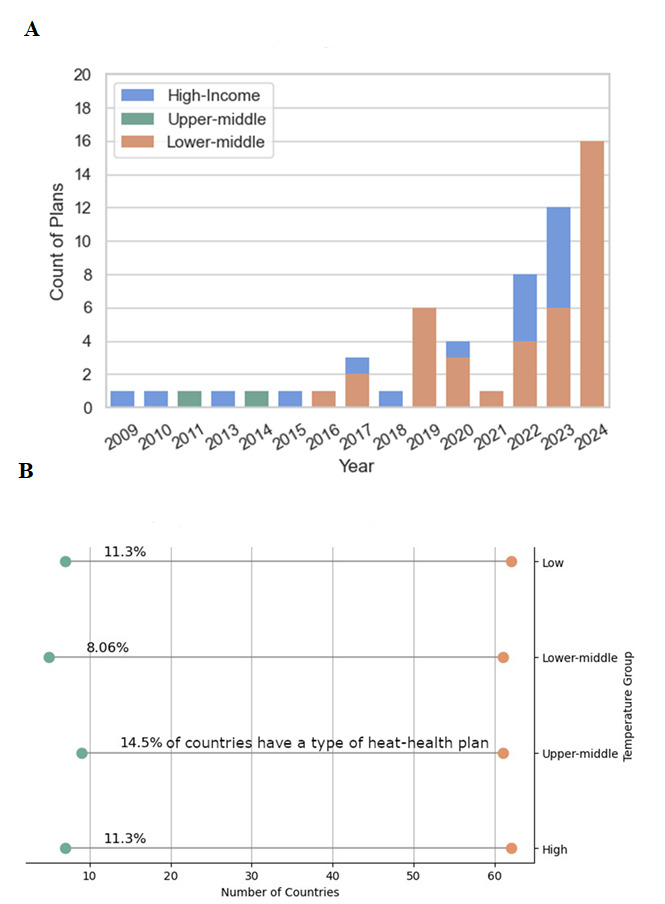
Results: We identified 83 eligible HHAPs from 24 countries, predominantly from high-income (49%) or lower-middle-income (47%) economies, with none from low-income economies. Most HHAPs identified children as a key population to protect (83%), with fewer naming pregnant individuals (52%). Even fewer mentioned newborns (39%) or postpartum and breastfeeding individuals (14%) as at-risk groups. We identified five broad activity categories targeting maternal, newborn, and child health (MNCH), with 'informing, education, and awareness raising' (77%) and 'improving care in health services or school settings' (59%) being the most common. However, no HHAP comprehensively addressed MNCH risks during extreme heat, and monitoring mechanisms were inadequate for assessing the impact of heat on MNCH.
Conclusions: This is the first review mapping MNCH content in HHAPs. Comprehensive action plans must incorporate targeted strategies for at-risk MNCH populations to ensure equitable health outcomes during heat events. While many HHAPs focus on behaviour change messages, structural and policy changes are needed to build broader resilience. Strengthened in-country monitoring mechanisms and global support for better documentation are essential to build an evidence base.
Copyright © 2025 by the Journal of Global Health. All rights reserved.
Conflict of interest statement
Disclosure of interest: The authors completed the ICMJE Disclosure of Interest Form (available upon request from the corresponding author) and disclose no relevant interest.
Figures
References
-
- United Nations Children’s Fund. The Coldest Year of the Rest of their Lives: Protecting children form the escalating impacts of heatwaves. New York, USA: United Nations Children's Fund; 2022. Available: https://www.unicef.org/media/129506/file/UNICEF-coldest-year-heatwaves-a.... Accessed: 9 May 2025.
-
- Intergovernmental Panel on Climate Change. Climate Change 2021: The Physical Science Basis. 2021. Available: https://www.ipcc.ch/report/ar6/wg1/. Accessed: 9 May 2025.