


Interobserver ground-truth variability limits performance of automated glioblastoma segmentation on [18F]FET PET
- PMID: 40478497
- PMCID: PMC12144010
- DOI: 10.1186/s40658-025-00767-y
Interobserver ground-truth variability limits performance of automated glioblastoma segmentation on [18F]FET PET
Abstract
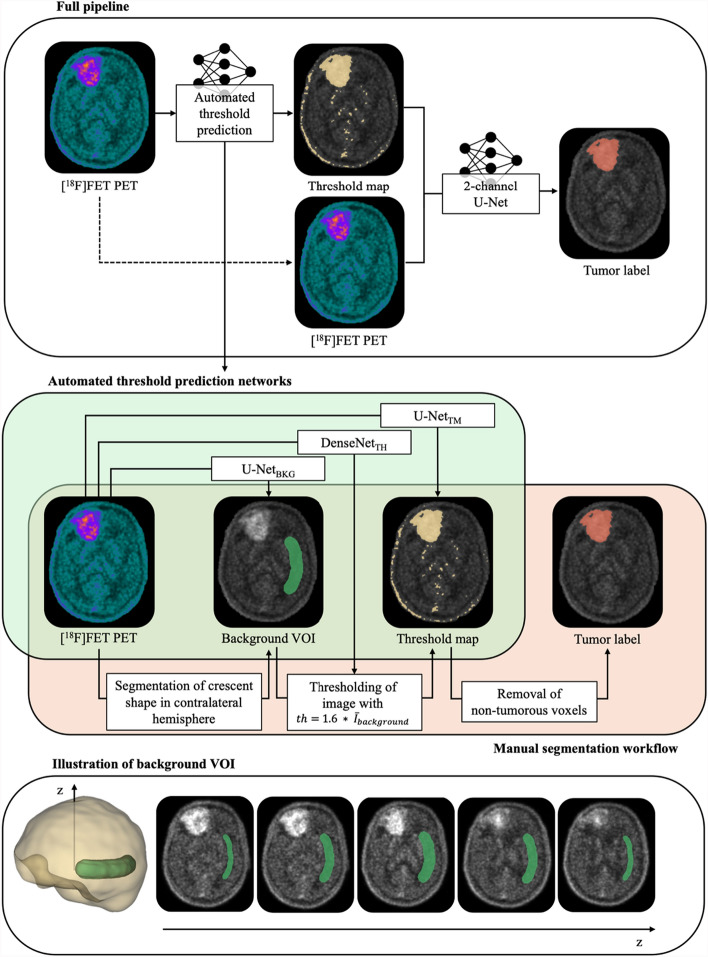
Background: Positron emission tomography (PET) with a [18F]fluoroethyl)-L-tyrosine ([18F]FET) tracer is of growing importance in the management of glioblastoma for the estimation of tumor extent and extraction of diagnostic and prognostic parameters. Robust and accurate glioblastoma segmentation methods are essential to maximize the benefits of this imaging modality. Given the importance of setting the foreground threshold during manual tumor delineation, this study investigates the added value of incorporating such prior knowledge to guide the automated segmentation and improve performance. Two segmentation networks were trained based on the nnU-Net guidelines: one with the [18F]FET PET image as sole input, and one with an additional input channel for the threshold map. For the latter, we investigate the benefit of manually obtained thresholds and explore automated prediction and generation of such maps. A fully automated pipeline was constructed by selecting the best performing threshold prediction approach and cascading this with the tumor segmentation model.
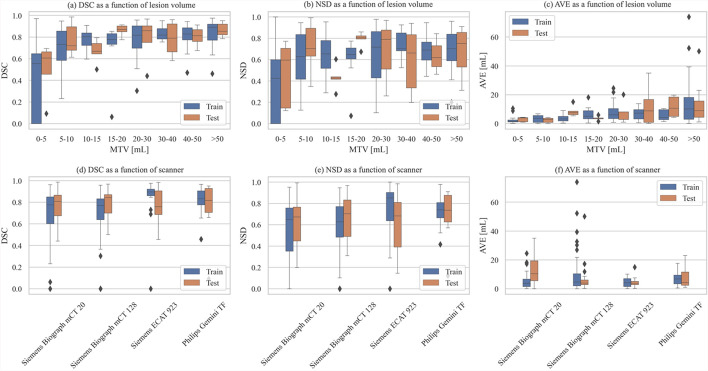
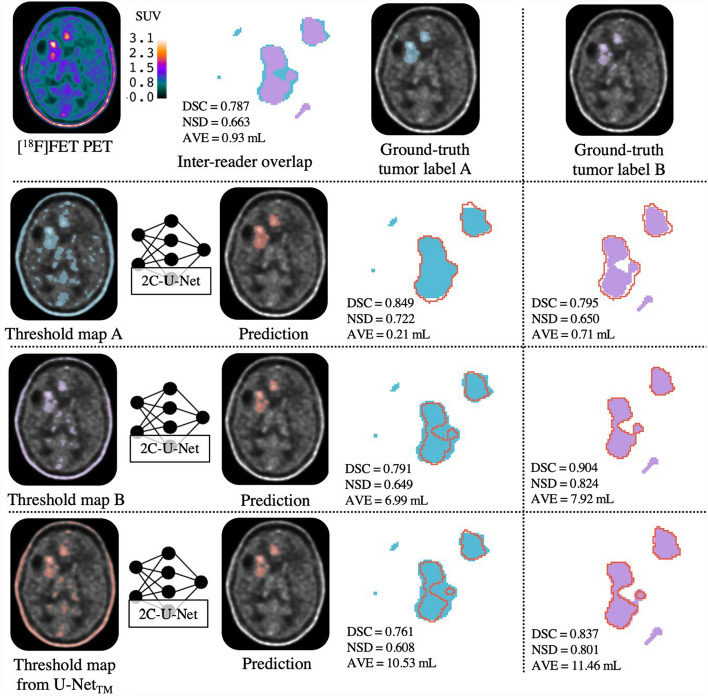
Results: The proposed two-channel network shows increased performance with guidance of threshold maps originating from the same reader whose ground-truth tumor label the prediction is compared to (DSC = 0.901). When threshold maps were generated by a different reader, performance reverted to levels comparable to the one-channel network and inter-reader variability. The proposed full pipeline achieves results on par with current state of the art (DSC = 0.807).
Conclusions: Incorporating a threshold map can significantly improve tumor segmentation performance when it aligns well with the ground-truth label. However, the current inability to reliably reproduce these maps-both manually and automatically-or the ground-truth tumor labels, restricts the achievable accuracy for automated glioblastoma segmentation on [18F]FET PET, highlighting the need for more consistent definitions of such ground-truth delineations.
Keywords: Brain; Deep learning; Glioblastoma; Positron emission tomography; Segmentation.
© 2025. The Author(s).
Conflict of interest statement
Declarations. Ethics approval and consent to participate: This single-center retrospective study was performed in line with the principles of the Declaration of Helsinki. Approval was granted by the Ethics Committee of Universitair Ziekenhuis Brussel (Commissie Medische Ethiek; protocol code EC-2021–137; date of approval 28–07-2021). This study is a retrospective analysis of data obtained during a prospective study (Axig (NCT01562197), GliAvAx (NCT03291314), and GlitIpNi (NCT03233152)), during which all patients signed informed consent for the use of their data. Consent for publication: The authors affirm that human research participants provided informed consent for publication of the images in Figs. 2 and 6. Competing interests: The authors declare that they have no competing interests.
Figures
References
Grants and funding
LinkOut - more resources
Full Text Sources
