Cornea Nerves Can Identify Different Types of Parkinson's Disease
- PMID: 40478562
- PMCID: PMC12155660
- DOI: 10.1167/iovs.66.6.21
Cornea Nerves Can Identify Different Types of Parkinson's Disease
Abstract
Purpose: To investigate whether the cornea nerve can distinguish between different subtypes of Parkinson's disease.
Methods: A total of 63 patients diagnosed with Parkinson's disease-comprising tremor-dominant (TD), postural instability and gait disturbance (PIGD), and mixed subtypes-were included alongside 31 age- and gender-matched control participants. All participants underwent In vivo confocal microscopy (IVCM) examinations along with comprehensive assessments of clinical neurological symptoms using the Movement Disorders Society Unified Parkinson's Disease Rating Scale, Hoehn and Yahr stages, and Montreal Cognitive Assessment scores. The detection range of IVCM includes the indicators of central and inferior whorl-like cornea nerve.
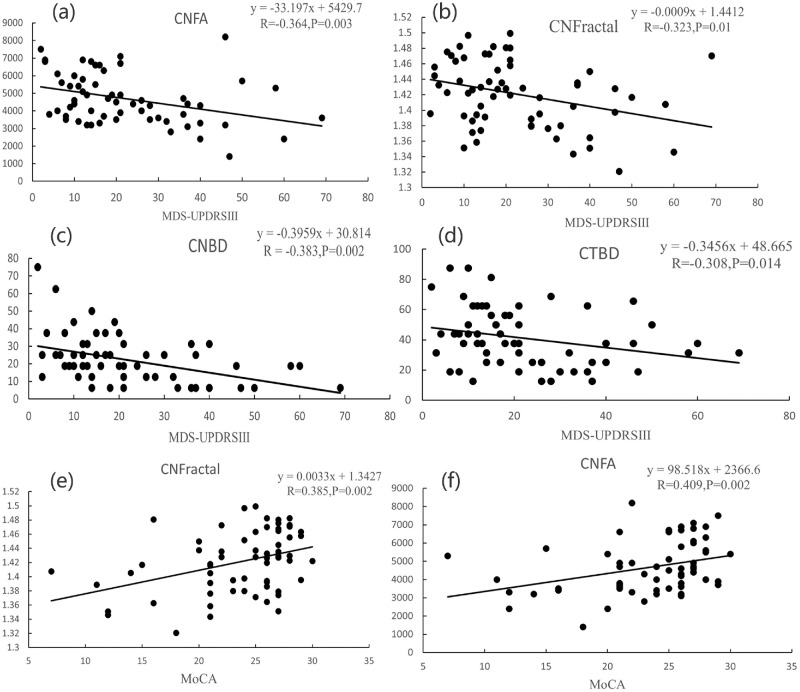
Results: This study involved 63 patients, 23 were classified as having the TD type, 30 as having the PIGD type, and 10 as mixed type. Among them, most of central and whorl-like corneal nerve indicators were significantly lower in the PIGD group compared to the TD group. Receiver operating characteristic analysis demonstrated that combined central and inferior whorl-like corneal nerve indicators exhibited high discriminatory power between TD and PIGD types, with an area under the curve of 0.969.
Conclusions: As a non-invasive examination method, IVCM holds significant value for differentiating Parkinson's disease subtypes and identifying patients with varying motor manifestations. Among these findings, individuals with PIGD displayed more pronounced corneal nerve damage; furthermore, patients exhibiting lower inferior whorl length, corneal nerve fiber width, and fractal dimension of corneal nerves values were found to be at greater risk of being classified within the PIGD subtype.
Conflict of interest statement
Disclosure:
Figures


References
-
- Poewe W, Seppi K, Tanner CM, et al.. Parkinson disease. Nat Rev Dis Primers. 2017; 3: 17013. - PubMed
-
- Nutt JG. Motor subtype in Parkinson's disease: different disorders or different stages of disease. Mov Disord. 2016; 31: 957–961. - PubMed
-
- van der Heeden JF, Marinus J, Martinez-Martin P, et al.. Postural instability and gait are associated with severity and prognosis of Parkinson disease. Neurology. 2016; 86: 2243–2250. - PubMed
-
- Reijnders JS, Ehrt U, Lousberg R, et al.. The association between motor subtypes and psychopathology in Parkinson's disease. Parkinsonism Relat Disord. 2009; 15: 379–382. - PubMed
MeSH terms
LinkOut - more resources
Full Text Sources
Medical
Research Materials