


Exploring innovative models of doula services in maternity care: A qualitative study on advancing equity and addressing disparities
- PMID: 40478637
- PMCID: PMC12144344
- DOI: 10.1177/17455057251345574
Exploring innovative models of doula services in maternity care: A qualitative study on advancing equity and addressing disparities
Abstract
Background: Maternal and infant health disparities remain a persistent public health issue in the United States, disproportionately affecting systematically marginalized communities. While doulas have been shown to improve birth outcomes and reduce inequities, their integration into maternity care systems remains limited.
Objectives: This study aimed to explore the roles and challenges of different doula models, identify systemic barriers to their integration, and propose strategies for sustainable implementation.
Design: A qualitative study using a phenomenological approach that adhered to the Consolidated Criteria for Reporting Qualitative Research guidelines.
Methods: Using purposive and snowball sampling, 20 stakeholders, including doulas, healthcare providers, Medicaid specialists, and public health professionals, were recruited from Omaha, Nebraska, and Nashville, Tennessee. Semi-structured interviews were conducted in person and via Zoom, lasting between 30 and 90 min. Thematic analysis, supported by Dedoose software, was used to identify key themes related to doula integration, systemic barriers, and policy recommendations. Data credibility was reinforced through member-checking and an audit trail documenting coding decisions.
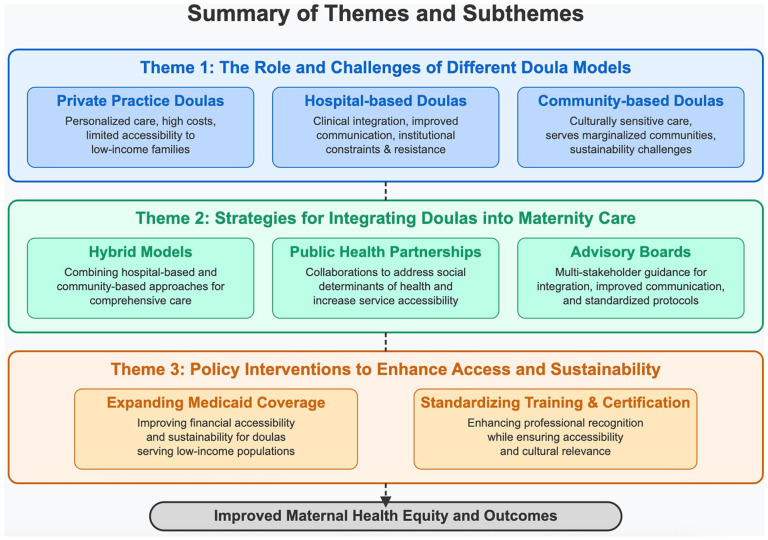
Results: Three primary themes emerged: (1) Doula Types and Their Impact, private practice doulas offer individualized care but face financial barriers; hospital-based doulas improve communication but encounter institutional constraints; community-based doulas provide culturally competent care but struggle with sustainability. (2) Strategies for Sustainable Integration, hybrid models enhance continuity of care, public health partnerships support funding and advocacy, and advisory boards foster interdisciplinary collaboration. (3) Policy Recommendations, expanding Medicaid coverage, increasing equitable reimbursement rates, and establishing standardized doula training and certification to improve accessibility and professional recognition.
Conclusion: Implementing policy reforms and fostering collaborative models can help optimize doula services and improve perinatal outcomes, particularly for systematically marginalized populations. Sustainable funding, standardized certification, and public health partnerships are essential for improving accessibility to doula care.
Keywords: Medicaid reimbursement; community-based care; doula services; health equity; integration strategies; maternal health disparities; perinatal care.
Plain language summary
Supporting birth journeys: Understanding doula care models and how to make them more accessible: This study examines how doulas (trained professionals who provide emotional, physical, and informational support during pregnancy and childbirth) can be better integrated into healthcare systems. We interviewed 20 experts including doulas, healthcare providers, and policy specialists to understand three types of doula services: private practice doulas (hired directly by families), hospital-based doulas (working within medical facilities), and community-based doulas (serving specific communities, often marginalized populations). Our findings show that while doulas improve birth experiences and outcomes, they face challenges including high costs for families, resistance from medical staff, and funding instability. We identified promising integration strategies such as hybrid models combining hospital and community approaches, partnerships with public health agencies, and advisory boards to guide implementation. Policy changes are needed, particularly Medicaid coverage for doula services and standardized training programs that maintain cultural relevance. These improvements could make doula support accessible to more families, especially those experiencing healthcare disparities, ultimately leading to better maternal and infant health outcomes across diverse communities.
Conflict of interest statement
Declaration of conflicting interestsThe author(s) declared no potential conflicts of interest with respect to the research, authorship, and/or publication of this article.
References
-
- Katon JG, Enquobahrie DA, Jacobsen K, et al. Policies for reducing maternal morbidity and mortality and enhancing equity in maternal health: a review of the evidence. Commonwealth Fund (Internet), 2021, https://www.commonwealthfund.org/publications/fund-reports/2021/nov/poli... (accessed 28 January 2025).
-
- Burke TJ. The correlation between maternal mortality and race: a state-level analysis of disparate outcomes in maternal health – ProQuest (Internet). Thesis, Georgestown University, Washinton, DC, 2024, https://www.proquest.com/openview/970d4832e5d5a29ef8abee9b14980d9c/1?pq-... (accessed 28 January 2025).
-
- Ely DM, Driscoll AK. Infant mortality among non-Hispanic Asian subgroups in the United States, 2018–2020 (Internet). National Center for Health Statistics (US), NCHS Health E-Stats, 2023, https://stacks.cdc.gov/view/cdc/122451 (accessed 28 January 2025). - PubMed
-
- National Academies of Sciences, Engineering, and Medicine, Health and Medicine Division, Board on Population Health and Public Health Practice, et al. The root causes of health inequity. In: Communities in action: pathways to health equity (Internet). National Academies Press (US), 2017, https://www.ncbi.mlm.nih.gov/books/NBK425845/ (accessed 28 January 2025). - PubMed
Publication types
MeSH terms
LinkOut - more resources
Full Text Sources
Medical
