


Protocol for evaluation of a virtual wheelchair simulator in assessing mobility skills and cognitive abilities in diverse populations: A multicentric mixed-methods pilot study
- PMID: 40478823
- PMCID: PMC12143504
- DOI: 10.1371/journal.pone.0325186
Protocol for evaluation of a virtual wheelchair simulator in assessing mobility skills and cognitive abilities in diverse populations: A multicentric mixed-methods pilot study
Abstract
Background: Current wheelchair acquisition, prescription, and training programs often require comprehensive assessments integrating both power mobility skills and cognitive abilities. While wheelchair simulators offer promise for these assessments, but they have not been fully validated.
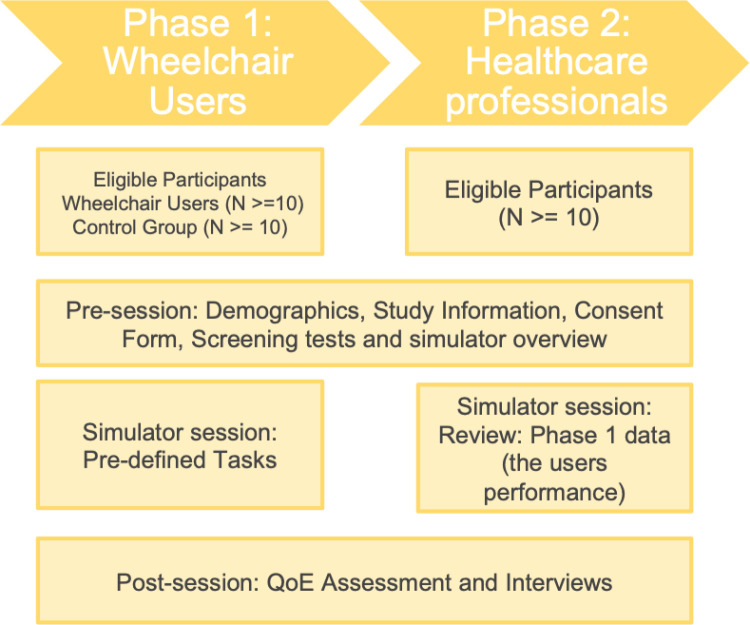
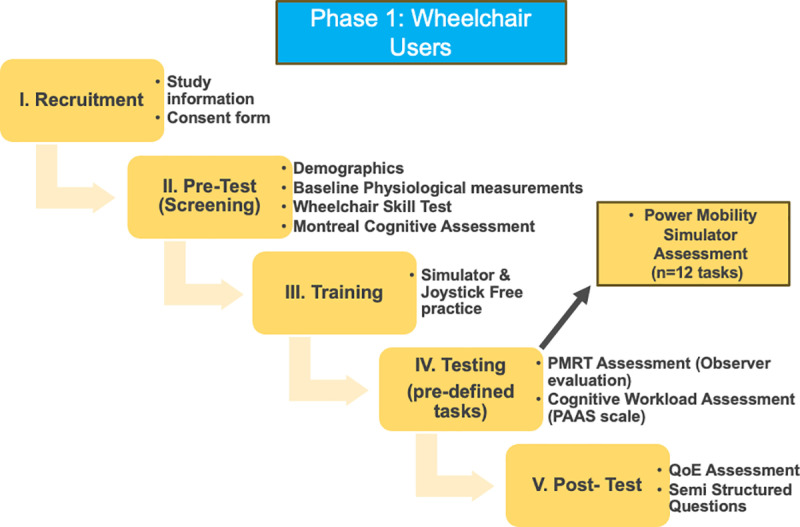
Objective: This study aims to develop and refine a protocol for evaluating the feasibility, reliability and preliminary validity of virtual wheelchair simulator metrics in assessing users' current power mobility skills and cognitive abilities, following STARD guidelines. Reference standards include the self-report Wheelchair Skill Test (WST), Power Mobility Road Test (PMRT) and the Montreal Cognitive Assessment (MoCA).
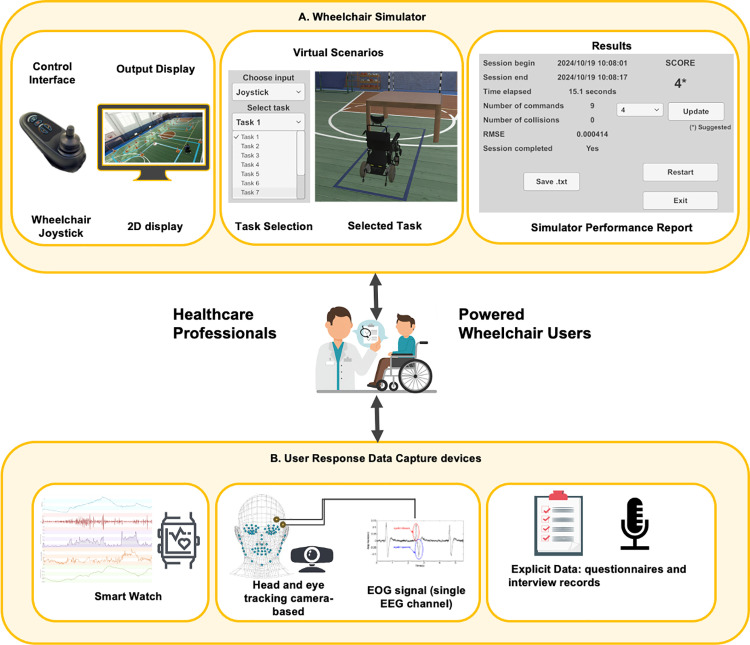
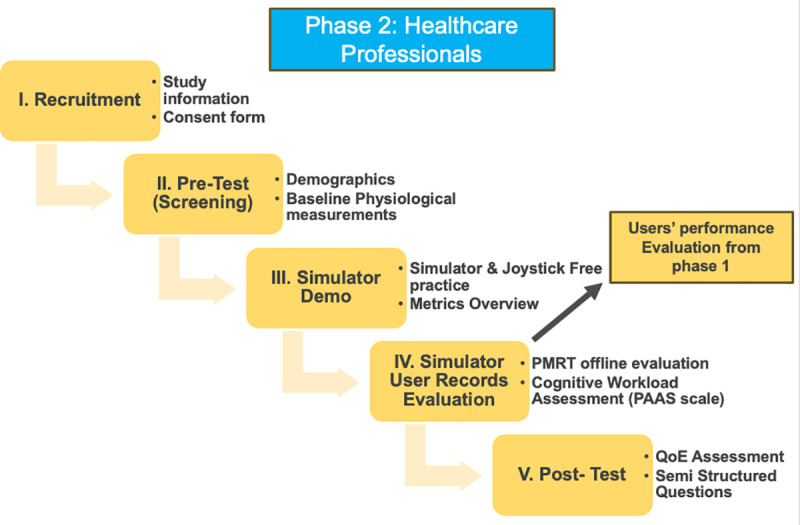
Methods: This multicentric, mixed-methods pilot study will recruit participants with mobility disabilities, a control group of individuals without disabilities, and healthcare professionals to use a virtual wheelchair simulator. Healthcare professionals will evaluate the simulator's assessments and provide expert feedback on the protocol. Quantitative data will include simulator-derived performance metrics compared to reference standards, and physiological data (e.g., heart rate, skin conductance, temperature, inter-beat-intervals, accelerometer and eye-gaze tracking). Qualitative data (semi-structured interviews) will capture user experiences and insights for protocol refinement. The Quality of Experience (QoE) evaluation framework will assess cognitive workload (NASA-TLX and PAAS), usability (System Usability Scale), immersion (IGroup Presence Questionnaire), and emotion (Self-Assessment Manikin). Data analysis will include correlation analysis, regression models, thematic analysis, and statistical tests (e.g., independent t-tests, Mann-Whitney U tests) to compare simulator-based performance across groups.
Discussion: This pilot study seeks to fill critical gaps in current wheelchair training and prescription methods by exploring the use of a virtual simulator to objectively assess both cognitive abilities and power mobility skills. Integrating the QoE assessment framework will provide insights into user interactions, ensuring that the simulator supports tailored training and improve user outcomes in mobility, and safety. Future research may extend this protocol to clinical settings to further evaluate its applicability and effectiveness.
Copyright: © 2025 Pereira Salgado et al. This is an open access article distributed under the terms of the Creative Commons Attribution License, which permits unrestricted use, distribution, and reproduction in any medium, provided the original author and source are credited.
Conflict of interest statement
The authors have declared that no competing interests exist.
Figures
Similar articles
-
Efficacy of Manual Wheelchair Skills Training for Improving Skills and Confidence in People With Hereditary Degenerative Disorders: Protocol for a Sequential Multimethods Study.JMIR Res Protoc. 2025 Jul 31;14:e66974. doi: 10.2196/66974. JMIR Res Protoc. 2025. PMID: 40742628 Free PMC article.
-
The influence of experience and environments on usability and user experience in a wheelchair simulator.Ann Med. 2025 Dec;57(1):2537930. doi: 10.1080/07853890.2025.2537930. Epub 2025 Jul 27. Ann Med. 2025. PMID: 40717044 Free PMC article.
-
Development of a wheelchair mobility skills test for children and adolescents: combining evidence with clinical expertise.BMC Pediatr. 2017 Feb 13;17(1):51. doi: 10.1186/s12887-017-0809-9. BMC Pediatr. 2017. PMID: 28193204 Free PMC article.
-
Interventions for interpersonal communication about end of life care between health practitioners and affected people.Cochrane Database Syst Rev. 2022 Jul 8;7(7):CD013116. doi: 10.1002/14651858.CD013116.pub2. Cochrane Database Syst Rev. 2022. PMID: 35802350 Free PMC article.
-
The Experience of Manual Wheelchair Training for People With Chronic and Progressive Conditions: Perspectives of Users and Trainers.Health Expect. 2025 Aug;28(4):e70342. doi: 10.1111/hex.70342. Health Expect. 2025. PMID: 40586620 Free PMC article.
References
-
- World Health Organization. Wheelchair provision guidelines. World Health Organization; 2023. https://www.who.int/publications/i/item/9789240074521 - PubMed
-
- Nilsson LM, Eklund M. Driving to learn: Powered wheelchair training for those with cognitive disabilities. Int J Ther Rehabil. 2006;13(11):517–27. doi: 10.12968/ijtr.2006.13.11.22466 - DOI
MeSH terms
LinkOut - more resources
Full Text Sources
Medical
