


Risk Factors and Consequences of Parental Burnout: Role of Early Maladaptive Schemas and Emotion-Focused Coping
- PMID: 40478977
- PMCID: PMC10081303
- DOI: 10.1007/s43076-023-00288-6
Risk Factors and Consequences of Parental Burnout: Role of Early Maladaptive Schemas and Emotion-Focused Coping
Abstract
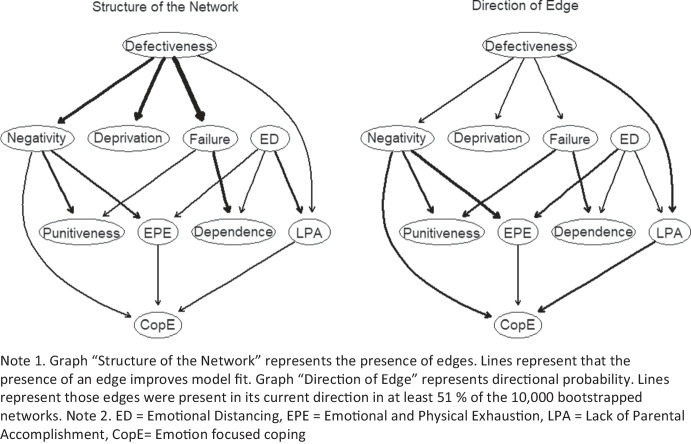
Resulting from chronic exposure to parenting stress, parental burnout is a syndrome located on a continuum between stress and depression. Research interest is growing, and several risk factors have already been identified, but more studies are needed. We assessed the relationship between early maladaptive schemas (as potential risk factors), coping strategies, and the three dimensions of parental burnout (emotional and physical exhaustion, emotional distancing, and loss of parental accomplishment). A total of 115 French-speaking parents answered an online questionnaire. Results (correlations and acyclic graph driven by emotion-focused coping) confirmed the influence of EMSs on the expression of parental burnout. More specifically, schemas in the following three EMS domains were identified as major risk factors: disconnection and rejection (especially abandonment/instability, emotional deprivation, and defectiveness/shame), impaired autonomy and performance (especially dependence/incompetence and failure), and over-vigilance and inhibition (especially negativity/pessimism and punitiveness). Interestingly, our results suggest that emotional coping is not a risk factor for parental burnout, but a consequence of emotional and physical exhaustion and loss of parental accomplishment. Thus, the more parents reported overactivation of these EMSs, the more they are exhausted, and the more they use emotion-focused coping. These results are discussed in terms of possible therapies.
Keywords: Adjustment; Directed acyclic graph; Early maladaptive schemas; Exhaustion; Parenthood.
© Associação Brasileira de Psicologia 2023. Springer Nature or its licensor (e.g. a society or other partner) holds exclusive rights to this article under a publishing agreement with the author(s) or other rightsholder(s); author self-archiving of the accepted manuscript version of this article is solely governed by the terms of such publishing agreement and applicable law.
Conflict of interest statement
Conflict of InterestThe authors declare no competing interests.
Figures
References
-
- Abeltina, M., & Rascevska, M. (2021). A network analysis of burnout subtypes, early maladaptive schemas and schema modes. Activitas Nervosa Superior Rediviva,63(2), 84–94.
-
- Billoux, S., Chapelle, F., Giocanti-Belmonte, C., & Callahan, S. (2012). Étude des relations entre les schémas précoces inadaptés, les stratégies de coping et la flexibilité psychologique chez des sujets présentant des troubles anxieux. Journal De Therapie Comportementale Et Cognitive,22(2), 46–52. 10.1016/j.jtcc.2012.02.001 - DOI
-
- Bruchon-Schweitzer, M., & Boujut, É. (2014). Psychologie de la santé (2ème édition). Dunod.
LinkOut - more resources
Full Text Sources