


Complex psychological responses to climate change: a longitudinal study exploring the interplay between climate change awareness and climate change anxiety among Chinese adolescents
- PMID: 40483426
- PMCID: PMC12144783
- DOI: 10.1186/s12889-025-23282-2
Complex psychological responses to climate change: a longitudinal study exploring the interplay between climate change awareness and climate change anxiety among Chinese adolescents
Abstract
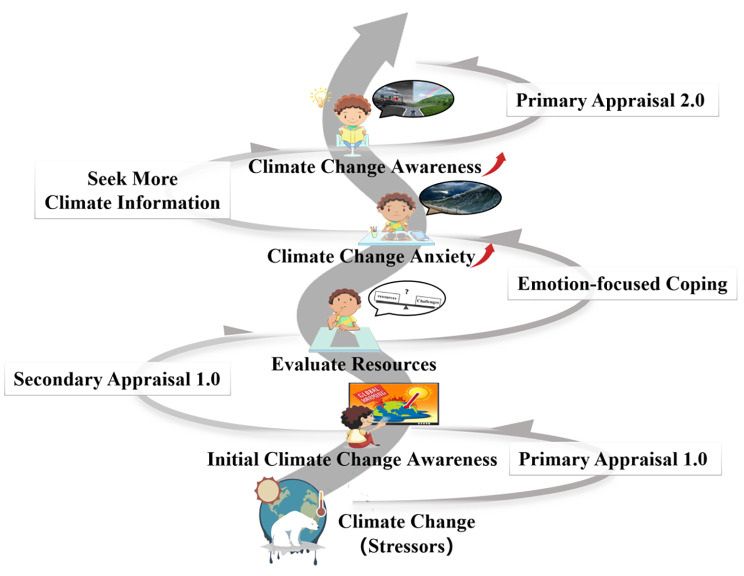
Background: Adolescents are increasingly recognized as important stakeholders in responding to the challenges of climate change, with their psychological responses shaping both mental health outcomes and behavioral choices. However, the intricate relationship between climate change awareness and climate change anxiety among adolescents, as significant manifestations of psychological reactions to climate change, has not yet been thoroughly investigated. Grounded in the Stress and Coping Theory, this study aimed to empirically investigate the bidirectional relationship between climate change awareness and climate change anxiety among Chinese adolescents.
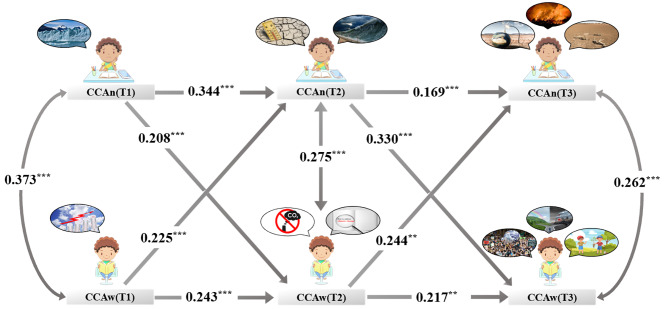
Methods: Data were collected through a three-wave longitudinal survey (2022-2024) from 426 Chinese adolescents. We employed repeated measures ANOVA to examine developmental patterns and gender differences in climate change awareness and climate change anxiety, and constructed cross-lagged panel models, along with the calculation of feedback effects, to investigate their reciprocal relationships across time points.
Results: Results revealed significant increases in both climate change awareness and climate change anxiety over time, with females consistently exhibiting higher levels. Cross-lagged analyses demonstrated that climate change awareness significantly predicted an increase in climate change anxiety, and climate change anxiety, in turn, significantly enhanced climate change awareness. Furthermore, the feedback effect between climate change awareness and climate change anxiety was significant at both T1-T2 and T2-T3 intervals.
Conclusion: This study demonstrates a bidirectional relationship between climate change awareness and anxiety among adolescents, providing a theoretical framework and empirical evidence for understanding adolescents' complex psychological responses to climate change. It also presents valuable suggestions for implementing targeted mental health interventions, and climate change education.
Keywords: Climate change anxiety; Climate change awareness; Cross-lagged analyses; Stress and coping theory.
© 2025. The Author(s).
Conflict of interest statement
Declarations. Ethics approval and consent to participate: All procedures performed in studies involving human participants were in accordance with the ethical standards of the institutional and/or national research committee and with the 1964 Helsinki Declaration and its later amendments or comparable ethical standards. This study was approved by the Research Ethics Committee of Zhejiang Normal University (number: ZSRT2022072). And informed consent was obtained from all individual participants included in this study. Consent for publication: Not applicable. Competing interests: The authors declare no competing interests.
Figures

References
-
- Hua Y, Qiu Y, Tan X. The effects of temperature on mental health: evidence from China. J Popul Econ. 2023;36(3):1293–332. 10.1007/s00148-022-00932-y. - DOI
-
- Gasparri G, Eissa M, Imbago-Jacome D, Nandini B. Climate emergency: how should COP27 do better for adolescents and young people? BMJ-BRITISH Med J. 2022;376. 10.1136/bmj.o816. - PubMed
MeSH terms
Supplementary concepts
Grants and funding
LinkOut - more resources
Full Text Sources
Medical
