


Linking self-esteem and marital adjustment among couples in the third trimester of pregnancy: the mediating role of dyadic coping
- PMID: 40483443
- PMCID: PMC12145644
- DOI: 10.1186/s12884-025-07757-z
Linking self-esteem and marital adjustment among couples in the third trimester of pregnancy: the mediating role of dyadic coping
Abstract
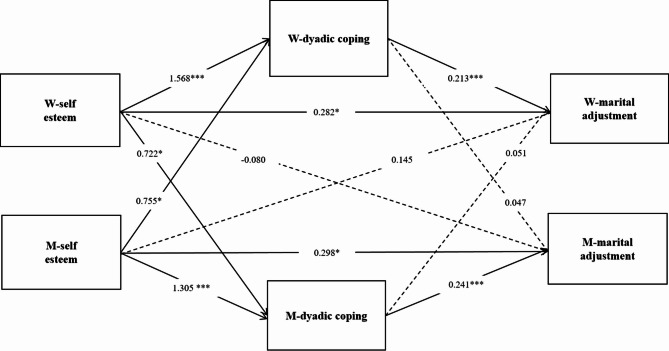
Background: Pregnancy poses a significant stressor for married couples. Alterations in marital dynamics may affect the marital adjustment of both parties, particularly in the third trimester of pregnancy. Self-esteem serves as a protective factor for marital adjustment; however, the extent to which dyadic coping strategies, which are jointly enacted by both partners, contribute to this process remains unexplored. Therefore, the objective of this study was to examine the effect of self-esteem on marital adjustment among couples in the third trimester of pregnancy, while exploring the potential mediating role of dyadic coping in this association.
Methods: A total of 228 pregnant women and their spouses (n = 456) participated in the study, completing the Rosenberg Self-Esteem Scale, the Dyadic Coping Inventory, and the Revised Dyadic Adjustment Scale independently. The actor-partner interdependence mediation model was used to examine the associations between these three variables within the dyad.
Results: Regarding the intra-individual aspect, a direct effect of self-esteem on marital adjustment (β = 0.282, P = 0.027 for women and β = 0.298, P = 0.014 for men) and an indirect effect of self-esteem on marital adjustment through dyadic coping (β = 0.334, 95% CI = 0.183, 0.526 for women and β = 0.315, 95% CI = 0.165, 0.510 for men) were found. As for the inter-individual aspect, an indirect effect was found, with actors' self-esteem being associated with partners' marital adjustment through partners' dyadic coping (β = 0.174, 95% CI = 0.043, 0.350 for women and β = 0.161, 95% CI = 0.048, 0.327 for men).
Conclusions: These findings highlight the importance of assessing the dyadic coping strategies of couples during late pregnancy to regulate the effect of self-esteem on marital adjustment and targeting them in the couple-based psychological support offered to couples to improve their dyadic coping and, consequently, their marital adjustment.
Keywords: Actor–partner interdependence mediation model; Couple; Dyadic coping; Late pregnancy; Marital adjustment; Self-esteem.
© 2025. The Author(s).
Conflict of interest statement
Declarations. Competing interest: The authors report no conflict of interest. Ethics approval: This study was reviewed and approved by the Biomedical Ethics Committee of The First Affiliated Hospital of Xi’an Jiaotong University (No.XJTU1AF2023LSYY-065). It was conducted in accordance with the Declaration of Helsinki (as revised in 2013). Consent to participate: Informed consent was obtained from all individual participants included in the study. Consent to publish: The authors affirm that human research participants provided informed consent for publication of the manuscript.
Figures
References
-
- Molgora S, Chiara A, Emanuela S. The role of dyadic coping for the individual and relational Well-Being of couples during the transition to parenthood. J Fam Issues. 2022;43(5):1364–85. - DOI
MeSH terms
Grants and funding
LinkOut - more resources
Full Text Sources
Research Materials
