. 2025 Jun 7;13(1):140.
doi: 10.1186/s40168-025-02143-5.

Species turnover within cystic fibrosis lung microbiota is indicative of acute pulmonary exacerbation onset

Affiliations

Species turnover within cystic fibrosis lung microbiota is indicative of acute pulmonary exacerbation onset

Leah Cuthbertson et al. Microbiome. .

Abstract

Background: Acute pulmonary exacerbations (PEx) are associated with increased morbidity and earlier mortality for people living with cystic fibrosis (pwCF). The most common causes of PEx in CF are by bacterial infection and concomitant inflammation leading to progressive airway damage. To draw attention to the seriousness of PEx they have been labelled as 'lung attacks', much like a 'heart attack' for acute myocardial infarction. Treatment typically starts when a pwCF presents with worsening respiratory symptoms. Hence, there is a pressing need to identify indicative biomarkers of PEx onset to allow more timely intervention. Set within an ecological framework, we investigated temporal microbiota dynamics to connect changes in the lung microbiota of pwCF to changes in disease states across a PEx event.

Results: Species-time relationships (STR) describe how the richness of a community changes with time, here STRs were used to assess temporal turnover (w) within the lung microbiota of each pwCF (n = 12, mean sample duration 315.9 ± 42.7 days). STRs were characterised by high interpatient variability, indicating that turnover and hence temporal organization are a personalized feature of the CF lung microbiota. Greater turnover was found to be significantly associated with greater change in lung function with time. When microbiota turnover was examined at a finer scale across each pwCF time series, w-values could clearly be observed to increase in the exacerbation period, then peaking within the treatment period, demonstrating that increases in turnover were not solely a result of perturbations caused by PEx antibiotic interventions. STR w-values have been found to have a remarkable degree of similarity for different organisms, in a variety of habitats and ecosystems, and time lengths (typically not exceeding w = 0.5). Here, we found w-values soon increased beyond that. It was therefore possible to use the departure from that expected norm up to start of treatment to approximate onset of PEx in days (21.2 ± 8.9 days across the study participants).

Conclusions: Here, we illustrate that changes in turnover of the lung microbiota of pwCF can be indicative of PEx onset in considerable advance of when treatment would normally be initiated. This offers translational potential to enable early detection of PEx and consequent timely intervention. Video Abstract.

Keywords: Cystic fibrosis; Island biogeography; Lung function; Lung microbiome; Microbiome ecology; Pulmonary exacerbation; Species turnover; Species-time relationships; Temporal dynamics.


Conflict of interest statement

Declarations. Ethics approval and consent to participate: The study was reviewed and approved by the Southampton and Southwest Hampshire Research Ethics Committee, UK (06/Q1704/24). All patients provided written informed consent. Consent for publication: Not applicable. Competing interests: The authors declare no competing interests.

Figures
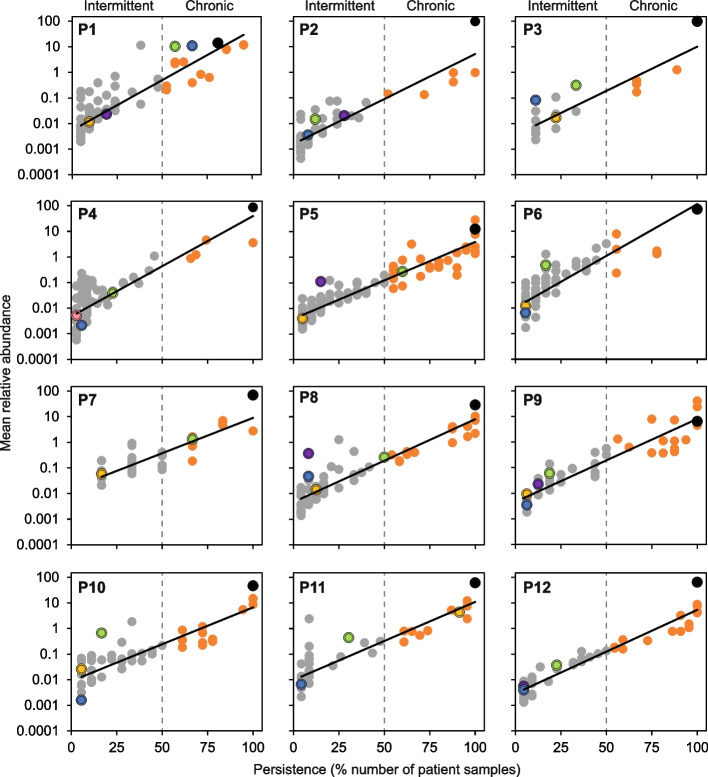
Fig. 1
Fig. 1
Persistence and abundance of chronic and intermittent colonizing bacterial taxa within patients. Using a modification of the Leeds criteria of chronic infection, patients were deemed to be chronically (orange circles) or intermittently (grey) colonized with a given bacterial taxon if present in > 50% or ≤ 50% samples, respectively. Canonical pathogens are marked as follows: Pseudomonas aeruginosa, black circle; Staphylococcus aureus, blue; Stenotrophomonas maltophilia, green; Burkholderia cepacia complex, pink; Haemophilus influenzae, purple; and Achromobacter xylosoxidans, yellow. Chronic or intermittent colonization status for all bacterial taxa within the microbiota of each patient is highlighted in the supplemental microbiota data (see “Data availability” section). Persistence-abundance relationship regression statistics: (P1) R2 = 0.77, F1,88 = 290.1; (P2) R2 = 0.77, F1,47 = 168.9; (P3) R2 = 0.78, F1,21 = 76.2; (P4) R2 = 0.64, F1,93 = 166.5; (P5) R2 = 0.88, F1,92 = 642.1; (P6) R2 = 0.72, F1,84 = 220.6; (P7) R2 = 0.76, F1,40 = 125.5; (P8) R2 = 0.84, F1,64 = 346.4; (P9) R2 = 0.85, F1,49 = 284.8; (P10) R2 = 0.74, F1,53 = 153.1; (P11) R2 = 0.80, F1,42 = 170.1; (P12) R.2 = 0.93, F1,49 = 675.1. All relationships were significant (P < 0.0001 in all instances)
Fig. 2
Fig. 2
Species-time relationships within patient lung microbiota. Disease states have been superimposed for each patient: B0, baseline pre-exacerbation; E, exacerbation; T, treatment period; R, recovery period; and B1 post-exacerbation baseline. Given are species-time relationships (STRs) for microbiota (blue), and the chronically (orange) and intermittently (grey) colonising taxa in each patient (P1 to P12). Also given in each instance is the STR slope value w for the microbiota (M), and the chronically (C) and intermittently (I) colonising taxa. All STRs were significant (P < 0.05). Full STR regression statistics are reported in Table S1
Fig. 3
Fig. 3
Cumulative changes in patient lung function with time. Given in each instance is the cumulative absolute change in %FEV1 between consecutive timepoints. Each plot has been fitted with a power regression; Δ%FEV1 = aTb. Where Δ%FEV1 is cumulative change in lung function, a is the intercept, T is time in days, and b = slope/rate of change in lung function over time. Disease states have been superimposed for each patient: B0, baseline pre-exacerbation; E, exacerbation; T, treatment period; R, recovery period; and B1 post-exacerbation baseline. Lung function-time relationship regression statistics: (P1) R2 = 0.25, F1,19 = 6.46, P = 0.02; (P2) R2 = 0.61, F1,23 = 35.60, P < 0.0001; (P3) R2 = 0.67, F1,7 = 14.19, P = 0.0007; (P4) R2 = 0.60, F1,33 = 49.22, P < 0.0001; (P5) R2 = 0.34, F1,18 = 9.10, P = 0.008; (P6) R2 = 0.51, F1,16 = 16.87, P = 0.001; (P7) R2 = 0.99, F1,4 = 920.53, P < 0.0001; (P8) R2 = 0.70, F1,22 = 50.77, P < 0.0001; (P9) R2 = 0.58, F1,14 = 19.25, P = 0.001; (P10) R2 = 0.44, F1,16 = 12.66, P = 0.003; (P11) R2 = 0.42, F1,21 = 15.38, P = 0.001; (P12) R.2 = 0.72, F1,20 = 51.99, P < 0.0001. All relationships were significant (P < 0.05 in all instances). Changes in patient lung function with time are presented in Fig. S1
Fig. 4
Fig. 4
Relationship between rate of change in lung function and taxa turnover. This relationship is plotted for the whole microbiota and the chronic and intermittent colonizing taxa groups. Taxa turnover w is derived from species-time relationships (Fig. 2). Rate of change in lung function b is derived from lung function-time relationships (Fig. 3). Regression statistics: microbiota R2 = 0.80, F1,10 = 40.08, P < 0.0001; chronic taxa R2 = 0.76, F1,10 = 31.15, P < 0.0001; and Intermittent taxa R2 = 0.43, F1,10 = 7.45, P = 0.022. All relationships were significant at P < 0.05 level
Fig. 5
Fig. 5
Finer scale examination of temporal turnover (w) and changes in rate of lung function (b) within individual patients. To derive finer scale measures of w (columns) and b (circles), species-time relationships and cumulative changes in lung function were respectively plotted using windows of five sample time points, shifting by one time point for each new plot along the time series for each patient (P1 to P12). Values of w and b values are plotted at the middle time point of each subsequent five time point window. Disease states have been superimposed for each patient: B0, baseline pre-exacerbation; E, exacerbation; T, treatment period; R, recovery period; and B1 post-exacerbation baseline

References

    1. Bhatt JM. Treatment of pulmonary exacerbations in cystic fibrosis. Eur Respir Rev. 2013;22:205. 10.1183/09059180.00006512. - PMC - PubMed
    1. Stanford GE, Dave K, Simmonds NJ. Pulmonary exacerbations in adults with cystic fibrosis: a grown-up issue in a changing cystic fibrosis landscape. Chest. 2021;159:93-102. 10.1016/j.chest.2020.09.084. - PMC - PubMed
    1. de Boer K, Vandemheen KL, Tullis E, Doucette S, Fergusson D, Freitag A, et al. Exacerbation frequency and clinical outcomes in adult patients with cystic fibrosis. Thorax. 2011;66:680-5. 10.1136/thx.2011.161117. - PubMed
    1. FitzGerald JM. Targeting lung attacks. Thorax. 2011;66:365-6. 10.1136/thx.2010.156760. - PubMed
    1. Castillo JR, Peters SP, Busse WW. Asthma exacerbations: pathogenesis, prevention, and treatment. J Allergy Clin Immunol Pract. 2017;5:918-27. 10.1016/j.jaip.2017.05.001. - PMC - PubMed
