


Abscence of specific humoral response in three dogs with clinical leishmaniosis
- PMID: 40484952
- PMCID: PMC12147281
- DOI: 10.1186/s13028-025-00814-9
Abscence of specific humoral response in three dogs with clinical leishmaniosis
Abstract
Background: Canine leishmaniosis, caused by Leishmania infantum, is a vector-borne disease. The immune response in infected dogs determines the clinical outcome, with a strong cell-mediated immune response linked to parasite control and mild clinical signs, while a humoral-dominant response is associated with severe disease. Low antibody levels in clinically asymptomatic dogs with negative molecular and/or parasitological test results may reflect prior exposure or the early stages of Leishmania infection. In contrast, elevated antibody levels are typically correlated with a high parasitic burden and active disease. The detection of dogs with clinical leishmaniosis and null-specific immune response against L. infantum is uncommon. However, this presentation has also been described in human leishmaniasis with the absence of humoral response detected by conventional serological methods.
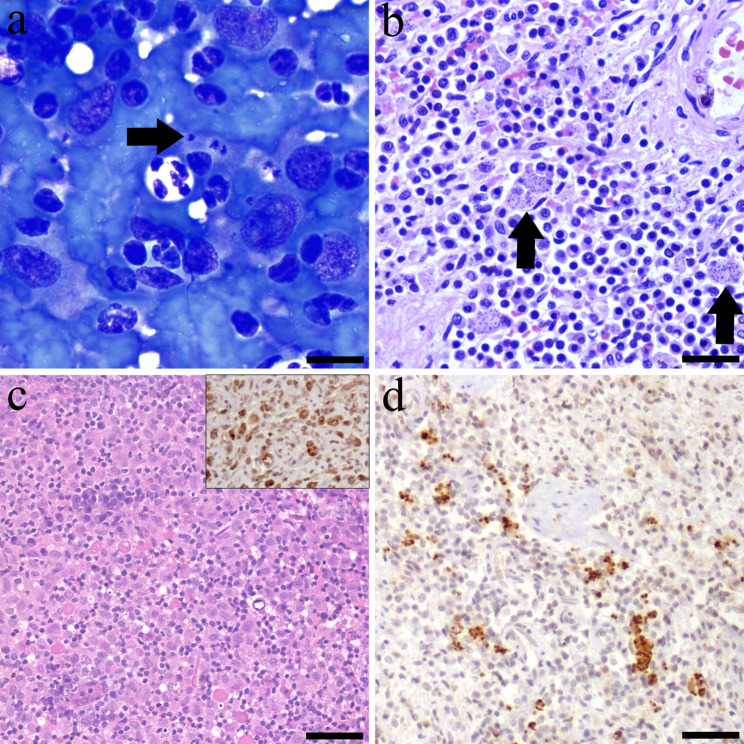
Case presentation: Case 1, a 9-year-old Border Collie, showed splenomegaly and Leishmania amastigotes within splenic macrophages. Case 2, a 10-month-old French Bulldog, had chronic anorexia and malabsorption syndrome with granulomatous splenitis and amastigotes confirmed by immunohistochemistry. Finally, case 3, a 7-year-old cross-breed, presented with cutaneous nodules and nasal ulcerative dermatitis, with Leishmania amastigotes detected histologically and confirmed by immunohistochemistry. All dogs were seronegative by two quantitative serological tests including indirect immunofluorescent test and enzyme-linked immunosorbent assay. The identification of the parasite in the affected organ established a clear cause-and-effect relationship. Consequently, anti-Leishmania treatment was initiated, consisting of allopurinol (10 mg/kg orally twice daily) and meglumine antimoniate (50 mg/kg subcutaneously twice daily for four weeks) in cases 1 and 3. In case 1, a favourable clinical response was noted, with a normal abdominal ultrasound and a negative result by quantitative molecular test from material obtained via ultrasound-guided splenic puncture. In case 3, the administration of meglumine antimoniate resulted in the resolution of dermatological signs. Clinical follow-up and anti-Leishmania treatment could not be performed for case 2.
Conclusions: These findings highlight the diagnostic challenges in detecting clinical leishmaniosis in seronegative dogs. The absence of a specific humoral response should be considered, emphasizing the importance of using multiple diagnostic methods, including cytology, and histopathology with immunohistochemistry. This case series underscores the need for a comprehensive approach in diagnosing and managing canine leishmaniosis.
Keywords: Leishmania infantum; Antibodies; Immune response; Serology.
© 2025. The Author(s).
Conflict of interest statement
Declarations. Ethics approval and consent to participate: This study did not require official or institutional ethical approval. The animals were handled according to high ethical standards and national legislation. Consent for publication: The animals were sampled with the owner’s consent and for clinical reasons. No additional ethical approval was required. Competing interests: The authors declare that they have no competing interests. Prior publication: Data have not been published previously.
Figures
References
-
- Baneth G, Koutinas AF, Solano-Gallego L, Bourdeau P, Ferrer L. Canine leishmaniosis - new concepts and insights on an expanding zoonosis: part one. Trends Parasitol. 2008;24:324–30. - PubMed
-
- Paltrinieri S, Gradoni L, Roura X, Zatelli A, Zini E. Laboratory tests for diagnosing and monitoring canine leishmaniasis. Vet Clin Pathol. 2016;45:552–78. - PubMed
-
- Blavier A, Keroack S, Denerolle P, Goy-Thollot I, Chabanne L, Cadoré JL, et al. Atypical forms of canine leishmaniosis. Vet J. 2001;162:108–20. - PubMed
Publication types
MeSH terms
Substances
Grants and funding
LinkOut - more resources
Full Text Sources
