


Reliability and Validity of the Arabic Translated Version of the Norwich Patellar Instability Score and the Banff Patellar Instability Instrument 2.0
- PMID: 40485877
- PMCID: PMC12144335
- DOI: 10.1177/23259671251340989
Reliability and Validity of the Arabic Translated Version of the Norwich Patellar Instability Score and the Banff Patellar Instability Instrument 2.0
Abstract
Background: The Banff Patellar Instability Instrument 2.0 (BPII 2.0) and Norwich Patellar Instability (NPI) score are reliable, valid patient-reported outcome (PRO) measures for evaluating patellofemoral instability. Both have been translated and culturally adapted to various languages to document PROs accurately. However, no validated Arabic versions of these PRO measures exist.
Purpose: To translate the BPII 2.0 and NPI score into Arabic and assess the reliability and validity of the translated questionnaires.
Study design: Cohort study (diagnosis); Level of evidence, 3.
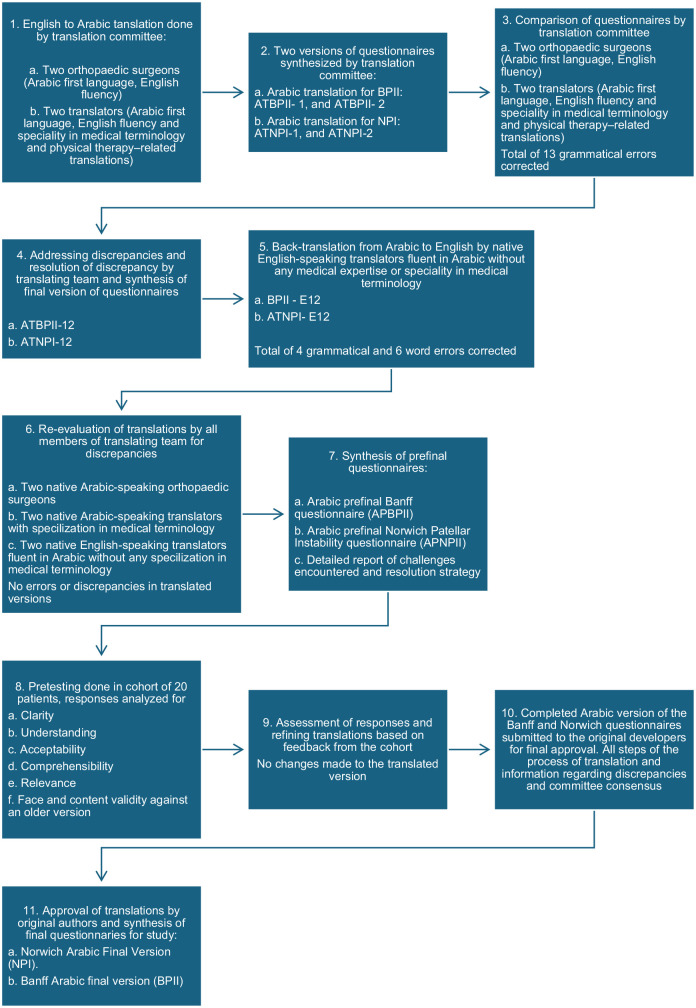
Methods: The NPI score and BPII 2.0 were translated into Arabic based on standard guidelines recommended by the Consensus-based Standards for the selection of health Measurement Instruments. Patients who underwent patellofemoral stabilization surgery were included in this study. Respondents completed the translated versions of the questionnaires 1 week apart. The validity of the translation was assessed using Cronbach alpha, and Pearson correlation coefficient (r) was used to determine the relationship between the Arabic versions of the NPI score, BPII 2.0, and Kujala Score (KS). Test-retest reliability was assessed using the intraclass correlation coefficient.
Results: The translated versions were assessed in 83 patients and found reliable. The response rate was 94.3%. A negative correlation was found between the KS and NPI score (r = -0.80; P < .05) and a positive correlation with BPII (r = 0.84; P < .05). A significant negative correlation was noted between the NPI and the BPII (r = -0.71). For first-time responses, Cronbach alpha for the NPI score was 0.80, with an intraclass correlation coefficient of 0.80 (0.68-0.83), while the BPII was 0.91 (0.87-0.93) and the KS was 0.80 (0.73-0.86). No floor or ceiling effects were observed.
Conclusion: The study demonstrated that the translated Arabic versions of the BPII and NPI score are valid and reliable for measuring PROs in Arabic-speaking patients with patellofemoral instability.
Keywords: Arabic translation; Banff Patellar Instability Instrument; Norwich Patellar Instability score; patellar instability; patellofemoral instability; patellofemoral pain syndrome; patient-reported outcome.
© The Author(s) 2025.
Conflict of interest statement
The authors declared that there are no conflicts of interest in the authorship and publication of this contribution. AOSSM checks author disclosures against the Open Payments Database (OPD). AOSSM has not conducted an independent investigation on the OPD and disclaims any liability or responsibility relating thereto.
Figures
References
-
- Acquadro C, Conway K, Giroudet C, Mear I. Linguistic Validation Manual for Patient-Reported Outcomes (PRO) Instruments. Mapi Research Institute; 2004;184.
-
- Acquadro C, Jambon B, Ellis D, Marquis P. Language and translation issues. In: Spilker B, ed. Quality of Life and Pharmaco Economics in Clinical Trials. Lippincott-Raven Publishers; 1996:575-585.
LinkOut - more resources
Full Text Sources
Miscellaneous
