


Google Trends Analysis of Interest in Smoking Cessation, Treatment Options, and Electronic Nicotine Delivery Systems Following Tax Increase and Introduction of Pictorial Health Warnings in Germany
- PMID: 40487145
- PMCID: PMC12144392
- DOI: 10.1177/1179173X251338447
Google Trends Analysis of Interest in Smoking Cessation, Treatment Options, and Electronic Nicotine Delivery Systems Following Tax Increase and Introduction of Pictorial Health Warnings in Germany
Abstract
Background: Smoking places a significant burden on healthcare systems, necessitating effective tobacco control measures. Pictorial health warnings (PHW) and tax increases have demonstrated great efficacy, yet their impact on cessation treatments and unintended shifts toward electronic nicotine delivery systems (ENDS) remains elusive. This study analyzes changes in public interest following these measures using online search volume for search terms regarding three categories: cessation, treatment, and ENDS.
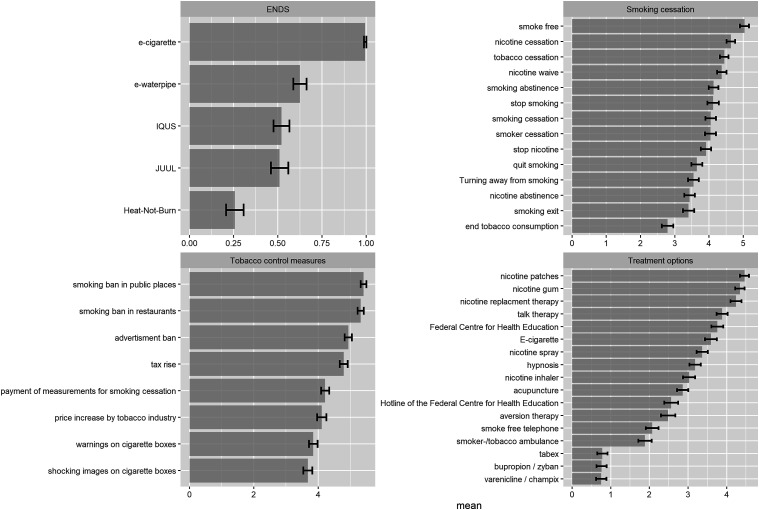
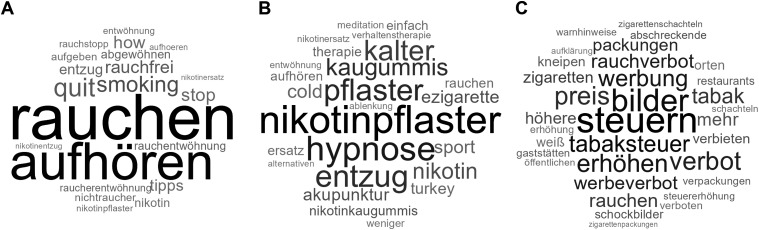
Methods: An interrupted time series analysis was conducted. First, an online survey in Germany determined relevant tobacco control measures and search terms related to the three categories. Participants (n = 487) were ≥18 years old, with German as their first language. Second, the relative search volume (RSV) of Google for Germany regarding the identified search terms was analyzed around the enactment of the determined measures. This data is an anonymized aggregate of all Google users. Autoregressive integrated moving average models were used to estimate the change in RSV.
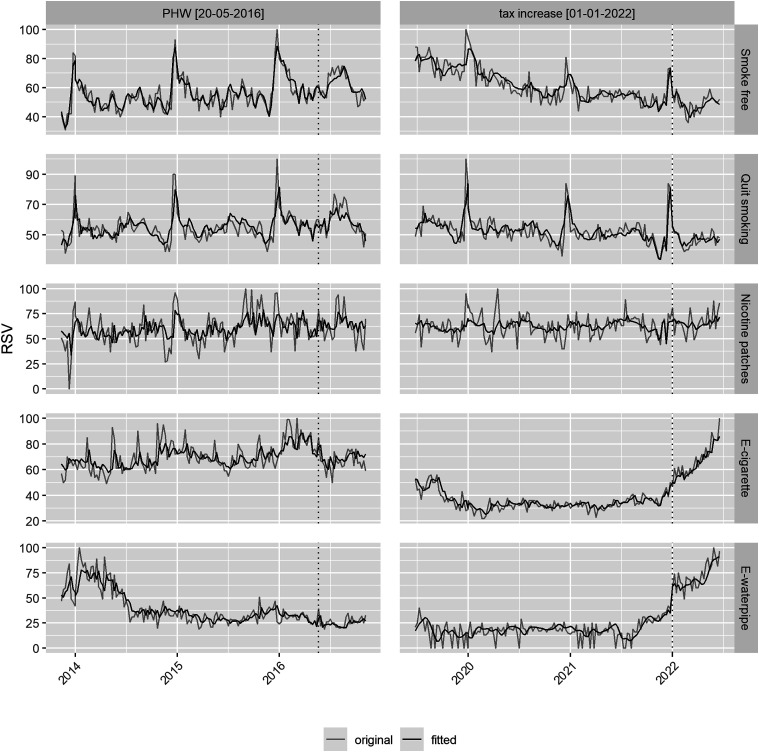
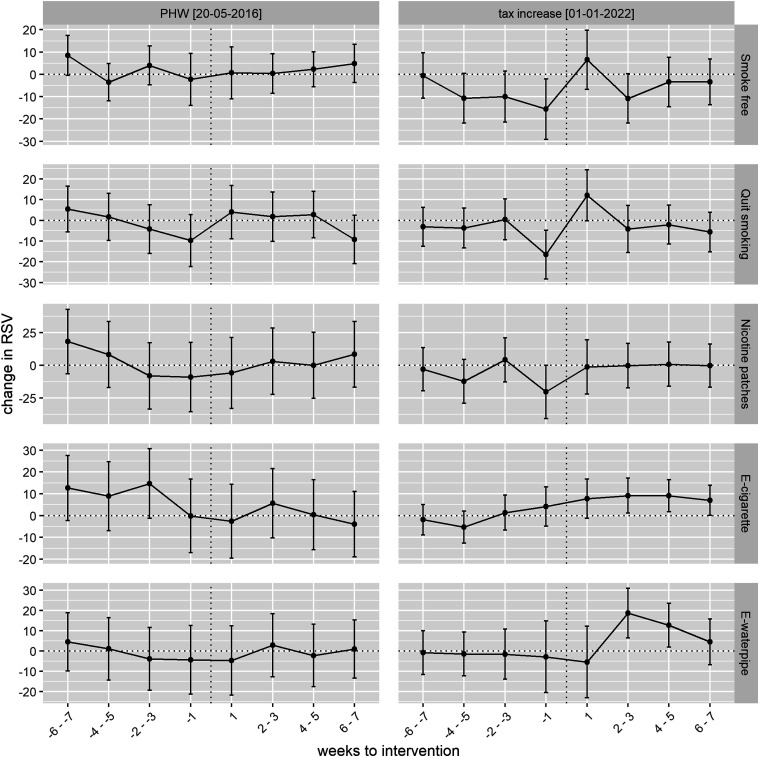
Results: The survey identified tax increases and PHW as the most relevant tobacco control measures among selectable options. The tax increase in 2022 elicited a greater shift in RSV than the implementation of PHW in 2016. Substantial peaks in RSV only occurred following the tax increase, with no significant anticipatory effects. After the tax increase, interest in cessation-related terms seemed to rise (week 1: smoke free 6.53% [95% CI -6.78%-19.84%], quit smoking 12.17% [95% CI -0.15%-24.49%]), alongside a significant rise in searches for ENDS (week 2-3: e-cigarette 9.15% [95% CI 1.12%-17.19%], e-waterpipe 18.7% [95% CI 6.43%-30.96%]).
Conclusion: A tobacco tax increase may lead to increased online interest in ENDS. Policymakers should concurrently educate the public about the harms associated with ENDS and promote evidence-based cessation aids. This may discourage both the initiation of ENDS and their use for smoking cessation while redirecting public interest toward medically recommended alternatives.
Keywords: electronic nicotine delivery systems; public health informatics; smoking cessation; tobacco cessation; tobacco control.
© The Author(s) 2025.
Conflict of interest statement
The authors declared no potential conflicts of interest with respect to the research, authorship, and/or publication of this article.
Figures
References
-
- Tabakatlas Deutschland 2020. Deutsches Krebsforschungszentrum. Published online 2020.
-
- DEBRA study – Deutsche Befragung zum Rauchverhalten | German study on tobacco use. DEBRA study. https://www.debra-study.info/. Accessed October 21, 2024.
-
- Mpower. https://www.who.int/initiatives/mpower. Accessed September 11, 2024.
-
- US National Cancer Institute and World Health Organization . The economics of tobacco and tobacco control. NIH Publication No 16-CA-8029A National Cancer Institute Tobacco Control Monograph 21, Bethesda, MD: US Department of Health and Human Services, National Institutes of Health, National Cancer Institute and Geneva, CH: World Health Organization, 2016. https://cancercontrol.cancer.gov/brp/tcrb/monographs/monograph-21. Accessed February 27, 2025.
LinkOut - more resources
Full Text Sources
