


Association Between Daytime Sleepiness and Quality of Life in Chinese Adolescents: A Moderated Mediation of Cognitive Dysfunction and Depressive Symptoms
- PMID: 40487342
- PMCID: PMC12145147
- DOI: 10.2147/NDT.S524185
Association Between Daytime Sleepiness and Quality of Life in Chinese Adolescents: A Moderated Mediation of Cognitive Dysfunction and Depressive Symptoms
Abstract
Background: Daytime sleepiness is prevalent among Chinese adolescents and has been associated with increased depressive symptoms, impaired cognitive function, and reduced quality of life. However, the interrelationships among these variables remain unclear, particularly regarding whether cognitive function moderates the association between daytime sleepiness and quality of life.
Methods: A large-scale cross-sectional survey was conducted among 52,964 students (grades 7-12) across five geographically diverse regions of China. Data were collected on daytime sleepiness, depressive symptoms, cognitive dysfunction, and quality of life using standardized self-report measures.
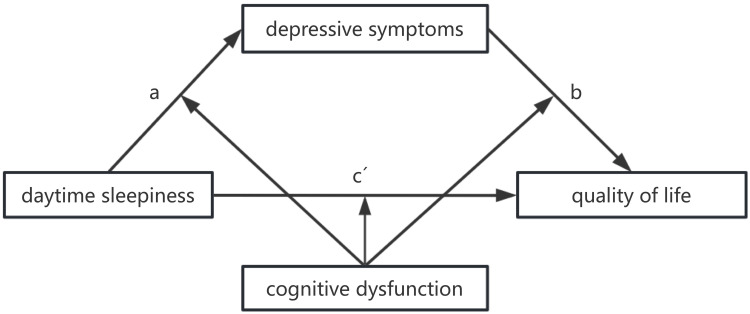
Results: 1) Among the Chinese adolescents, excessive daytime sleepiness (13.87%) and poor quality of life were prevalent. 2) Quality of life was negatively correlated with daytime sleepiness (r = -0.277), depressive symptoms (r = -0.416), and cognitive dysfunction (r = -0.217), all p-values < 0.001. 3) Depressive symptoms played a partially mediating role in the association between daytime sleepiness and quality of life (effect size = -0.232), accounting for 82.86% of the total effect. 4) In the moderated mediation model of daytime sleepiness → depressive symptoms → quality of life, cognitive dysfunction plays a moderating role. Specifically, cognitive dysfunction significantly moderated the association between daytime sleepiness and depressive symptoms (a = 0.100, SE = 0.003, t = 34.618), the association between depressive symptoms and quality of life (b = -0.014, SE = 0.005, t = -2.929), and the direct effect of daytime sleepiness on quality of life (c' = -0.048, SE = 0.005, t = -9.996), all p-values < 0.001.
Conclusion: Depressive symptoms partially mediate the relationship between daytime sleepiness and quality of life, while cognitive dysfunction plays a moderating role in both direct and indirect effects. Improving depressive symptoms and cognitive dysfunction may be potential strategies to mitigate the adverse effects of daytime sleepiness on adolescents' quality of life.
Keywords: adolescents; cognitive dysfunction; daytime sleepiness; depressive symptoms; quality of life.
© 2025 Li et al.
Conflict of interest statement
All authors declare no competing financial interest.
Figures


References
LinkOut - more resources
Full Text Sources
