Review
. 2025 May;15(5):2402-2430.
doi: 10.1016/j.apsb.2025.03.033. Epub 2025 Mar 19.

Inhaled non-viral delivery systems for RNA therapeutics

Affiliations
Review

Inhaled non-viral delivery systems for RNA therapeutics

Cheng Huang et al. Acta Pharm Sin B. 2025 May.

Abstract

RNA-based gene therapy has been widely used for various diseases, and extensive studies have proved that suitable delivery routes greatly help the development of RNA therapeutics. Identifying a safe and effective delivery system is key to realizing RNA therapeutics' clinical translation. Inhalation is a non-invasive pulmonary delivery modality that can enhance the retention of therapeutic agents in the lungs with negligible toxicity, thereby improving patient compliance. Inhaled RNA therapeutics are increasingly becoming an area of focus for researchers; however, only several clinical trials have explored inhaled delivery of RNA for pulmonary diseases. This review presents an overview of recent advances in inhaled delivery systems for RNA therapeutics, including viral and nonviral systems, highlighting state of the art regarding inhalation in the messenger RNA (mRNA) field. We also summarize the applications of mRNA inhalants in infectious and other lung diseases. Simultaneously, the research progresses on small interfering RNAs (siRNAs), antisense oligonucleotides (ASOs), and different types of RNA are also discussed to provide new strategies for developing RNA inhalation therapy. Finally, we clarify the challenges inhaled RNA-based therapeutics face before their widespread adoption and provide insights to help advance this exciting field to the bedside.

Keywords: Inhalation therapy; Lipid nanoparticle; Non-viral vectors; Pulmonary diseases; mRNA.


Conflict of interest statement

The authors have no conflicts of interest to declare.

Figures

Image 1
Graphical abstract
Figure 1
Figure 1
(A) Pulmonary deposition of inhaled particles and their way of separation in healthy lungs. (B) The deposition efficiency of aerosols at different regions of the respiratory tract as a function of aerosol diameter. Reprinted with the permission from Ref. . Copyright © 2021 Elsevier. (C,D) Hypersecreted mucus and pulmonary surfactant that could impede the therapeutic efficacy of RNA. (E) Intracellular barriers such as degradation by lysosomes must be overcome by siRNA in order for it to silence the target mRNA efficiently. Reprinted with the permission from Ref. . Copyright © 2023 Elsevier. (F) At the cellular level, nanocarriers should preferentially accumulate in antigen-presenting cells and efficiently release mRNA within the cytosol.
Figure 2
Figure 2
The expanding universe of therapeutic RNA payloads. (A) The diagram of inhaled RNA therapeutics classification framework. (B–D) One class of RNA therapeutics requires the delivery of small RNA molecules. siRNAs can reduce gene expression via RISC-mediated mRNA degradation, ASOs can alter isoforms by binding to splice sites, and miRNAs exert post-transcriptional gene regulation activity by targeting messenger RNA. Reprinted with the permission from Ref. . Copyright © 2022 Springer Nature. (E) Large RNAs have the potential for functional RNA replacement therapies (iii) as well as vaccines (i) or protein-replacement therapies (ii). Reprinted with the permission from Ref. . Copyright © 2023 Elsevier. (F) After reaching the target organs, nonviral vectors carry CRISPR/Cas mRNA and gRNA across cell membranes via endocytosis pathways. Following the endosomal escape, mRNA-encoded Cas proteins bind with the noncoding gRNA to form RNP. Upon entering the nucleus, RNP induces targeted gene editing. Reprinted with the permission from Ref. . Copyright © 2022 John Wiley and Sons.
Figure 3
Figure 3
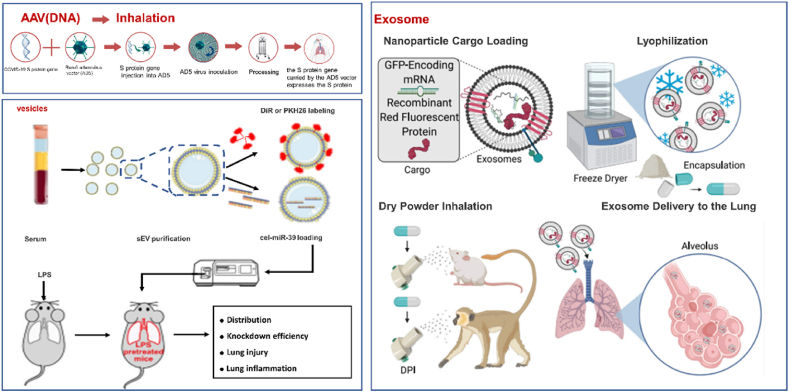
Delivery systems for nucleic acid inhalation, including AAV, extracellular vesicles, Reprinted with the permission from Ref. . Copyright © 2022 Elsevier. And exosomes, Reprinted with the permission from Ref. . Copyright © 2022 Elsevier.
Figure 4
Figure 4
Surveying how five LNP chemical traits influence inhaled mRNA delivery. (A) The spray drying process consists of four main stages. Reprinted with the permission from Ref. . Copyright © 2023 Elsevier. (B) Several factors might influence the prescribing pattern of LNP, such as ionizable and cationic lipids, PEG lipids, helper phospholipids and cholesterol,. (C,D) Excipients and buffer modifications for improved LNP stability and in vivo delivery. (C) Bioluminescence in lungs 6 h after inhaled administration of 0.5 mg firefly luciferase mRNA with different formulations and (D) PEG excipients showing a significant increase over no excipients change in mRNA encapsulation before and after inhalation. Reprinted with the permission from Ref. . Copyright © 2023 Springer Nature. (E) Schematic illustrating the preparation and mechanism of CAS-LNP. Incorporating charged lipids into clinical LNP formulation, the increased electrostatic repulsions among CAS-LNPs enhanced LNP stability during inhalation. Reprinted with the permission from Ref. . Copyright © 2023 Chem Rxiv. This content is a preprint and has not been peer-reviewed. (F) Improved LNP inhaled effect by PEG concentration and cholesterol substitution with β-sitosterol in LNPs. (1) Change in mRNA encapsulation before and after nebulization. (2) CryoTEM image of LNP containing varying amounts of PEG lipids. (3) 3D-SMART results to capture nanoparticle diffusion. Reprinted with the permission from Ref. . Copyright © 2022 American Chemical Society.
Figure 5
Figure 5
Related carriers for inhaled RNA delivery. Among nanoparticles loaded with RNA positively charged delivery carriers are the most commonly used. Positively charged vectors play a crucial role in the delivery of nucleic acid drugs because they wrap the mRNA through electrostatic adsorption between them and the negatively charged nucleic acid. These carriers can be classified in polymer, polycomplex, cationic, and ionizable lipids. Here, we listed representative polymer carriers (DD90-118, P76, 7C1), polycomplex (T704, P–N), cationic lipids (DOTAP, DOTMA, L4), ionizable lipids (CKK-E12, DLin-MC3-DMA, G0-C14, SM102, IR-117-17, IR-19-Py, C12-200). In addition, common auxiliary materials were summarized, including DOPE, DSPC, cholesterol, β-sitosterol, and DMG-PEG-2000. Developing an efficient delivery carrier and optimizing the prescription can be used to realize the efficient inhaled delivery of RNA.
Figure 6
Figure 6
(A) Therapeutic mechanism of mMMP13@RP/P-KGF. After inhaled delivery in a mouse with IPF induced by bleomycin, the mMMP13@RP/P-KGFs deposited in the fibrotic foci were cleaved into KGF and mMMP13@RP/P by overexpressed MMP2 to achieve a synergistic antifibrosis effect based on ECM turnover and re-epithelialization. Reprinted with the permission from Ref. . Copyright © 2022 John Wiley and Sons. (B) Schematic illustration of the preparation and inhalation delivery of dual-targeted mRNA HDPM NPs. (C) IF staining of lung tissues from mice with orthotopic non-small cell lung cancer after inhalation of empty HDPM NPs or firefly luciferase mRNA HDPM NPs. Reprinted with the permission from Ref. . Copyright © 2023 National Academy of Sciences. (D) Inhaled delivery of siRNA-encapsulated PPGC NPs to MLFs for the treatment of IPF. Reprinted with the permission from Ref. . Copyright © 2022 The American Association for the Advancement of Science. (E) Schematic illustration of inhalable siKRAS@GCLPP NPs for suppressing KRAS-mutant NSCLC. Reprinted with the permission from Ref. . Copyright © 2022 American Chemical Society. (F) Miktoarm star NPs self-assemble siRNA into form small, non-toxic nanocomplexes. Reprinted with the permission from Ref. . Copyright © 2022 Elsevier.
Figure 7
Figure 7
(A) SARS-CoV-2 entry into the cell. SARS-CoV-2 binds to ACE2 through spike protein's receptor-binding domain (RBD). Reprinted with the permission from Ref. . Copyright 2020 Spring Nature. (B) mRNA and adenovirus vector vaccines elicit immunity to SARS-CoV-2. Reprinted with the permission from Ref. . Copyright © 2021 Spring Nature. (C–E) Schematic of type I and II mucosal tissues and mucosal tissue IgA distribution. Reprinted with the permission from Ref. . Copyright © 2023 Spring Nature. (F) Model for motile cilia during SARS-CoV-2 entry. (G) Model for SARS-CoV-2 entry, egress, and spread in the nasal airway. (H) SARS-CoV-2 neutralization antibody inhibits attachment of SARS-CoV-2 to cilia. Reprinted with the permission from Ref. . Copyright © 2023 Elsevier.
Figure 8
Figure 8
(A) Current injected COVID-19 vaccines didn't generate immunity in mucosal tissues that line the airways at the site of viral entry. Next-generation inhaled vaccines are being developed to boost such immune responses. Reprinted with the permission from Ref. . Copyright © 2023 Spring Nature. (B) Schematic of S protein mRNA loading into lung-derived exosomes, dry powder formulation, inhaled vaccine delivery doses, antibody production against SARS-CoV-2 spike protein, and pseudoviral challenge. (C) TEM images of S-Exos and S-Lipos at room temperature. (D) ELISA detected an anti-spike IgG antibody titer from murine BALF, and an anti-spike SIgA antibody titer was detected from murine NPLF. (E) Ex vivo images of PBS or pseudovirus in solution (left) and in lungs 24 h after dry powder inhalation (right), and Ex vivo images of S-Exo- or S-Lipo-vaccinated (right) lungs 24 h after pseudoviral challenge. Reprinted with the permission from Ref. . Copyright © 2022 Elsevier. (F) Schematic representation of the fabrication of the RBD-Exo vaccine, which was delivered into the lungs via inhalation. RBD-Exo induced mucosal and systemic immunity by generating RBD-specific IgA and IgG antibodies against SARS-CoV-2 infection in hamsters. (G) ELIS detected RBD-specific SIgA antibody titers from NPLF (left) and BALF (right). (H) Protective effect of the RBD-Exo vaccine in the Syrian hamster model of SARS-CoV-2 infection. Reprinted with the permission from Ref. . Copyright © 2022 Spring Nature.
Figure 9
Figure 9
(A, B) An in vivo workflow to evaluate how chemically diverse LNPs deliver mRNA to the lung after inhalation. PB2 targeted guide selection and influenza A sequence coverage. (C) RNA-fluorescence in situ hybridization analysis for AncNanoLuc mRNA uptake in epithelial cell subtypes. (D) NLD1 carrying AncNanoLuc was administered at a dose of 20 μg per mouse. Protein expression was quantified and imaged over several days. (E) NLD1 treatment regimen for H1N1 study. (F) Survival curves of mice receiving the NLD1 treatments. Reprinted with the permission from Ref. . Copyright © 2021 Spring Nature. (G) Inhalable antiviral Cas13a mRNA in rodent and apparatus for mouse studies. (H) Quantitative Analysis of the total flux. (I) Hamsters were dosed with Cas13a mRNA with guides 20 h before infection with SARS-CoV-2. (J) Lung viral loads from hamsters on Day 6 after infection. Reprinted with the permission from Ref. . Copyright © 2021 Spring Nature.
Figure 10
Figure 10
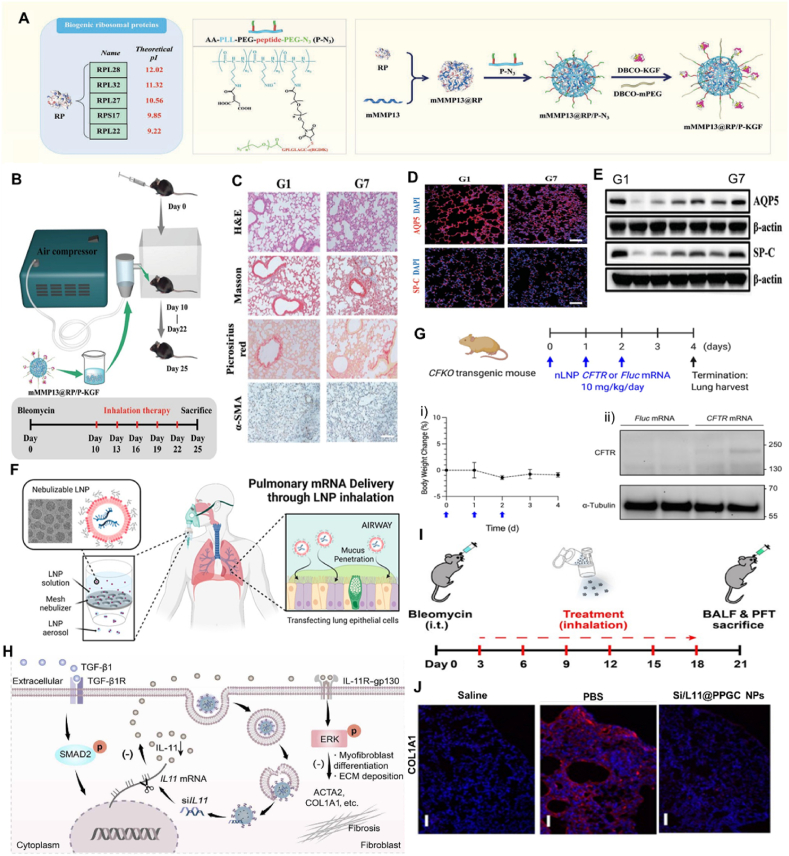
(A) A class of biogenic ribosomal proteins with various theoretical pls and the construction of mMMP13@RP/P-KGF with MMP2-responsive and pH-sensitive abilities. (B) Schematic of the study design. (C) Representative histologic analyses of lung sections. (D,E) Representative immunostaining and Western blot assay of lung sections for determining surfactant protein C and aquaporin 5. Reprinted with the permission from Ref. ,. Copyright © 2022 John Wiley and Sons. (F) Inhaled LNP deliver mRNA encoding CFTR for the treatment of IPF. (G) A dosing regimen for CFTR mRNA delivery via inhalation. (i) Body weight change of CFKO transgenic mice after repeat dosing (blue arrow). (ii) Western blot images after immunoprecipitation using an anti-CFTR antibody. mRNA delivered by inhalation is noted above the images. Upper and lower blots were probed using anti-CFTR and anti-α-tubulin antibodies, respectively. Reprinted with the permission from Ref. . Copyright © 2022 American Chemical Society. (H) Inhaled delivery of siRNA-encapsulated PPGC NPs to MLFs for treating IPF. (I) Experimental design of the animal study. (J) Representative immunofluorescence images of COL1A1 from mouse lung sections treated with indicated treatment. Reprinted with the permission from Ref. . Copyright © 2022 The American Association for the Advancement of Science.
Figure 11
Figure 11
(A) Schematic illustration of AECs-specific delivery of LNP-siTSLP alleviated allergic asthma via pulmonary administration. (B) Deposition of LNP-siRNA in the airway post pulmonary administration. (C) ICAM-1 receptor-mediated endocytosis of Pep-LNP-siTSLP by AECs and the following RNA interfering action. (D) Suppression of the production of T helper 2 cytokines, eosinophils infiltration and mucin over-secretion. (E) Alleviated airway inflammation in allergic asthma. Reprinted with permission from Ref. . Copyright © 2022 Elsevier. (F) Polyplexes made from siRNA complexed with Tf-PEI and Mel-PEI were shown to be specifically taken up by ATCs, facilitating the endosomal release necessary for efficient gene silencing. Dry powders were obtained for pulmonary delivery as a therapeutic option in asthma treatment by spray drying. Reprinted with the permission from Ref. . Copyright © 2022 Wiley Periodicals, Inc.
Figure 12
Figure 12
(A) Schematic showing IL-12 mRNA loading into HEK-Exo (IL-12-Exo) or liposomes (IL-12-Lipo), followed by nebulized inhalation administration to LL/2 tumor-bearing mouse lungs. (B) Schematic showing the establishment of the B16F10 melanoma lung metastatic tumor model and anti-metastatic tumor assessments after mice were administered with different treatments. (C) Representative lung morphologies 21 days after B16F10 tumor inoculation. Black points indicate the metastatic foci. Reprinted with the permission from Ref. . Copyright © 2024, Springer Nature. (D) A vibrating mesh nebulizer connected to a whole-body chamber delivered IVT-mRNA encoding for firefly luciferase to mice. (E) bioluminescence in the lung 24 h after inhaled delivery of mRNA. Reprinted with the permission from Ref. . Copyright © 2019 John Wiley and Sons. (F) Schematic diagram of the aerosol delivery system. (G) Size distribution of let-7b miRNA mimic particles in the exposure chamber. (H) Efficacy of inhaled let-7b miRNA in the B(a)P-induced lung cancer model. Reprinted with the permission from Ref. . Copyright © 2021 John Wiley and Sons. (I) The design of inhaled siKRAS@GCLPP NPs for KRAS-mutant non-small-cell lung cancer NPs includes. (J) Quantitative BLI light intensity of the chest before and after the treatment. Reprinted with the permission from Ref. . Copyright © 2022 American Chemical Society.
Figure 13
Figure 13
(A) Chronic obstructive pulmonary disease (COPD) results in airway inflammation, remodelling, and lung damage. Created with BioRender.com (B) Pharmacological actions of noncoding RNA molecules as potential therapeutics for COPD. Reprinted with the permission from Ref. . Copyright © 2020 Elsevier Science London. (C) The inhaled delivery of RNAi molecules as therapeutics against TB. Reprinted with the permission from Ref. . Copyright © 2023 Elsevier.

References

    1. Cho S.J., Stout-Delgado H.W. Aging and lung disease. Annu Rev Physiol. 2020;82:433–459. - PMC - PubMed
    1. Luppi F., Sebastiani M., Salvarani C., Bendstrup E., Manfredi A. Acute exacerbation of interstitial lung disease associated with rheumatic disease. Nat Rev Rheumatol. 2022;18:85–96. - PubMed
    1. High K.A. Turning genes into medicines-what have we learned from gene therapy drug development in the past decade?. Nat Commun. 2020;11:5821. - PMC - PubMed
    1. Wang Y., Bruggeman K.F., Franks S., Gautam V., Hodgetts S.I., Harvey A.R., et al. Is viral vector gene delivery more effective using biomaterials?. Adv Health Mater. 2021;10 - PubMed
    1. Nikam R.R., Gore K.R. Journey of siRNA: clinical developments and targeted delivery. Nucleic Acid Ther. 2018;28:209–224. - PubMed

LinkOut - more resources