


Iodine intake and status of school-age girls in Ireland
- PMID: 40488891
- PMCID: PMC12148989
- DOI: 10.1007/s00394-025-03731-9
Iodine intake and status of school-age girls in Ireland
Abstract
Purpose: Insufficient iodine intake can lead to a variety of preventable health and developmental outcomes. Consequently, continuous monitoring of a population's iodine adequacy is important. The aim of this study was to examine iodine intake and status in a nationally representative sample of school-age girls living in Ireland.
Methods: Analyses were based on 516 schoolgirls aged 5-18 years from the cross-sectional National Children's Food Survey II (2017-2018) and the National Teens' Food Survey II (2019-2020). Dietary data were collected using a four-day weighed food diary. Adequacy of iodine intake and the contribution of food categories to overall dietary iodine intake was assessed. Urinary iodine concentration (UIC) was measured using a spot urine sample using the Sandell-Kolthoff reaction by a modified microplate method.
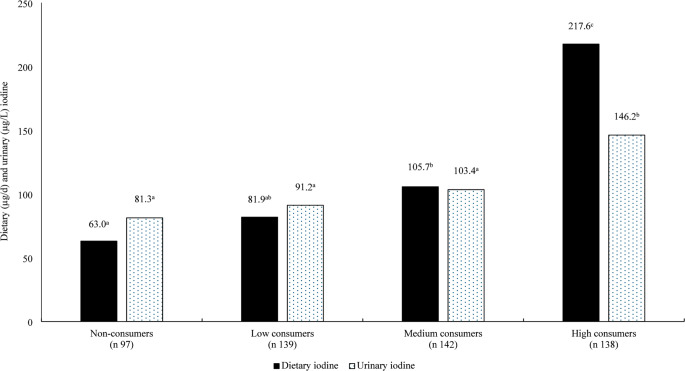
Results: Median iodine intake was 94.8 µg/d (IQR 54.9-155.5 µg/d), with 40% of girls having intakes below the estimated average requirement (EAR). The median UIC was 87.8 µg/L, with younger girls having a significantly higher UIC compared to older girls (104.4 µg/L - 77.0 µg/L respectively; p < 0.001). The main dietary source was milk, contributing to over 50% of iodine intake, with non-consumers of milk having significantly lower dietary and urinary iodine levels compared to high consumers (p < 0.001).
Conclusion: This study suggests that school aged girls living in Ireland have mild iodine deficiency and given the concerns associated with such deficiencies and their potential public health implications, it is essential that iodine status in other population groups in Ireland is ascertained. The need for targeted public health strategies to eradicate iodine deficiency may be warranted.
Keywords: Children; Females; Iodine; Ireland; Teenagers.
© 2025. The Author(s).
Conflict of interest statement
Declarations. Ethical approval: All human studies have been approved by the appropriate ethics committee and have therefore been performed in accordance with the ethical standards laid down in the 1964 Declaration of Helsinki and its later amendments. Conflict of interest: On behalf of all authors, the corresponding author states that there is no conflict of interest.
Figures
References
-
- WHO, UNICEF and ICCIDD (2007) Assessment of iodine deficiency disorders and monitoring their elimination. WHO, Geneva. https://iris.who.int/handle/10665/43781
-
- Stanbury JB, Ermans AE, Bourdoux P, Todd C, Oken E, Tonglet R et al (1998) Iodine-induced hyperthyroidism: occurrence and epidemiology. Thyroid 8(1):83–100. 10.1089/thy.1998.8.83 - PubMed
-
- Martinez AH, Perez EJ (2012) Iodine: characteristics, sources, and health implications. Nova Biomedical Books, New York
MeSH terms
Substances
LinkOut - more resources
Full Text Sources
