


Functional outcomes and quality of life after intersphincteric resection with transverse coloplasty pouch anastomosis for ultralow rectal cancer: a prospective cohort study
- PMID: 40488963
- PMCID: PMC12148994
- DOI: 10.1007/s10151-025-03174-8
Functional outcomes and quality of life after intersphincteric resection with transverse coloplasty pouch anastomosis for ultralow rectal cancer: a prospective cohort study
Abstract
Background: Functional outcomes and quality of life (QoL) of transverse coloplasty pouch (TCP) in intersphincteric resection (ISR) for ultralow rectal cancer remain poorly understood.
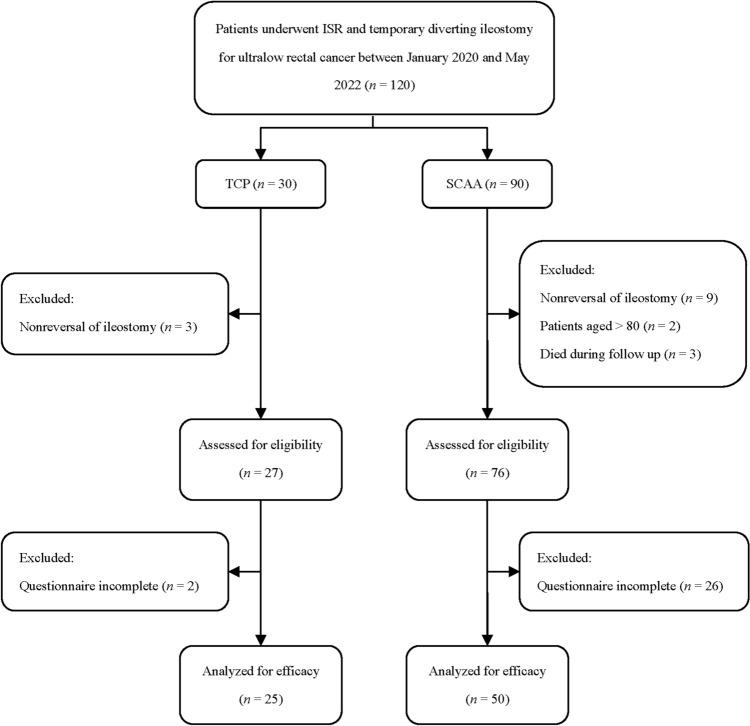
Methods: A prospective analysis was conducted on patients who received ISR treatment from January 2020 to May 2022. Patients were divided into TCP and straight coloanal anastomosis (SCAA) groups. Comparisons were made for low anterior resection syndrome (LARS) score, Wexner incontinence score (WIS), Kirwan's incontinence score, visual analog scale (VAS), and fecal incontinence quality of life (FIQL) questionnaire at 3, 6, and 12 months post ileostomy closure. Additionally, anorectal manometry outcomes were compared pre ileostomy closure.
Results: A total of 75 patients were included, with 25 in the TCP group and 50 in the SCAA group. At 3, 6, 12 months post ileostomy closure, the TCP group showed significantly lower LARS (31, 30, 28; p = 0.033, 0.044, 0.019, respectively), WIS (11.04, 9.92, 7.32; p = 0.025, 0.043, 0.007, respectively), and Kirwan's incontinence scores (p = 0.044, 0.033, 0.022). Additionally, the TCP group showed higher VAS (5, 6, 7; p = 0.004, 0.006, 0.005, respectively) and FIQL summary scores (2.67, 2.79, 2.86; p = 0.001, 0.002, 0.004, respectively). Prior to ileostomy closure, the rectal first sensation and maximum tolerance volumes were significantly higher in the TCP group compared to the SCAA group (22 ml vs. 20 ml, 51.56 ml vs. 34.52 ml; p = 0.019, 0.038, respectively). There were no significant differences in postoperative complications or recurrence rates between the groups.
Conclusions: TCP is a safe technique, which may improve bowel function and QoL in ISR patients with low rectal cancer within 1 year.
Keywords: Functional outcomes; Intersphincteric resection; Quality of life; Transverse coloplasty pouch; Ultralow rectal cancer.
© 2025. The Author(s).
Conflict of interest statement
Declarations. Conflict of interest: The authors declare that they have no conflict of interest. Ethics approval: This study has been approved by our institutional ethics committee. The procedures used in this study adhere to the tenets of the Declaration of Helsinki. Informed consent: Informed consent was obtained from all individual participants included in the study.
Figures
References
-
- Tsukamoto S, Miyake M, Shida D, Ochiai H, Yamada K, Kanemitsu Y (2018) Intersphincteric resection has similar long-term oncologic outcomes compared with abdominoperineal resection for low rectal cancer without preoperative therapy: results of propensity score analyses. Dis Colon Rectum 61:1035–1042. 10.1097/dcr.0000000000001155 - DOI - PubMed
MeSH terms
Grants and funding
LinkOut - more resources
Full Text Sources
