


Exploring the Subcellular Localization and Degradation of Spherical Nucleic Acids Using Fluorescence Lifetime Imaging Microscopy
- PMID: 40489247
- PMCID: PMC12203632
- DOI: 10.1021/acsnano.5c00177
Exploring the Subcellular Localization and Degradation of Spherical Nucleic Acids Using Fluorescence Lifetime Imaging Microscopy
Abstract
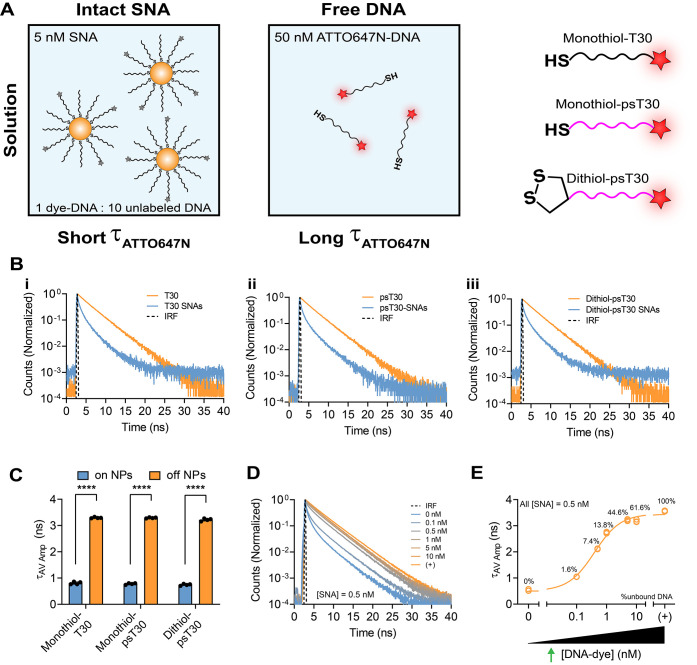
Spherical nucleic acids (SNAs) are a powerful class of nucleic acids with broad applications that span from diagnostic sensors to nanoflares and gene therapeutic agents. SNAs accomplish these varied tasks by taking advantage of the programmability of nucleic acids coupled with enhanced multivalent interactions and improved cellular delivery. Nonetheless, the intracellular trafficking of SNAs remains poorly understood, as conflicting claims in the literature suggest rapid endosomal entrapment and degradation in some cases, while others suggest SNA stability and cytoplasmic escape. One of the challenges in this area is that some of the prior literature claims rely on intensity-based fluorescence measurements, which are indirect and prone to artifacts. Here, we demonstrate the use of fluorescence lifetime imaging microscopy (FLIM) as a tool to provide additional insight into the SNA intracellular fate. We specifically employ FLIM to investigate monothiol and dithiol anchored gold nanoparticle conjugates as well as phosphorothioate backbone-modified SNAs which allow us to characterize the initial stages of SNA degradation within cells. Our work shows that internalized SNAs lose up to 20% of their nucleic acids within 24 h depending on DNase II-activity and thiol-displacement in model cell lines.
Keywords: endocytosis; endosomal entrapment; fluorescence lifetime imaging microscopy (FLIM); nanoparticles; nucleic acids; spherical nucleic acids.
Figures



References
MeSH terms
Substances
Grants and funding
LinkOut - more resources
Full Text Sources
Research Materials
