


Association of kyphosis index with decreased physical function and cognitive domain in community-dwelling older adults: a cross-sectional study
- PMID: 40490692
- PMCID: PMC12147278
- DOI: 10.1186/s12877-025-06098-y
Association of kyphosis index with decreased physical function and cognitive domain in community-dwelling older adults: a cross-sectional study
Abstract
Background: Cognitive and physical function both typically decline with age. Kyphosis is backward curvature of the spine that is especially commonly seen in older adults. This study seeks to clarify the suspected relationship between kyphosis posture and cognitive function in community-dwelling older adults.
Methods: This cross-sectional study included 301 community-dwelling individuals aged ≥ 60 years in Japan. The kyphosis index (KI) was determined according to a previously-reported method, cognitive function was evaluated using ACE-III, and physical functions were measured by handgrip strength, gait speed, and 2-step test. Multiple linear regression analysis was applied to identify factors affecting the KI, and we used a simple mediation analysis to clarify factors mediating the relationship between the KI and cognitive function using PROCESS Macro- Model 4 for SPSS and bootstrap method. Indirect effects were tested using bootstrapped confidence intervals (CI).
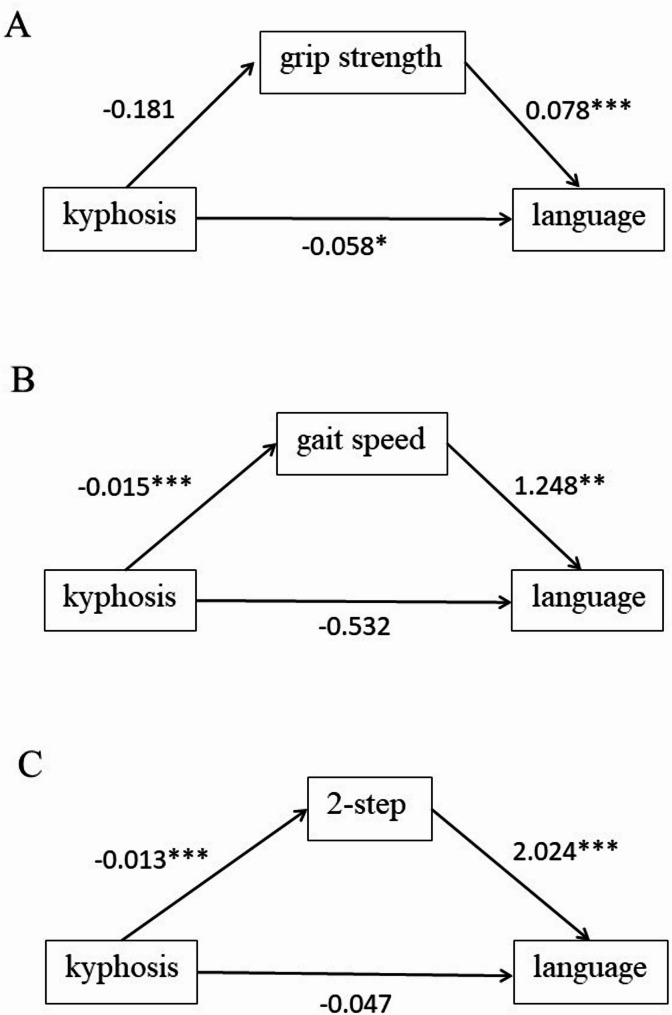
Results: In multiple linear regression analysis, gait speed (β = -0.188, p = 0.0007), 2-step value (β = -0.227, p < 0.0001) and language domain score (β = -0.136, p = 0.0160) were significantly associated with KI after adjustment for sex, age, education, body mass index and osteoporosis. Mediation analysis revealed a relationship between KI and language score; gait speed (indirect effect: −0.019, 95% CI: −0.039 to − 0.005) and 2-step value (indirect effect: −0.026, 95% CI: −0.051 to − 0.007) in complete mediation and grip strength (indirect effect: −0.014, 95% CI: −0.036 to − 0.001) in partial mediation.
Conclusions: This study highlights worsening of kyphosis results to be related to decline in language ability by physical function.
Trial registration: Not applicable.
Supplementary Information: The online version contains supplementary material available at 10.1186/s12877-025-06098-y.
Keywords: Cognitive function; Kyphosis index; Older adults; Physical function.
Conflict of interest statement
Declarations. Ethics approval and consent to participate: All subjects gave written informed consent to the use of their data in the study. The study protocol was approved by the Osaka Kawasaki Rehabilitation University Ethics Committee (Reference No. OKRU-RA0081). This study was performed in accordance with the Declaration of Helsinki. Consent for publication: Not applicable. Competing interests: The authors declare no competing interests.
Figures
References
-
- Peel NM, Alapatt LJ, Jones LV, Hubbard RE. The association between gait speed and cognitive status in community-dwelling older people: a systematic review and meta-analysis. J Gerontol Gerontol Biol Sci Med Sci. 2019;74(6):943–8. 10.1093/gerona/gly140 - PubMed
-
- Montero-Odasso M, Hachinski V. Preludes to brain failure: executive dysfunction and gait disturbances. Neurol Sci. 2014;35(4):601–4. 10.1007/s10072-013-1613-4 - PubMed
-
- Schlaich C, Minne HW, Bruckner T, Wagner G, Gebest HJ, Grunze M, et al. Reduced pulmonary function in patients with spinal osteoporotic fracture. Osteoporos Int. 1998;8(3):261–7. 10.1007/s001980050063 - PubMed
Grants and funding
LinkOut - more resources
Full Text Sources
Miscellaneous
