. 2025 Apr 10;8(2):145-156.
doi: 10.1093/abt/tbaf006. eCollection 2025 Apr.

Preclinical development of mecbotamab vedotin (BA3011), a novel, AXL-specific conditional active biologic antibody-drug conjugate

Affiliations

Preclinical development of mecbotamab vedotin (BA3011), a novel, AXL-specific conditional active biologic antibody-drug conjugate

Hwai Wen Chang et al. Antib Ther. .

Abstract

Background: AXL, a tyrosine kinase receptor, is over-expressed in many solid and hematologic cancers, promoting progression and poor clinical outcomes. It also contributes to resistance against chemotherapeutic agents, especially tyrosine kinase inhibitors, by upregulating AXL signaling or switching oncogenic pathways. These factors make AXL an attractive therapeutic target. However, early attempts with naked antibody therapies failed due to the high doses need for efficacy, and antibody-drug conjugates (ADCs) targeting AXL were hindered by off-tumor toxicities due to its expression on normal tissues.

Methods: To address these issues, we developed a novel, conditionally active biologic ADC, mecbotamab vedotin (BA3011), which selectively binds to AXL in the acidic tumor microenvironment. In healthy tissue, binding to AXL is substantially diminished due to a powerful selection mechanism utilizing naturally occurring, physiological chemicals referred to as Protein-associated Chemical Switches. BA3011 was tested in vitro and in vivo against AXL expressing cancer cells.

Results: Mecbotamab vedotin demonstrates the expected AXL, tumor-specific binding properties and effectively induced lysis of AXL-positive cancer cell lines in vitro. In vivo, mecbotamab vedotin exhibited potent and lasting antitumor effects in human cancer xenograft mouse models. Furthermore, in nonhuman primates, mecbotamab vedotin demonstrated excellent tolerability at doses of up to 5 mg/kg and maintained linker-payload stability in vivo.

Conclusions: These findings indicate that mecbotamab vedotin has the potential to be a robust and less toxic therapeutic agent, offering promise as a treatment for patients with AXL-positive cancers.

Keywords: AXL; antibody–drug conjugate; conditional active biologic; mecbotamab; tumor microenvironment.


Conflict of interest statement

All authors are shareholders of BioAtla Inc., which owns intellectual property rights to CABs- and PaCS-related technology. H.W.C., G.F., and J.M.S. are inventors of relevant patents. J.M.S. serves as a Director of BioAtla.

Figures

Figure 1
Figure 1
In vitro characterization of BA3011. (A) pH affinity ELISA. Binding of BA3011 to human AXL at pH 6.0 (filled circles) and pH 7.4 (open circles) was determined by ELISA with a series of antibody concentrations as indicated. (B) pH range ELISA. Binding of BA3011 to human AXL at different pH values as indicated in the graph was determined by ELISA. The pH inflection point (50% binding activity compared to pH 6.0) was at pH 6.6. (C) Cross species ELISA. Binding of BA3011 to human (circles), cynomolgus (squares), mouse (diamonds), and rat (triangles) AXL at pH 6.0 (filled symbols) and pH 7.4 (open symbols) was determined by ELISA. (D) Specificity evaluation. Binding specificity of BA3011 at pH6.0 (filled bars) and pH7.4 (open bars) to AXL (bottom panel) was tested by flow cytometry using CHO cells transfected with human TYRO3 (top panel) or to HEK293 cells transfected with human MER (middle panel) To confirm TYRO3 and MER expression, cells were stained with TYRO3- or MER-specific antibodies. B12-MMAE was used as isotype control.
Figure 2
Figure 2
Binding of BA3011 to cell-surface expressed AXL analyzed by flow cytometry. (A) Concentration-dependent binding of BA3011 to human (top left panel) or cynomolgus AXL (top right panel) expressed on the surface of 293-F cells and cancer cell lines DU145 (bottom left panel) and LCLC103H (bottom right at pH 6.0 (solid line) and pH 7.4 (dashed line). (B) The table shows the EC50 values at pH6.0 calculated from the binding curves shown in (A). No meaningful EC50 could be calculated at pH 7.4.
Figure 3
Figure 3
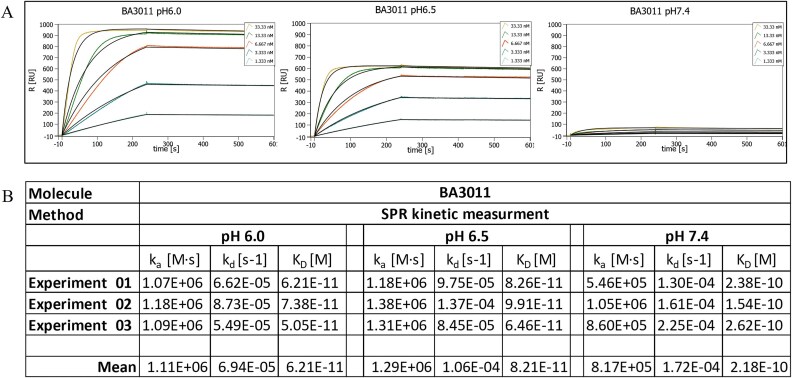
BA3011 binding kinetics to human AXL at the indicated pH value measured by SPR. (A) Representative sensorgrams for pH 6.0 (left), pH 6.5 (middle), and pH 7.4 (right). (B) Calculated binding kinetics of BA3011 to human AXL based on 3 independent experiments.
Figure 4
Figure 4
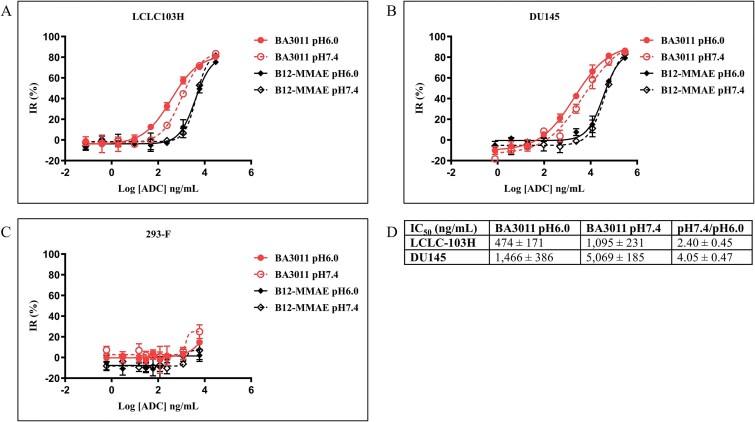
BA3011 in vitro cytotoxicity assay. BA3011 in vitro cell killing of LCLC103H cells (A), DU145 cells (B), or AXL-negative 293-F cells (C) at pH 6.0 (solid lines) and pH 7.4 (dashed lines). Ctrl: B12-MMAE. (D) IC50 values calculated from the inhibition curves from three independent experiments.
Figure 5
Figure 5
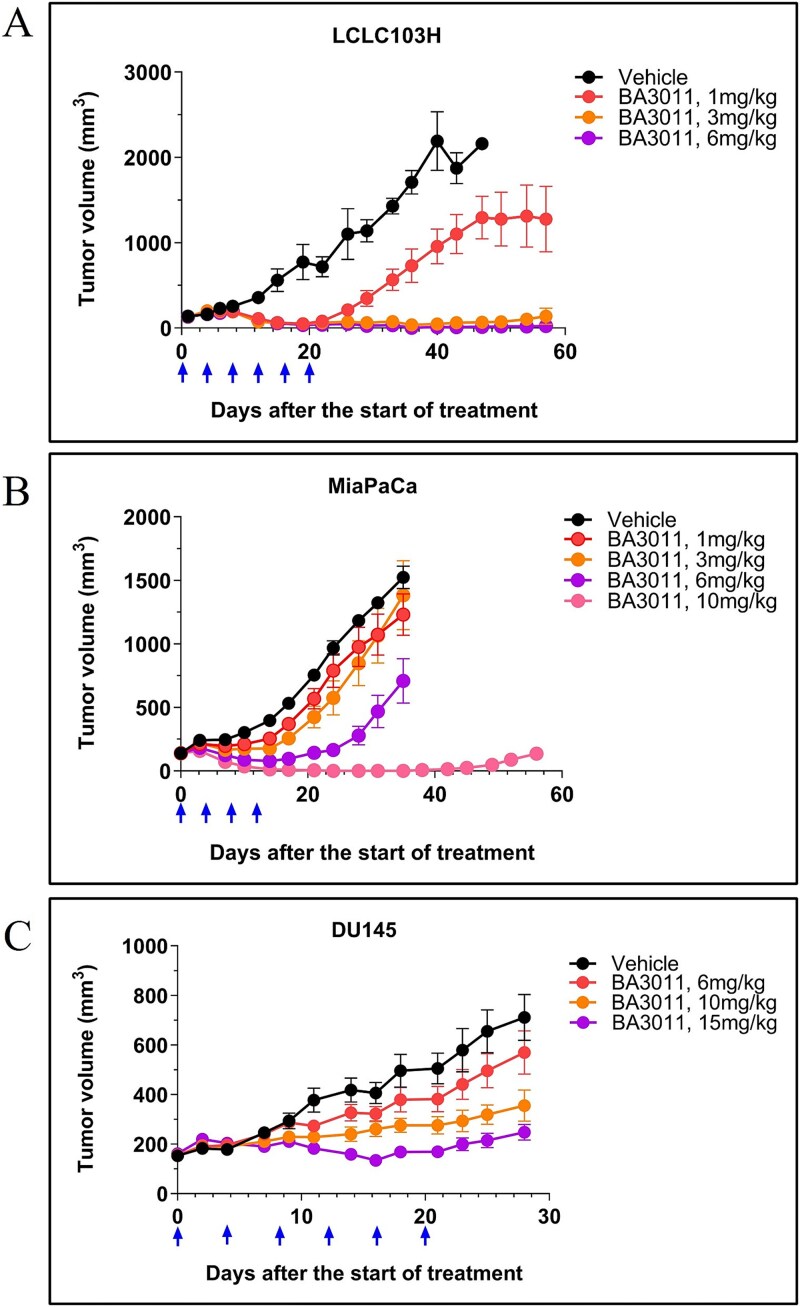
In vivo cytotoxicity of BA3011. Cytotoxicity of BA3011 was tested in several cell-line derived tumor models in mice: (A) LCLC103H (lung cancer); (B) MiaPaCa (pancreatic cancer), and (C) DU145 (prostate cancer). Animals were dosed every 4 days (arrows) intravenously with BA3011 or buffer only (vehicle) at the concentrations indicated in the graph.
Figure 6
Figure 6
Pharmacokinetic and toxicokinetic analysis of BA3011 in NHPs. (A) PK analysis for a single dose of BA3011 in cynomolgus monkeys. Plasma concentrations of total ADC, total antibody, and free MMAE in the serum of cynomolgus monkeys after a single dose of 3 mg/kg BA3011 (A) or repeat dosing on day 1 and day 22 with 1, 5, or 10 mg/kg (C) were determined at different times post dosing. TK parameters for single dose are summarized in (B) and for repeat dosing in (D).

References

    1. Aguilera TA, Giaccia AJ. Molecular pathways: oncologic pathways and their role in T-cell exclusion and immune evasion-a new role for the AXL receptor tyrosine kinase. Clin Cancer Res 2017;23:2928–33. 10.1158/1078-0432.CCR-17-0189. - DOI - PMC - PubMed
    1. Gjerdrum C, Tiron C, Hoiby T. et al. Axl is an essential epithelial-to-mesenchymal transition-induced regulator of breast cancer metastasis and patient survival. Proc Natl Acad Sci U S A 2010;107:1124–9. 10.1073/pnas.0909333107. - DOI - PMC - PubMed
    1. Axelrod H, Pienta KJ. Axl as a mediator of cellular growth and survival. Oncotarget 2014;5:8818–52. 10.18632/oncotarget.2422. - DOI - PMC - PubMed
    1. Paccez JD, Vogelsang M, Parker MI. et al. The receptor tyrosine kinase Axl in cancer: biological functions and therapeutic implications. Int J Cancer 2014;134:1024–33. 10.1002/ijc.28246. - DOI - PubMed
    1. Lemke G. Biology of the TAM receptors. Cold Spring Harb Perspect Biol 2013;5:a009076. 10.1101/cshperspect.a009076. - DOI - PMC - PubMed

LinkOut - more resources