


Individual and collective positive health behaviors and academic achievement among U.S. undergraduate students
- PMID: 40498749
- PMCID: PMC12157305
- DOI: 10.1371/journal.pone.0323610
Individual and collective positive health behaviors and academic achievement among U.S. undergraduate students
Abstract
Background: Behaviors associated with chronic disease can become habituated during young adulthood and may influence students' academic achievement, affecting their future health and economic prospects. However, more research is needed to understand this relationship. This study therefore examined the connection, both individually and collectively, between undergraduate students' chronic disease prevention behaviors and academic performance.
Methods: We examined the relationship between 14 positive health behaviors related to diet, physical activity, sedentary screen time, and tobacco product use and cumulative grade point average (GPA; A, B, C, D/F) using the Spring 2023 American College Health Association-National College Health Assessment III (N = 50,792 students; N = 125 institutions). Log binomial regressions produced adjusted prevalence ratios for performing each health behavior based on GPA, controlling for year in school, sex/gender, race/ethnicity, and BMI. A composite health index was also calculated, and multivariate negative binomial regression examined the health index score by GPA category.
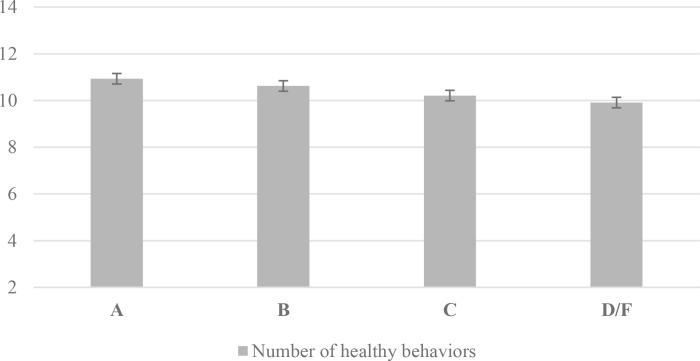
Results: Analyses found that A and B GPA categories were significantly different than D/F for all dietary behaviors, all physical activity behaviors, watching TV and gaming, and using vaping products. Students with a higher GPA had significantly more positive health behaviors based on the composite index than each proceeding GPA group.
Conclusions: This study found a relationship between students' academic achievement and engagement in positive behaviors that prevent or mitigate chronic disease and is the first to examine college students' health behaviors cumulatively. Initiatives that support college student well-being may benefit students' academic success as well as reduce chronic disease risk.
Copyright: © 2025 Lederer et al. This is an open access article distributed under the terms of the Creative Commons Attribution License, which permits unrestricted use, distribution, and reproduction in any medium, provided the original author and source are credited.
Conflict of interest statement
The authors have declared no competing interests.
Figures
References
-
- Lederer AM, Oswalt SB. The value of college health promotion: a critical population and setting for improving the public’s health. American Journal of Health Education. 2017;48(4):215–8. doi: 10.1080/19325037.2017.1316692 - DOI
-
- Centers for Disease Control and Prevention. Health and academics. 2022. Available from: https://www.cdc.gov/healthyyouth/health_and_academics/index.htm
MeSH terms
LinkOut - more resources
Full Text Sources
Miscellaneous
