. 2025 Jun 11;11(1):63.
doi: 10.1038/s41540-025-00544-8.

QSP modeling of loncastuximab tesirine with T-cell-dependent bispecific antibodies guides dose-regimen strategy

Affiliations

QSP modeling of loncastuximab tesirine with T-cell-dependent bispecific antibodies guides dose-regimen strategy

Yuezhe Li et al. NPJ Syst Biol Appl. .

Abstract

Antibody-drug conjugates (ADCs) and T-cell-dependent bispecific antibodies (TDBs) show single-agent efficacy in relapsed/refractory (R/R) lymphomas. While coadministering therapeutics with orthogonal mechanisms of action may safely enhance efficacy, testing every potential combination regimen is infeasible in the clinic. An integrated quantitative systems pharmacology model of a CD19-targeted ADC and CD3/CD20-targeted TDBs was developed to predict combination regimen efficacy in R/R diffuse large B-cell lymphoma (DLBCL). Clinically validated models of the ADC loncastuximab tesirine and TDB mosunetuzumab were combined and extended to additional TDBs (glofitamab and epcoritamab). Virtual DLBCL populations were calibrated using monotherapy response data, and tumor volume dynamics simulated under alternate combination dosing regimens and patient scenarios. Additive antitumor effects were predicted from the fourth cycle onward, with combination efficacy insensitive to loncastuximab tesirine dose reductions or patient lymphopenias. Results of the LOTIS-7 study (NCT04970901) will soon be available to assess these predictions.


Conflict of interest statement

Competing interests: Y.L., A.K.W., J.D., T.K., and D.C.K. are employees of Metrum Research Group. M.T. is an employee and current equity holder at ADC Therapeutics. J.B. is an equity holder at ADC Therapeutics and was employed at ADC Therapeutics when the study was conducted.

Figures
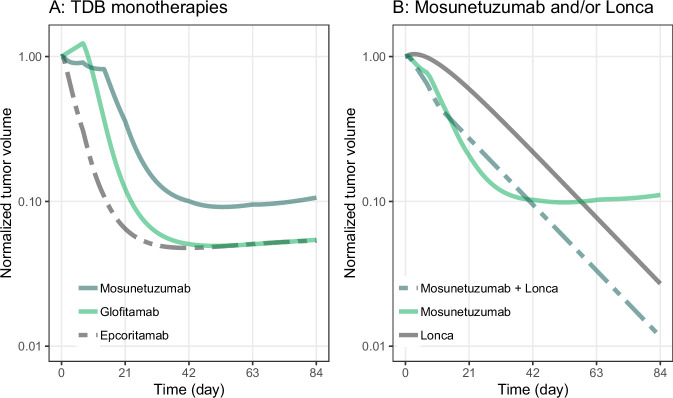
Fig. 1
Fig. 1. Tumor dynamic responses to TDB monotherapies and mosunetuzumab + loncastuximab tesirine combination therapy in a prototypic patient.
A Comparison of tumor dynamics between TDB monotherapies. The TDB monotherapies were dosed following their corresponding labels. B Comparison of tumor dynamics between mosunetuzumab monotherapy, loncastuximab tesirine monotherapy, and mosunetuzumab + loncastuximab tesirine combination therapy, following the dosing scheme proposed in the LOTIS-7 study as described in the Methods, with the first 2 loncastuximab tesirine doses at 150 µg/kg. For both simulations, the tumor was composed of CD19+CD20+ B cells and had an initial volume of 49.5 mL, with a doubling time of 23 days. Lonca loncastuximab tesirine, TDB T-cell-dependent bispecific antibody.
Fig. 2
Fig. 2. Virtual population responses to TDB and loncastuximab tesirine combinations following 2 cycles of therapy (Day 42).
Combination indices (CI) were computed 37 to quantify the degree of non-additive effects resulting from the combinations (CI > 1 indicates synergy). (+/−) indicates presence/absence of loncastuximab tesirine. Dashed line: separation between nonresponders and responders. Tumor response classification based on ref. . TDB T-cell-dependent bispecific antibody, CI combination index.
Fig. 3
Fig. 3. Virtual population responses to TDB and loncastuximab tesirine combination therapy by cycle and loncastuximab tesirine dosing regimen.
Dashed line: separation between nonresponders and responders. Tumor response classification based on ref. . Lonca loncastuximab tesirine, TDB T-cell-dependent bispecific antibody.
Fig. 4
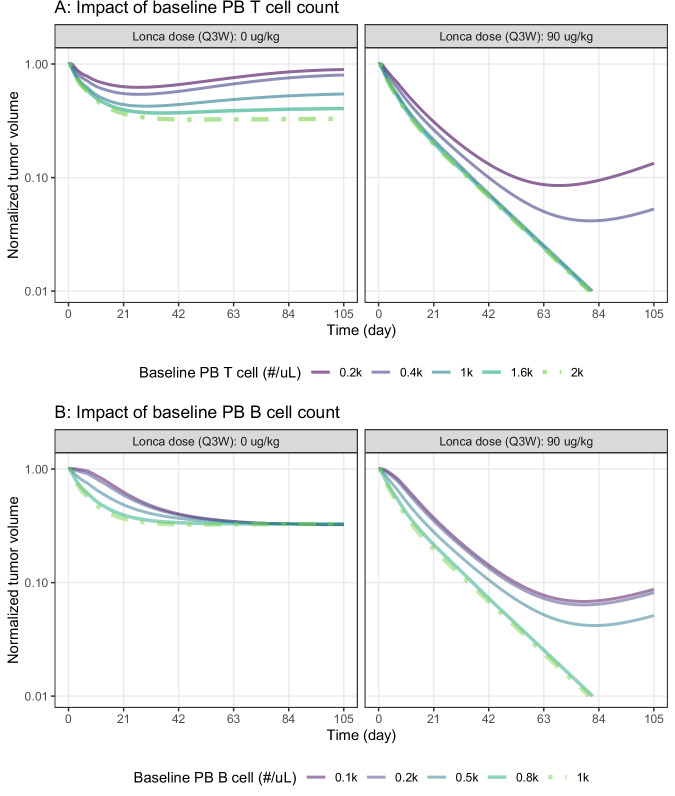
Fig. 4. Sensitivity of TDB (epcoritamab) and TDB + loncastuximab tesirine tumor responses to differences in initial circulating T-cell and B-cell counts.
Default healthy baseline T-cell counts (A) were set at 2000 cells/uL, and default baseline B-cell counts (B) at 1000 cells/uL. The loncastuximab tesirine dose was set to be either 0 µg/kg or 90 µg/kg Q3W, with the epcoritamab dose following as described in the Methods. The tumor was assumed to have an initial volume of 7.5 mL with 80% CD19+CD20+ tumor B cells and 20% CD19-CD20+ cells. Lonca loncastuximab tesirine-lpyl, PB peripheral blood, Q3W, every 3 weeks, TDB T-cell-dependent bispecific antibody.
Fig. 5
Fig. 5. Schematic diagrams for the TDB + loncastuximab tesirine combination therapy model.
A compartmental PK diagram. The PK model includes three compartments: a central compartment (i.e., peripheral blood), a peripheral tissue compartment to account for drug distribution, and a deposit compartment to account for subcutaneous injection. B Tumor B-cell and T-cell dynamics in the presence of TDB and loncastuximab tesirine. T cells in the tumor cycle through resting state, activated state, and postactivated state (exhausted state), and may die at any state. Only activated T cells proliferate and induce both healthy and cancerous B-cell death. All T cells could enter or leave the tumor from/the bloodstream. Loncastuximab tesirine could also induce the death of tumor B cells. Tumor cells killed by loncastuximab tesirine transition to a dying stage before being removed from the tumor. Lonca loncastuximab tesirine, PK pharmacokinetic, TDB T-cell-dependent bispecific antibody. Created in BioRender. Li, Y. (2025) https://BioRender.com/nmbj785.

References

    1. Scott, E. C. et al. Trends in the approval of cancer therapies by the FDA in the twenty-first century. Nat. Rev. Drug Discov.22, 625–640 (2023). - PubMed
    1. Tang, L., Huang, Z., Mei, H. & Hu, Y. Immunotherapy in hematologic malignancies: achievements, challenges and future prospects. Signal Transduct. Target. Ther.8, 306 (2023). - PMC - PubMed
    1. Dotan, E., Aggarwal, C. & Smith, M. R. Impact of rituximab (Rituxan) on the treatment of B-cell non-Hodgkin’s lymphoma. P T35, 148–157 (2010). - PMC - PubMed
    1. Meng, F., Zhong, D., Zhang, L., Shao, Y. & Ma, Q. Efficacy and safety of rituximab combined with chemotherapy in the treatment of diffuse large B-cell lymphoma: a meta-analysis. Int. J. Clin. Exp. Med.8, 17515–17522 (2015). - PMC - PubMed
    1. Song, F. et al. Safety and efficacy of autologous and allogeneic humanized CD19-targeted CAR-T cell therapy for patients with relapsed/refractory B-ALL. J. Immunother. Cancer11, e005701 (2023). - PMC - PubMed

MeSH terms

LinkOut - more resources