


This is a preprint.
A novel Notch and WNT signaling mechanism contribute to paediatric DCM: a pathway to new therapeutics
- PMID: 40501561
- PMCID: PMC12157673
- DOI: 10.1101/2025.06.07.658396
A novel Notch and WNT signaling mechanism contribute to paediatric DCM: a pathway to new therapeutics
Abstract
Background: Paediatric Idiopathic dilated cardiomyopathy (iDCM) is a life-threatening disease. The lack of disease-specific animal models limits our understanding of its mechanisms. We previously demonstrated that paediatric iDCM serum-circulating proteins promote pathologic remodeling in vitro, and that secreted frizzled related protein 1 (sFRP1) increases stiffness in cardiomyocytes. Here we investigated the mechanisms by which sFRP1 contributes to iDCM.
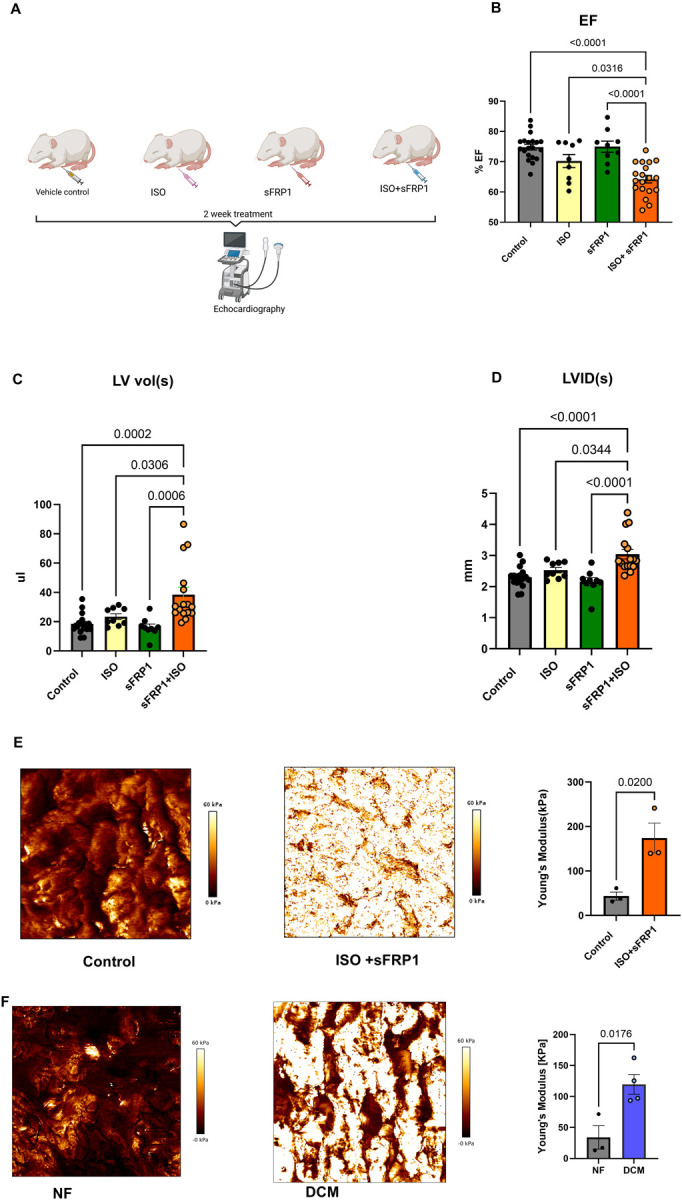
Methods: The effect of sFRP1 in combination with isoproterenol (ISO) (to recapitulate the increase in circulating catecholamine observed in paediatric iDCM) was evaluated in neonatal rat ventricular myocytes (in vitro), and in neonatal rats through intraperitoneal injections (in vivo). Function and molecular mechanisms were investigated through echocardiography and next-generation-sequencing. Protein levels and localization were determined by Western blot. Tissue stiffness was measured by Atomic Force Microscopy. In vitro and in vivo data were compared to explanted human heart tissue.
Results: We show that ISO+sFRP1 reactivates the fetal gene program in vitro, and promotes cardiac dysfunction, dilation and stiffness in vivo. Importantly, we show stiffness is also increased in paediatric iDCM hearts. We identified co-activation of Notch and WNT signaling in both ISO+sFRP1-treated rats and paediatric iDCM hearts. Mechanistically, in vitro inhibition of Notch or β-catenin prevented pathological remodeling, and Notch inhibition improved cardiac function, myocardial stiffness and ventricular dilation in ISO+sFRP1-treated rats.
Conclusion: We identified alterations in Notch and WNT signaling in paediatric iDCM hearts and in our model. Notch inhibition abrogated pathologic changes in vitro and in vivo. These findings provide novel mechanistic insights and a potential therapeutic target for paediatric iDCM.
Keywords: Heart failure; Notch; Paediatric; WNT; dilated cardiomyopathy; stiffness.
Conflict of interest statement
Disclosure of interest None of the authors have a conflict of interest
Figures



References
-
- Loss KL, Shaddy RE, Kantor PF. Recent and Upcoming Drug Therapies for Paediatric Heart Failure. Front Pediatr. 2021;9:11. doi: 10.3389/FPED.2021.681224 - DOI
-
- Quiat D, Witkowski L, Zouk H, Daly KP, Roberts AE. Retrospective Analysis of Clinical Genetic Testing in Paediatric Primary Dilated Cardiomyopathy: Testing Outcomes and the Effects of Variant Reclassification. J Am Heart Assoc. 2020;9(11). doi: 10.1161/JAHA.120.016195 - DOI
-
- Patel MD, Mohan J, Schneider C, et al. Paediatric and adult dilated cardiomyopathy represent distinct pathological entities. JCI Insight. 2017;2(14). doi: 10.1172/JCI.INSIGHT.94382 - DOI
Publication types
Grants and funding
LinkOut - more resources
Full Text Sources
Research Materials
