


This is a preprint.
Reduced neuronal self-avoidance in mouse starburst amacrine cells with only one Pcdhg isoform
- PMID: 40502005
- PMCID: PMC12154620
- DOI: 10.1101/2025.05.29.656828
Reduced neuronal self-avoidance in mouse starburst amacrine cells with only one Pcdhg isoform
Update in
-
Reduced Neuronal Self-Avoidance in Mouse Starburst Amacrine Cells With Only One Pcdhg Isoform.Dev Neurobiol. 2026 Jan;86(1):e70005. doi: 10.1002/dneu.70005. Dev Neurobiol. 2026. PMID: 41466490 Free PMC article.
Abstract
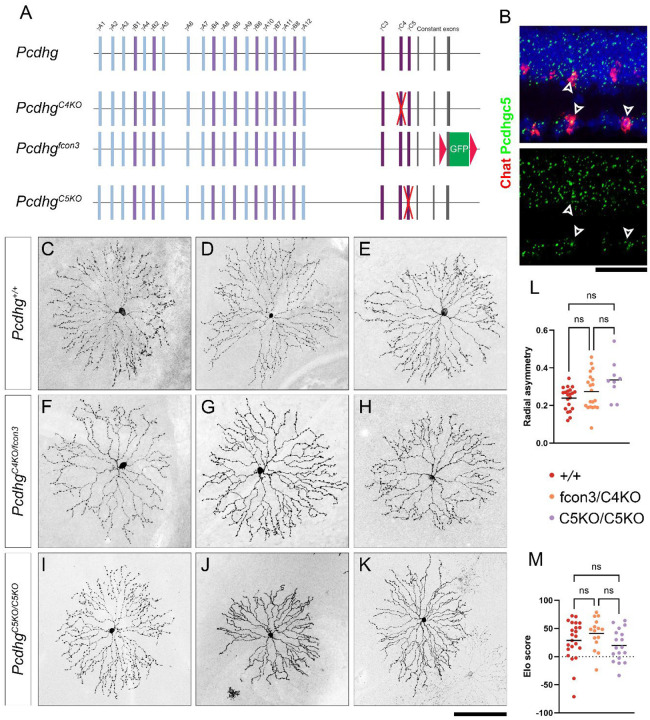
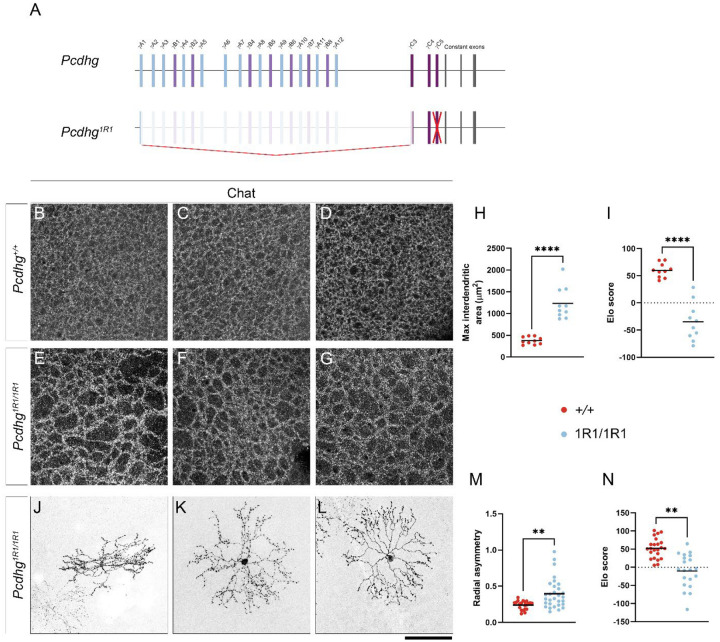
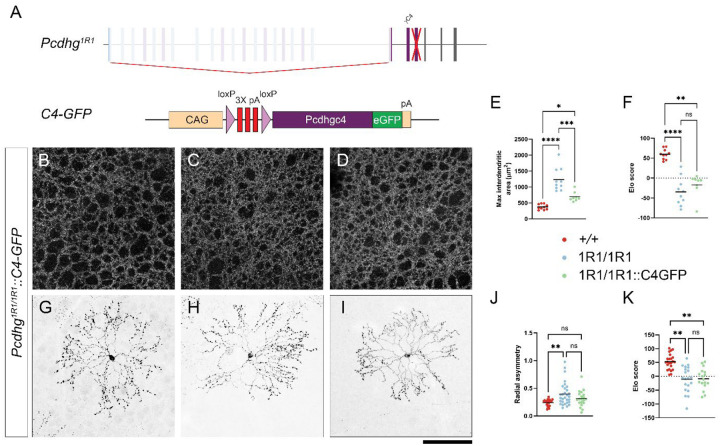
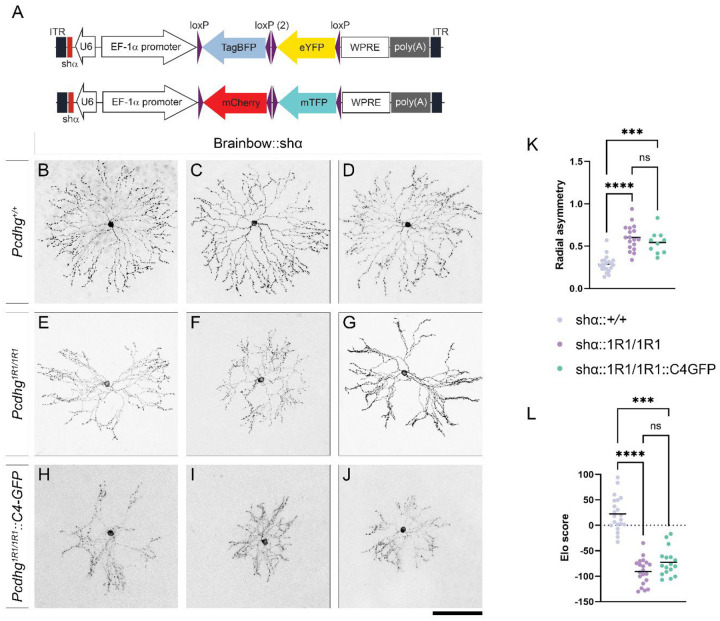
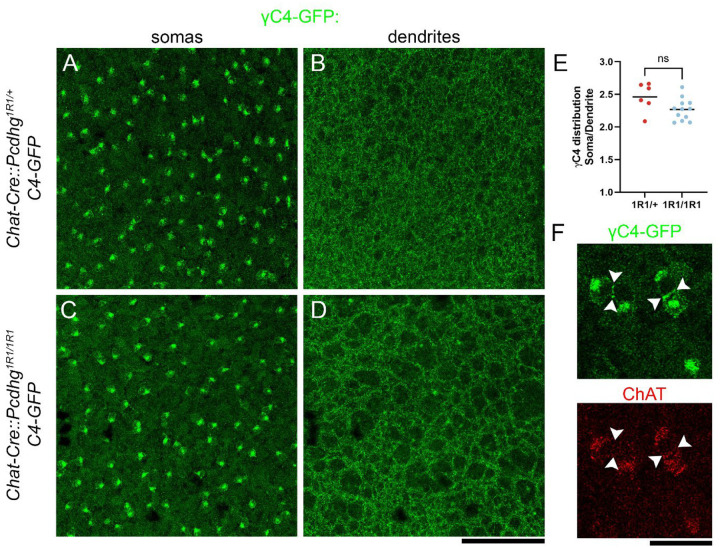
The clustered protocadherins (cPcdhs) are a family of ~60 homophilic cell adhesion molecules expressed across three gene clusters (Pcdha, Pcdhb, and Pcdhg) with a variety of essential roles in the developing nervous system. Some of these roles rely on specific isoforms, while others are more consistent with a model of isoform redundancy or a requirement for diversity. The γ-Pcdhs (expressed from the Pcdhg gene cluster) are particularly important for neuronal self-avoidance in starburst amacrine cells in the mouse retina. Here, we used mouse mutants to test two of the C-type isoforms - γC4 and γC5 - and found that neither was required for normal self-avoidance. Conversely, when we analyzed a mutant with only γC4 intact, we found significant failures in self-avoidance that could not be completely rescued by overexpression of this isoform from a transgene. We have recently found that this isoform is essential for normal neuronal survival during development, and our new findings here support the hypothesis that γC4 is specialized for the survival function at the expense of a significant role in self-avoidance.
Figures
References
-
- Zipursky L.S. and Grueber W.B., The Molecular Basis of Self-Avoidance. Annual Review of Neuroscience, 2013. 36(1): p. 547–568. - PubMed
-
- Zipursky L.S. and Sanes J.R., Chemoaffinity Revisited: Dscams, Protocadherins, and Neural Circuit Assembly. Cell, 2010. 143(3): p. 343–353. - PubMed
-
- Wu Q. and Maniatis T., A Striking Organization of a Large Family of Human Neural Cadherin-like Cell Adhesion Genes. Cell, 1999. 97(6): p. 779–790. - PubMed
Publication types
Grants and funding
LinkOut - more resources
Full Text Sources
