


Hemoglobin glycation index and all-cause mortality in adults: insights from a decade-long prospective cohort study
- PMID: 40510488
- PMCID: PMC12158740
- DOI: 10.3389/fendo.2025.1586309
Hemoglobin glycation index and all-cause mortality in adults: insights from a decade-long prospective cohort study
Abstract
Background: The hemoglobin glycation index (HGI), an indicator of individual differences in glucose metabolism. This study undertakes a detailed 10-year cohort analysis to investigate the potential association between HGI and all-cause mortality in a Chinese adult population.
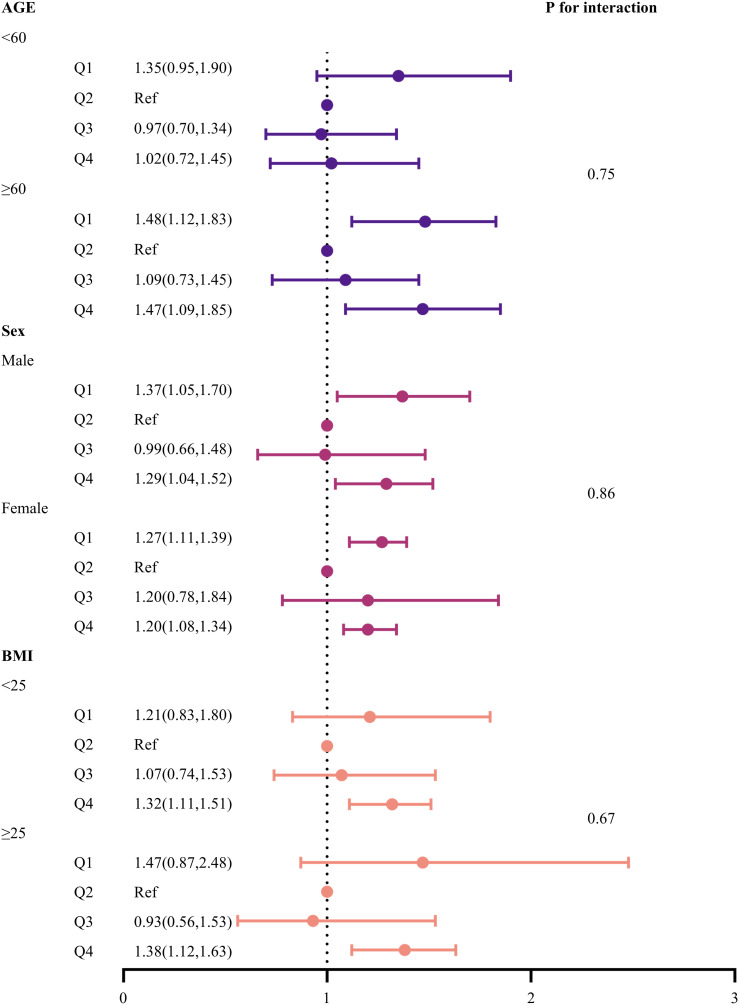
Methods: Baseline data encompassing lifestyle and metabolic parameters were collected from 10,008 participants, with a subsequent 10-year follow-up. Following exclusions based on predefined criteria, 9,084 individuals were included in the final analysis. Participants were categorized into quartiles based on their HGI values. A suite of statistical tools, including Kaplan-Meier survival analysis, Cox proportional hazards models, restricted cubic splines (RCS), threshold effect models, and subgroup analyses, was employed to investigate the association between HGI and all-cause mortality.
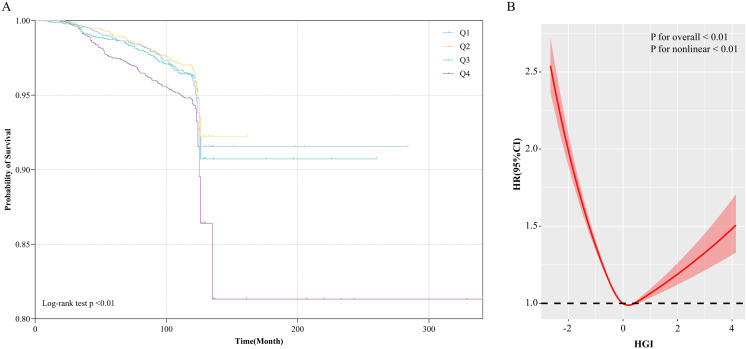
Results: During the 10-year follow-up period, a total of 514 all-cause mortality cases were recorded. Kaplan-Meier survival analysis identified the Q2 group as having the lowest mortality rate. Fully adjusted Cox proportional hazards models demonstrated significant associations, indicating higher all-cause mortality risks in participants with both extremely low and high HGI levels compared to the Q2 group. RCS analysis further illustrated a U-shaped relationship between HGI and all-cause mortality.
Conclusions: In the Chinese population, both markedly elevated and significantly reduced HGI levels are associated with adverse impacts on long-term survival.
Core tip: The aim of this study was to assess the association of Hemoglobin Glycation Index(HGI) with all-cause mortality in non-type 2 diabetic patients based on a 10-year cohort study from China. After COX regression, restricted cubic spline analysis, and subgroup analyses, it was found that a significant increase or decrease in HGI adversely affected long-term survival.
Keywords: U-shaped correlation; all-cause mortality; hemoglobin glycation index; prospective cohort study; risk fcator.
Copyright © 2025 Zhang, Li and Wan.
Conflict of interest statement
The authors declare that the research was conducted in the absence of any commercial or financial relationships that could be construed as a potential conflict of interest.
Figures
References
MeSH terms
Substances
LinkOut - more resources
Full Text Sources
Medical
