


Associations between sugar-sweetened beverage consumption, moderate-to-vigorous-intensity physical activity levels, and depressive symptoms: a cross-sectional study based on Tibetan university students at high altitude in China
- PMID: 40510499
- PMCID: PMC12158687
- DOI: 10.3389/fnut.2025.1582167
Associations between sugar-sweetened beverage consumption, moderate-to-vigorous-intensity physical activity levels, and depressive symptoms: a cross-sectional study based on Tibetan university students at high altitude in China
Abstract
Background: Depressive symptoms are spreading globally with increasing life stress and have become an important public health issue. However, fewer studies have been conducted on the association between sugar-sweetened beverages (SSBs) consumption, moderate-to-vigorous-intensity physical activity (MVPA), and depressive symptoms among Tibetan university students at high altitudes. The present study may provide a reference for the mental health development of Tibetan university students at high altitudes.
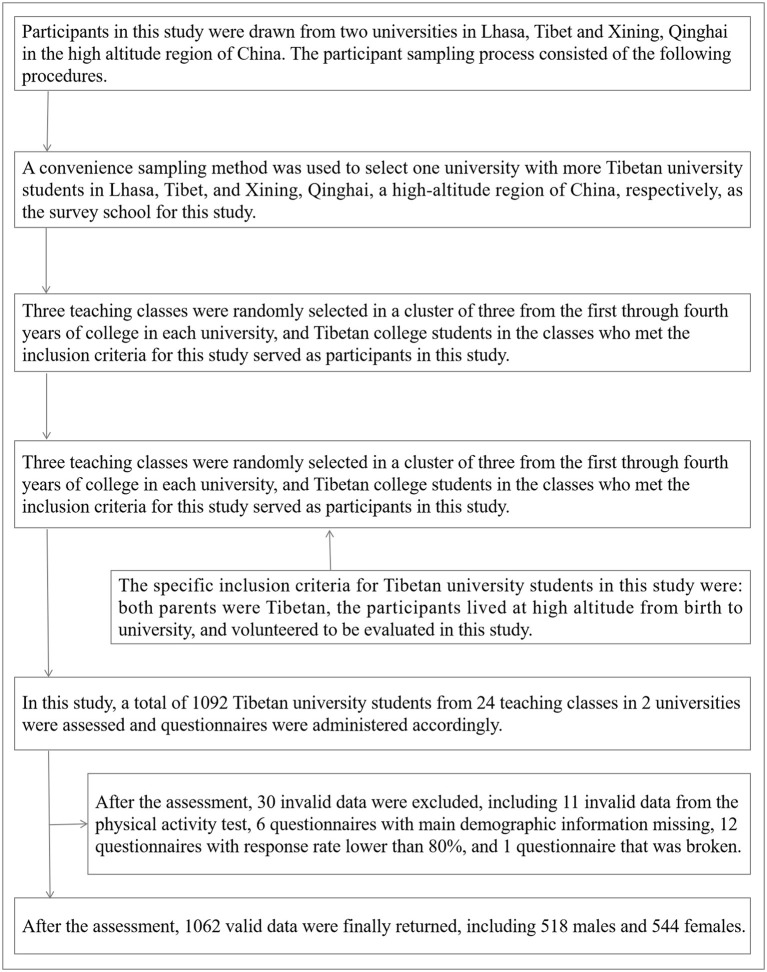
Methods: In this study, SSBs consumption, MVPA time objectively measured by Actigraph GT3X+ accelerometer, and depressive symptoms were assessed in 1,062 university students aged 19-22 years from two universities in Lhasa, Tibet, and Xining, Qinghai, China, using stratified randomized whole-cluster sampling. The methods of chi-square test, logistic regression analysis, and ordered logistic regression analysis with a generalized linear model were used to analyze the association between SSBs consumption, MVPA levels, and the presence of depressive symptoms.
Results: It was found that the proportions of Tibetan university students at high altitudes in China with SSBs 3-5 times/week and ≥6 times/week were 24.3% and 20.3%, respectively. The proportion of MVPA >60 min/day was only 5.6%. The prevalence of depressive symptoms was 37.5%. Ordered logistic regression analysis adjusted for covariates showed that, in general, for those with SSBs ≤2 times/week and MVPA >60 min/day, there was a positive association between those with SSBs ≥6 times/week and MVPA 30-60 min/day and the occurrence of depressive symptoms (OR = 5.92, 95% CI: 1.94-18.10). Those with SSBs ≥6 times/week and MVPA <30 min/day were also positively associated (P < 0.001) with the occurrence of depressive symptoms (OR = 5.91, 95% CI: 2.19-15.94).
Conclusions: The prevalence of depressive symptoms among Tibetan university students at high altitudes in China is concerning. Higher SSB consumption and lower MVPA were associated with a higher prevalence of depressive symptoms. The findings of this study may provide necessary references and lessons for the government and educational departments to develop public health and educational measures for university students in high-altitude areas.
Keywords: Tibetan; depressive symptoms; high altitude; moderate-to-vigorous-intensity physical activity; sugar-sweetened beverage; university students.
Copyright © 2025 Zhang, Tang, Yao and Li.
Conflict of interest statement
The authors declare that the research was conducted in the absence of any commercial or financial relationships that could be construed as a potential conflict of interest.
Figures
References
LinkOut - more resources
Full Text Sources
