


Nonmetallic magnetic hyperthermia and chemo-immunotherapy of tumors
- PMID: 40510832
- PMCID: PMC12159489
- DOI: 10.1016/j.mtbio.2025.101910
Nonmetallic magnetic hyperthermia and chemo-immunotherapy of tumors
Abstract
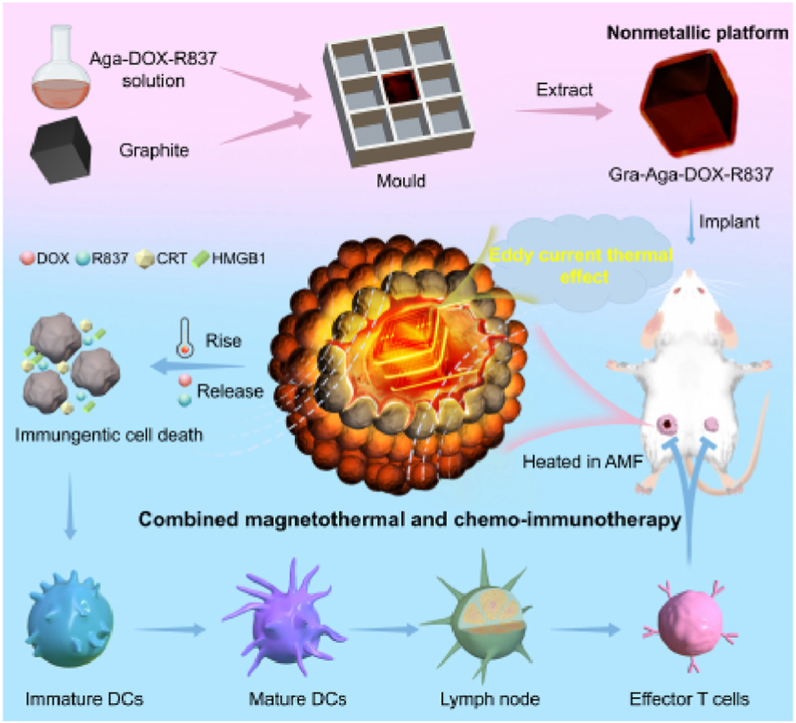
Combined therapy based on magnetic hyperthermia holds significant promise for tumor treatment. Nevertheless, the existing magnetic hyperthermia platforms are often constrained by suboptimal heating efficiency and concerns over the potential metal ion toxicity. Herein, a minimalistic and nonmetallic graphite-agarose gel-drug (Gra-Aga-Drug) implant is prepared by mold-assisted casting method for magnetic hyperthermia-based combination therapy of tumors. This implant can achieve magnetic hyperthermia through the strong eddy current thermal effect of Gra, while the agarose gel provides the implant with universal and efficient drug-loading capacity and magnetic hyperthermia-responsive release ability. The chemotherapeutic drug doxorubicin (DOX) and the immune adjuvant imiquimod (R837) are chosen to prepare Gra-Aga-DOX-R837 implant for combination therapy of tumors in vivo. The magnetic hyperthermia and DOX induce immunogenic cell death (ICD) of tumors, combined with the immune adjuvant R837, eliciting a robust anti-tumor immune response to efficiently ablate primary tumors and suppress distant tumors growth. Importantly, the implant platform effectively addresses the challenges of limited heating efficiency and metal ion toxicity associated with traditional magnetic hyperthermia materials. This study marks the pioneering construction of nonmetallic combination therapy platform with excellent magnetothermal performance and favorable biocompatibility.
Keywords: Controlled drug release; Graphite; Nonmetallic magnetic hyperthermia; Tumor combination therapy; Universal and efficient drug loading.
© 2025 The Authors.
Conflict of interest statement
The authors declare that they have no known competing financial interests or personal relationships that could have appeared to influence the work reported in this paper.
Figures



References
-
- Etemadi H., Plieger P.G. Magnetic fluid hyperthermia based on magnetic nanoparticles: physical characteristics, historical perspective, clinical trials, technological challenges, and recent advances. Adv. Ther. 2020;3(11) doi: 10.1002/adtp.202000061. - DOI
-
- Gavilan H., Avugadda S.K., Fernandez-Cabada T., Soni N., Cassani M., Mai B.T., et al. Magnetic nanoparticles and clusters for magnetic hyperthermia: optimizing their heat performance and developing combinatorial therapies to tackle cancer. Chem. Soc. Rev. 2021;50(20):11614–11667. doi: 10.1039/d1cs00427a. - DOI - PubMed
LinkOut - more resources
Full Text Sources
Miscellaneous
