Review
. 2025 Aug;56(2):125.
doi: 10.3892/ijmm.2025.5566. Epub 2025 Jun 13.

Molecular mechanisms and intervention approaches of heart failure (Review)

Affiliations
Review

Molecular mechanisms and intervention approaches of heart failure (Review)

Shuang Guo et al. Int J Mol Med. 2025 Aug.

Abstract

Heart failure is a major health issue that threatens life and health. Previous studies have shown that heart failure is the terminal stage of arrhythmia, dilated cardiomyopathy, hypertension, hypertrophic cardiomyopathy and myocardial infarction. The pathological mechanisms through which cardiovascular diseases result in heart failure include myocardial fibrosis and hypertrophy, myocardial cell death, mitochondrial dysfunction, vascular remodeling and calcium dysregulation. However, the detailed molecular mechanisms of heart failure remain elusive because of its complexity, hindering the development of intervention approaches for heart failure. The present study reviewed recent research progress on heart failure and provided references and strategies for the prevention and treatment of heart failure.

Keywords: arrhythmias; dilated cardiomyopathy; heart failure; hypertension; hypertrophic cardiomyopathy; myocardial infarction.


Conflict of interest statement

The authors declare that they have no competing interests.

Figures
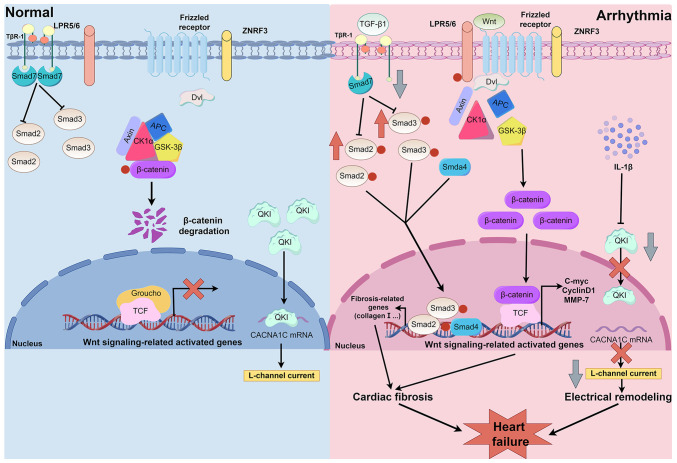
Figure 1
Figure 1
Molecular mechanisms through which arrhythmias lead to heart failure. The activation of the TGF-β1/Smad and Wnt/β-catenin signaling pathways can result in cardiac fibrosis and heart failure. In addition, the secretion of IL-1β can decrease the L-type calcium current and myocardial electrical remodeling and alleviate heart failure. Wnt, wingless-type MMTV integration site family; TβR-1, type I transforming growth factor β1 receptor; LPR5/6, lipoprotein receptor-associated protein 5/6; Dvl, disheveled; Axin, complex composed of axial proteins; APC, adenomatous polyposis coli protein; GSK-3β, glycogen synthase 3β; CK1α, casein kinase 1α; IL-1β, interleukin-1β; TCF, T cell factor; CACNA-1C, calcium voltage-gated channel subunit α1 C; QKI, quaking; ZNRF3, zinc and ring finger 3.
Figure 2
Figure 2
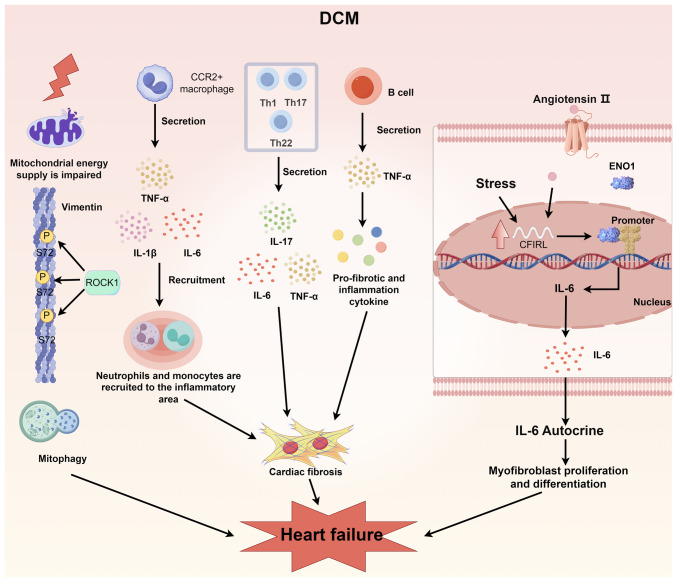
Molecular mechanisms through which DCM leads to heart failure. ROCK1-VIN pathway activation can lead to mitophagy and heart failure. Immune cells such as macrophages, T cells and B cells can secrete inflammatory and chemotactic factors, resulting in cardiac fibrosis and heart failure. The upregulation of CFIRL expression can cause IL-6 autocrine activity, myofibroblast proliferation and differentiation, and heart failure. ROCK1, rho-associated coiled-coil containing protein kinase 1; DCM, dilated cardiomyopathy; CCR2+, C-C chemokine receptor 2 positive; TNF-α, tumor necrosis factor-α; Th1, T helper 1 cell; ENO1, enolase 1; CFIRL, calcium-independent receptor for α-latrotoxin.
Figure 3
Figure 3
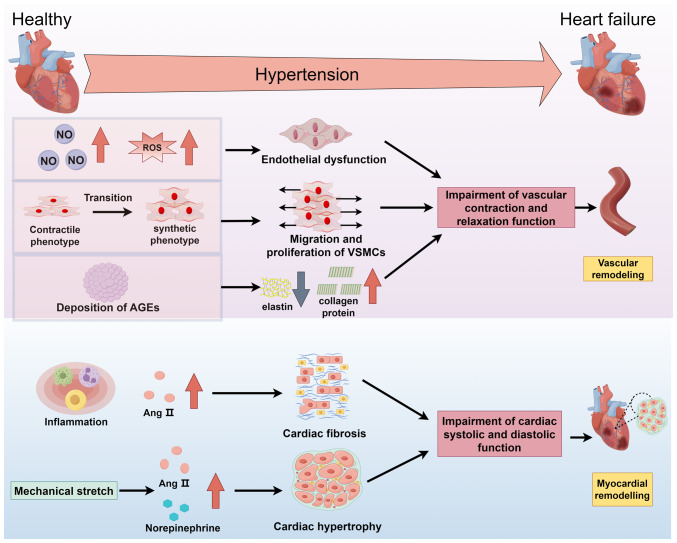
Molecular mechanisms through which hypertension leads to heart failure. Endothelial cell dysfunction, the migration and proliferation of VSMCs and the dysregulation of extracellular matrix components can cause vascular remodeling and heart failure. Cardiac fibrosis is induced by inflammation or Ang II and hypertrophy by Mechanical stretch, and Ang II or norepinephrine can result in myocardial remodeling and heart failure. NO, nitric oxide; ROS, reactive oxygen species; VSMCs, vascular smooth muscle cells; AGEs, advanced glycation end-products; Ang II, angiotensin II; RAAS, renin-angiotensin-aldosterone system.
Figure 4
Figure 4
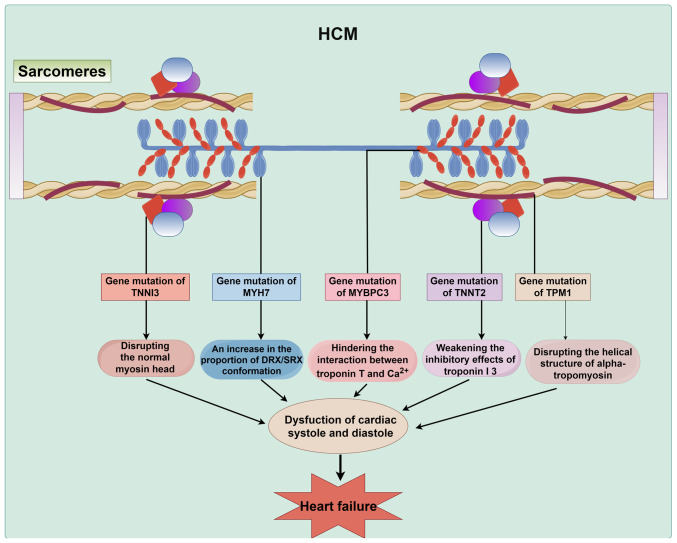
Molecular mechanisms through which HCM leads to heart failure. In hypertrophic cardiomyopathy, mutations in sarcomere-related genes, including MYH7, MYBPC3, TNNT2, TNNI3 and TPM1, can cause the dysregulation of cardiac systole and diastole function, which leads to heart failure. MYH7, myosin heavy chain7; MYBPC3, myosin-binding protein C3; TNNT2, cardiac-type troponin T2; TPM1, tropomyosin 1; DRX, disordered relaxation; SRX, superrelaxation; HCM, hypertrophic cardiomyopathy.
Figure 5
Figure 5
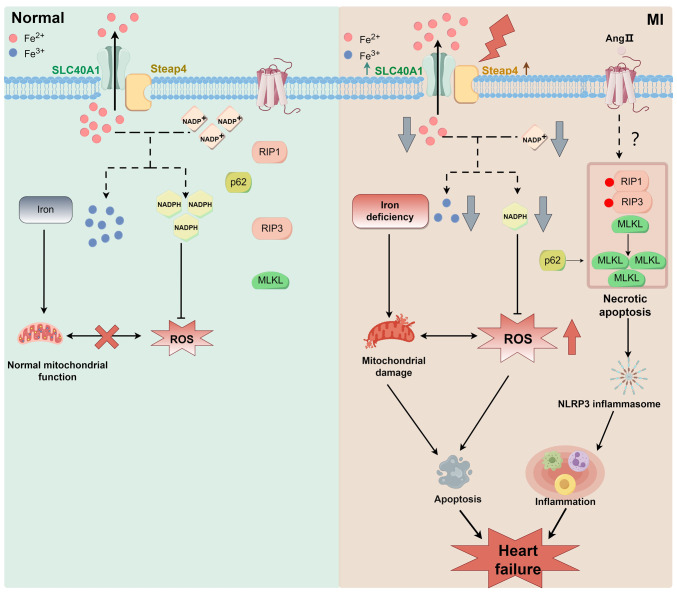
Molecular mechanisms through which MI leads to heart failure. The upregulation of SLC40A1 and Steap4 expression can result in mitochondrial impairment and increase ROS levels, which ultimately cause cell apoptosis and heart failure. Necrotic apoptosis mediated by Ang II can cause myocardial inflammation and heart failure. SLC40A1, solute carrier family 40 member 1; Steap4, steap family member 4; MI, myocardial infarction; NADPH, nicotinamide adenine dinucleotide phosphate-hydrogen; RIP1, receptor-interacting protein 1; ROS, reactive oxygen species; p62, sequestosome-1; MLKL, mixed-lineage kinase domain-like protein; Ang II, angiotensin II; NLRP3, NOD-like receptor protein 3.

References

    1. Ketabi M, Andishgar A, Fereidouni Z, Sani MM, Abdollahi A, Vali M, Alkamel A, Tabrizi R. Predicting the risk of mortality and rehospitalization in heart failure patients: A retrospective cohort study by machine learning approach. Clin Cardiol. 2024;47:e24239. doi: 10.1002/clc.24239. - DOI - PMC - PubMed
    1. Xu X, Xu Z, Association between phenotypic age the risk of mortality in patients with heart failure A retrospective cohort study. Clin Cardiol. 2024;47:e24321. doi: 10.1002/clc.24321. - DOI - PMC - PubMed
    1. Pratley R, Guan X, Moro RJ, do Lago R. Chapter 1: The burden of heart failure. Am J Med. 2024;137(2S):S3–S8. doi: 10.1016/j.amjmed.2023.04.018. - DOI - PubMed
    1. Mulugeta H, Sinclair PM, Wilson A. Prevalence of depression and its association with health-related quality of life in people with heart failure in low- and middle-income countries: A systematic review and meta-analysis. PLoS One. 2023;18:e0283146. doi: 10.1371/journal.pone.0283146. - DOI - PMC - PubMed
    1. Shahim B, Kapelios CJ, Savarese G, Lund LH. Global public health burden of heart failure: An updated review. Card Fail Rev. 2023;9:e11. doi: 10.15420/cfr.2023.05. - DOI - PMC - PubMed

LinkOut - more resources