


Exploring BMI categories and their association with fragility fractures in Thai men: a retrospective study at Burapha University Hospital
- PMID: 40514229
- PMCID: PMC12164645
- DOI: 10.1136/bmjopen-2024-087424
Exploring BMI categories and their association with fragility fractures in Thai men: a retrospective study at Burapha University Hospital
Abstract
Objectives: To examine the association between body mass index (BMI) categories and the fragility fractures in Thai men and to identify the most common anatomical sites of these fractures. We hypothesised that BMI is associated with the risk of fragility fractures in this population.
Design: Retrospective observational study.
Setting: A tertiary care centre in eastern Thailand, based on data from Burapha University Hospital.
Participants: The study included 419 Thai men aged 40 years or older who underwent bone mineral density (BMD) assessment between 2014 and 2022. Participants were classified according to the presence or absence of documented fragility fractures. Exclusion criteria included pathological fractures, high-energy trauma and incomplete BMI or BMD data.
Primary and secondary outcomes: The primary outcome was the association between BMI categories and the risk of fragility fractures. The secondary outcome was the anatomical distribution of these fractures.
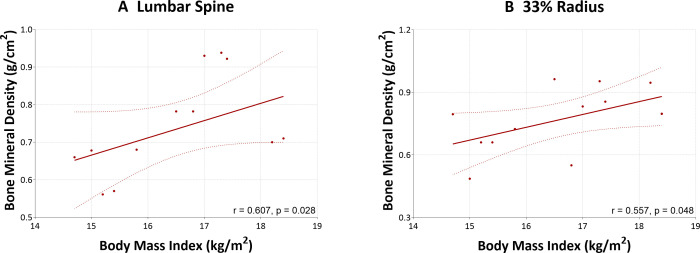
Results: Among 419 participants, 147 (35.1%) had fragility fractures and 272 (64.9%) did not. Underweight men had significantly increased odds of fragility fractures (OR, 3.44; 95% CI, 1.03 to 11.47; p=0.044) and vertebral fractures (OR, 4.30; 95% CI, 1.36 to 13.58; p=0.013), compared with men of normal BMI. In contrast, overweight men had lower odds of overall fractures (OR, 0.50; 95% CI, 0.31 to 0.80; p=0.004) and vertebral fractures (OR, 0.48; 95% CI, 0.27 to 0.84; p=0.010). Among underweight participants, BMI was moderately positively correlated with BMD at the lumbar spine (r=0.607; p=0.028) and at the one-third radius (r=0.557; p=0.084).
Conclusions: Lower BMI was significantly associated with increased risk of fragility fractures, particularly vertebral fractures. These findings support prior evidence in Asian populations and reveal a fracture pattern, predominantly vertebral followed by hip fractures, which differs from those observed in predominantly Caucasian populations.
Keywords: Body Mass Index; Bone diseases; Calcium & bone; Fractures, Closed; GERIATRIC MEDICINE.
© Author(s) (or their employer(s)) 2025. Re-use permitted under CC BY-NC. No commercial re-use. See rights and permissions. Published by BMJ Group.
Conflict of interest statement
Competing interests: None declared.
Figures
References
Publication types
MeSH terms
LinkOut - more resources
Full Text Sources
Medical
