Review
. 2025 Jun;31(6):1765-1775.
doi: 10.1038/s41591-025-03742-3. Epub 2025 Jun 13.

Strategies for shortening tuberculosis therapy

Affiliations
Review

Strategies for shortening tuberculosis therapy

Véronique A Dartois et al. Nat Med. 2025 Jun.

Abstract

In the absence of effective patient-stratification approaches, tuberculosis (TB) treatment relies on overtreating most patients to ensure high cure rates. Shortening treatment duration without compromising efficacy is therefore high on the agenda of the global TB community. While new and better drugs are certainly needed, we argue that innovative but rational treatment strategies, using both new and existing therapies, will help achieve this goal. There is growing recognition that patient stratification, based on host and pathogen factors, is key to delivering the right drug regimen for the right duration. In this Perspective, we review the current knowledge on the heterogeneity of TB disease and propose approaches to optimize treatment duration in distinct patient groups, taking into consideration the realities of TB control globally. We emphasize key insights that improve the understanding of bacterial vulnerabilities in patients with easy-to-treat and hard-to-treat TB, helping to reduce diagnostic uncertainties. We explore how the TB research community can integrate disease biology, pathology and symptoms, to rethink therapeutic strategies and reduce TB treatment duration.


Conflict of interest statement

Competing interests: The authors declare no competing interests.

Figures
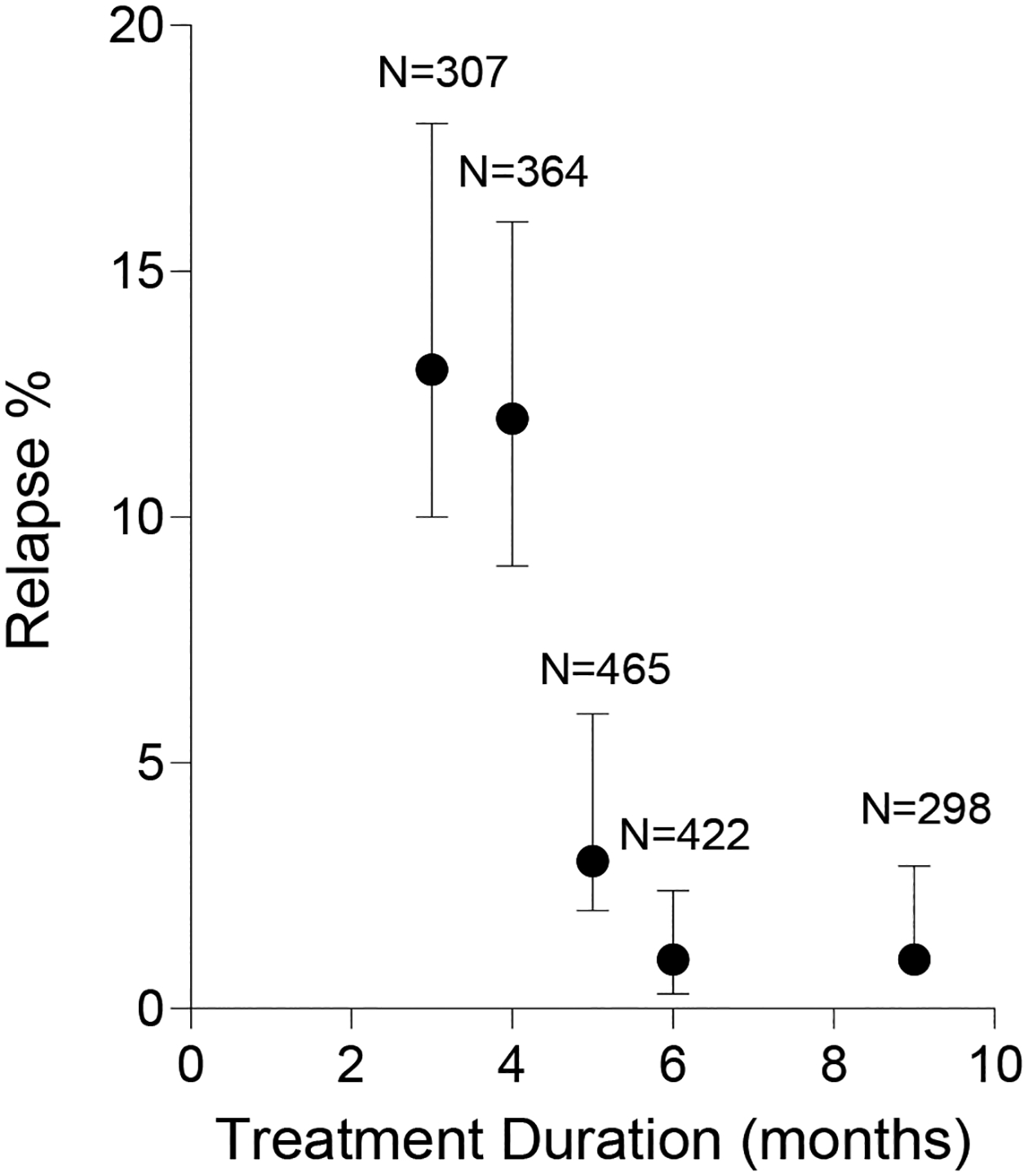
Figure 1.
Figure 1.. Microbiological relapse rates as a function of treatment duration.
The graph shows pooled results with 95% confidence limits and the total number of participants per trial, plotted from historical data in ref. Regimens contained various combinations of isoniazid, rifampicin, pyrazinamide, ethambutol and streptomycin. It was recognized from this analysis that more than 80% of all TB patients were cured within 3 months of combination therapy, supporting the notion that we overtreat a large fraction of patients with the current standard of care. For the remaining 20% of patient, sit wasn’t until > 5 months of therapy that relapse rates could be driven down to less than 5%, which supported 6 months as the shortest duration providing near-maximal efficacy across a heterogeneous population.
Figure 2.
Figure 2.. Immunopathological features of typical easy-to-treat (ETT) and hard-to-treat (HTT) TB.
(A-B) Two patients treated for four months in the Predict TB trial, one successfully (A) and one not (B). ETT patients typically show thin-walled cavities and pulmonary nodules, visible in both the left and right lungs of the patient shown in (A). HTT patients typically show large, thick-walled cavities as shown in the left upper lobe in (B) which was also the site of disease relapse six months after this patient discontinued treatment. In the initial sputum nucleic acid amplification test (GeneXpert), patient A showed a Cycle threshold (Ct) value of 26.1 indicative of low sputum burden while patient B showed a Ct of 19.8 indicative of high sputum burden. (C) Working model illustrating hypothetical pathological features that may create a bottleneck to cure in ETT and HTT patients and how they may overlap. Parenchymal granulomas refer to small cellular lesions. Alveolitis refers to neutrophil-driven polymorphonuclear airway disease in terminal airways and bronchitis in larger airways, the latter resulting from bronchial spread of caseous spills.
Figure 3.
Figure 3.. Patient stratification approach.
The figure illustrates the interplay between diagnosis, host-bacterium features, and treatment optimization for TB. As a long-term vision, algorithms that integrate disease severity and bacterial burden, comprehensive drug susceptibility profiles, pharmacogenomics, pharmacokinetics and drug-drug interactions will be developed and validated to deliver optimized, patient-tailored drug doses and regimens. Real-time monitoring of treatment response will enable adjustments of treatment duration to avoid overtreating as much as undertreating.

References

    1. Esmail H, Macpherson L, Coussens AK & Houben R Mind the gap - Managing tuberculosis across the disease spectrum. EBioMedicine 78, 103928, doi: 10.1016/j.ebiom.2022.103928 (2022). - DOI - PMC - PubMed
    1. Imperial MZ et al. A patient-level pooled analysis of treatment-shortening regimens for drug-susceptible pulmonary tuberculosis. Nat Med 24, 1708–1715, doi: 10.1038/s41591-018-0224-2 (2018). - DOI - PMC - PubMed
    1. WHO. Target regimen profile for tuberculosis treatment, https://www.who.int/publications/i/item/9789240081512. (Geneva, 2023).
    1. Aldridge BB et al. The Tuberculosis Drug Accelerator at year 10: what have we learned? Nat Med, doi: 10.1038/s41591-021-01442-2 (2021). - DOI - PMC - PubMed
    1. Berger CA et al. Variation in tuberculosis treatment outcomes and treatment supervision practices in Uganda. J Clin Tuberc Other Mycobact Dis 21, 100184, doi: 10.1016/j.jctube.2020.100184 (2020). - DOI - PMC - PubMed

MeSH terms

Substances

LinkOut - more resources
