. 2025 Jul;1549(1):120-138.
doi: 10.1111/nyas.15394. Epub 2025 Jun 15.

Brazil climate highlights 2023

Affiliations

Brazil climate highlights 2023

Luana Albertani Pampuch et al. Ann N Y Acad Sci. 2025 Jul.

Abstract

In the year 2023, the Earth experienced the highest near-surface temperature anomalies ever recorded until then. In addition, several extreme weather and climate events occurred around the world, including in Brazil. In this context, the primary objective of this study is to analyze the anomalous temperature and precipitation patterns observed in Brazil during 2023, along with the most significant extreme events. Different datasets and methodologies were applied. The north coast of the state of São Paulo had the highest accumulation of rainfall recorded in Brazil in a single day. September, October, and November 2023 experienced the large precipitation deficits over the Amazon region, leading to a very intense and prolonged drought. The south of Brazil was affected by a large amount of precipitation in a short time, associated with cyclones, resulting in fatalities and economic losses. Southeast and Central-West Brazil experienced two intense heatwaves in the austral spring, breaking daily temperature records in major cities like São Paulo and Rio de Janeiro. Overall, this study describes the main physical processes responsible for these extremes, along with the socioenvironmental impacts caused by most of them.

Keywords: Brazil; extreme precipitation; heatwaves; intense winds; synoptic‐scale cyclones.


Conflict of interest statement

The authors declare no conflicts of interest.

Figures

FIGURE 1
FIGURE 1
Records of Instituto Nacional de Meteorologia (INMET) conventional meteorological stations: (A) 2023 annual anomalies of compensated average temperature (°C) (the stations where the highest temperature anomaly was recorded in 2023 are marked with (*); (B) 2023 annual anomalies of precipitation (mm) (stations with highest precipitation anomaly recorded in 2023 are marked with upward triangles, while the lowest precipitation anomaly recorded in 2023 are marked with downward triangles); (C) 2023 records of air temperature (°C); and (D) 2023 records of maximum temperature (°C), with four events in September (red), seven in October (blue), 11 in November (purple), and one in December (green).
FIGURE 2
FIGURE 2
Compensated average temperature (°C) monthly anomalies for 2023 for Instituto Nacional de Meteorologia (INMET) conventional meteorological stations using 1991–2020 climatology, for (A) January, (B) February, (C) March, (D) April, (E) May, (F) June, (G) July, (H) August, (I) September, (J) October, (K) November, and (L) December (in °C) (the stations with the highest temperature monthly anomaly are marked with *).
FIGURE 3
FIGURE 3
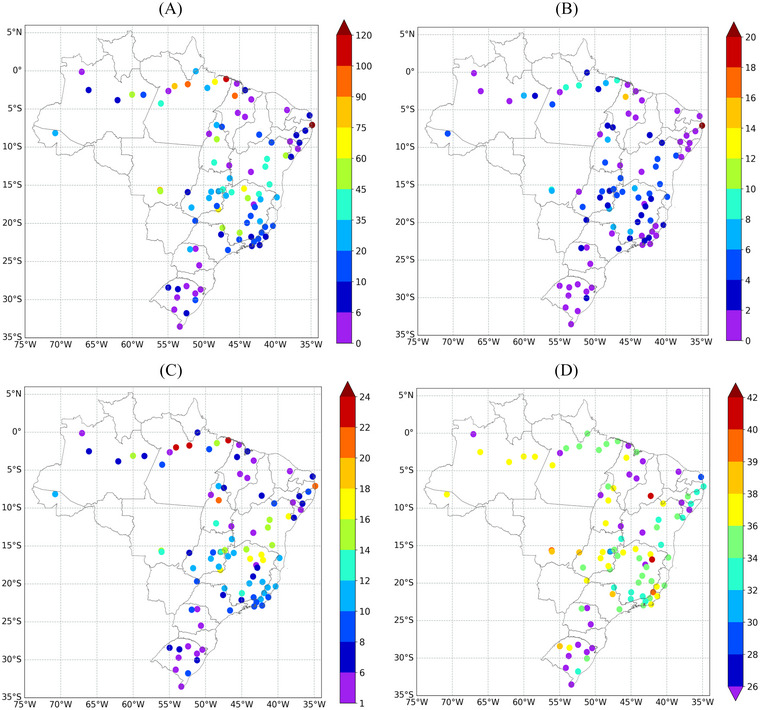
(A) Warm Spell Duration Index (WSDI, in days); (B) yearly number of heatwaves (HWN); (C) length (in days) of the longest heatwave of the year (HWD); and (D) average daily magnitude (in °C) of all heatwaves events (HWM) during 2023.
FIGURE 4
FIGURE 4
Precipitation monthly anomalies for 2023 for Instituto Nacional de Meteorologia (INMET) conventional meteorological stations using 1991–2020 climatology: (A) January, (B) February, (C) March, (D) April, (E) May, (F) June, (G) July, (H) August, (I) September, (J) October, (K) November, and (L) December (in mm).
FIGURE 5
FIGURE 5
(A, B) Thickness between 1000 and 500 hPa layer (m, red lines), mean sea level pressure (hPa, black lines), and 850‐hPa isotachs (m/s, shaded); (C, D) air temperature (°C, red lines), geopotential height (m, black lines), cyclonic relative vorticity (10−5 s−1), and omega (hPa s−1) at 500‐hPa; (E, F) 250‐hPa streamlines and isotachs (m/s, shaded); (G, H) infrared images (CH13, 10.35 µm) from the GOES‐16 satellite at 00 UTC on February 18 (A,C,E, and G) and 19 (B,D,F, and H). The red box represents the coast of the São Paulo state, highlighting the recorded precipitation totals in the analyzed municipalities shown in (I).
FIGURE 6
FIGURE 6
Sea surface temperature anomalies (panels A, D, and G), vertical cross sections of anomalous vertical velocity (omega, 10−2 Pa.s−1) meridionally averaged between 10°N and 10°S (panels B, E, and H), and vertical cross sections of anomalous vertical velocity (omega) zonally averaged between 70°W and 40°W (panels C, F, and I) for September (the first row), October (the second row), and November (the third row) 2023. Anomalies were computed with respect to the 1991−2020 climatology using ERA5.
FIGURE 7
FIGURE 7
Accumulated precipitation (mm; panels A‐D) from Multi‐Sensor Weather (MSWX) reanalysis, percentage of monthly precipitation (%; panels E‐H), and maximum daily wind speed (m/s; panels I‐L) associated with four selected cyclones of 2023: (A)‐(E)‐(I) June 14–22, (B)‐(F)‐(J) July 12–16, (C)‐(G)‐(K) September 02–05, and (D)‐(H)‐(L) October 03–06.
FIGURE 8
FIGURE 8
Day with maximum positive difference between daily precipitation and the climatological 95th percentile of daily precipitation (1991–2020) associated with the four cyclones of 2023: (A) June 16, 2023, (B) July 12, 2023, (C) September 4, 2023, and (D) October 4, 2023.
FIGURE 9
FIGURE 9
Annual density of genesis: (A) 2023; (B) annual anomaly calculated for 2023 by subtracting the reference period of 1991–2020. The density unit is the number of cyclones per area (km2) × 105 per year.
FIGURE 10
FIGURE 10
Synoptic conditions for heatwave episodes of (A, C, E, G) September 17–27, 2023 and (B, D, F, H) November 11–18, 2023 for the following variables: (A, B) anomalies of 2 m air temperature (shaded, unit:°C) and sea level pressure (contour, unit: hPa); (C, D) 500‐hPa geopotential height (contour) and 500‐hPa geopotential height anomalies (shaded, unit: mgp); (E, F) 200‐hPa zonal wind speed (contour) and 200‐hPa zonal wind speed anomalies (shaded, unit: m/s); and (G, H) 850‐hPa specific humidity anomaly (shaded, unit: g/kg) and 850‐hPa horizontal wind direction (vector, unit: m/s).

References

    1. IPCC . (2023). Summary for policymakers. In Core Writing Team, Lee H., & Romero J. (Eds), Climate Change 2023: Synthesis Report. Contribution of Working Groups I, II and III to the Sixth Assessment Report of the Intergovernmental Panel on Climate Change (pp. 1–34). IPCC. 10.59327/IPCC/AR6-9789291691647.001 - DOI
    1. World Meteorological Organization . (2024). State of the Global Climate 2023.
    1. Copernicus . (2024). The 2023 Annual Climate Summary. Global Climate Highlights 2023. https://climate.copernicus.eu/global‐climate‐highlights‐2023
    1. The Paris Agreement . (2016). United Nations Framework Convention on Climate Change (UNFCCC). https://unfccc.int/sites/default/files/resource/parisagreement_publicati...
    1. IPCC . (2021). Summary for policymakers. In Masson‐Delmotte V., Zhai P., Pirani A., Connors S. L., Péan C., Berger S., Caud N., Chen Y., Goldfarb L., Gomis M. I., Huang M., Leitzell K., Lonnoy E., Matthews J. B. R., Maycock T. K., Waterfield T., Yelekçi O., Yu R., & Zhou B. (Eds.), Climate Change 2021: The Physical Science Basis. Contribution of Working Group I to the Sixth Assessment Report of the Intergovernmental Panel on Climate Change (p. 3–32). Cambridge University Press. 10.1017/9781009157896.001 - DOI