


Circulating membrane aminophospholipids contribute to thrombotic risk in rheumatoid arthritis
- PMID: 40523622
- PMCID: PMC12273563
- DOI: 10.1016/j.jlr.2025.100842
Circulating membrane aminophospholipids contribute to thrombotic risk in rheumatoid arthritis
Abstract
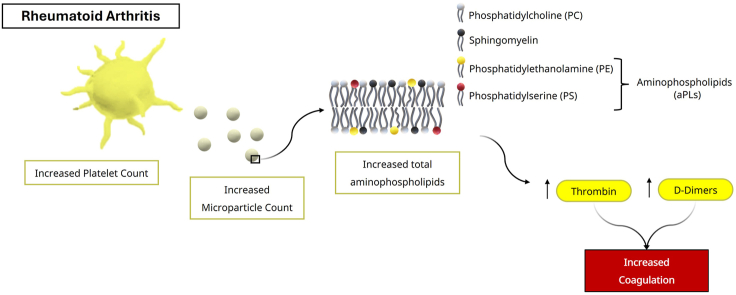
Patients with rheumatoid arthritis (RA) are at elevated risk of thrombotic events, yet the underlying mechanisms remain unknown. The contribution of the procoagulant membrane surface provided by aminophospholipids (aPLs) in driving thrombotic risk in RA has not been investigated. Specifically, neither the type of aPL exposed on circulating blood cell membranes in patients is characterized nor is their ability to support thrombin generation is known. Here, lipidomics was used to characterize the external-facing and total levels of aPL molecular species in RA, specifically phosphatidylserine and phosphatidylethanolamine on extracellular vesicles (EVs), platelets, and white blood cells (WBCs). The ability of the cells and EVs to support thrombin generation from patients and healthy controls was compared using an in vitro prothrombinase assay. RA patient plasma had significantly higher levels of thrombin-antithrombin and d-dimers, indicating increased thrombotic activity in vivo. Higher EV and platelet counts were seen in RA, but WBC counts were not elevated. EVs from RA patients supported higher levels of thrombin generation compared with healthy controls, whereas for platelets and WBC, thrombin generation was similar for both groups. EVs from RA patients also showed elevated external-facing phosphatidylserine molecular species, with total aPL also increased. For platelets and WBC, total and external-facing aPL levels were similar. Thrombin-antithrombin (TAT) complexes significantly correlated with EV particle counts, indicating that their circulating numbers are directly related to coagulation in vivo. Overall, our data suggest that elevated plasma EV levels in RA are a major source of procoagulant membranes, contributing to thrombotic risk in RA.
Keywords: aminophospholipids; extracellular vesicles; lipidomics; rheumatoid arthritis; thrombosis.
Copyright © 2025 The Authors. Published by Elsevier Inc. All rights reserved.
Conflict of interest statement
Conflict of interest E. C. has received research grants and honoraria from Abbvie, Alfasigma, Bio-Cancer, Biocon, Biogen, Chugai Pharma, Eli Lilly, Fresenius Kai, Galapagos, Gedeon Richter, Gilead, Inmedix, Janssen, Pfizer, Sanofi, UCB, and Viatris. S. A. J. has received funding support from Hoffman-La Roche, GlaxoSmithKline, Ferring Pharmaceuticals, Meastag Therapeutics, and NovImmune. S. A. J. has acted as an advisory consultant for Roche, Chugai Pharmaceuticals, NovImmune SA, Genentech, Sanofi Regeneron, Johnson & Johnson, Janssen Pharmaceuticals, Eleven Biotherapeutics, and Mab Design. V. O. D. is a consultant for Metasight.
Figures


References
-
- del Rincón I.D., Williams K., Stern M.P., Freeman G.L., Escalante A. High incidence of cardiovascular events in a rheumatoid arthritis cohort not explained by traditional cardiac risk factors. Arthritis Rheum. 2001;44:2737–2745. - PubMed
-
- Solomon D.H., Karlson E.W., Rimm E.B., Cannuscio C.C., Mandl L.A., Manson J.E., et al. Cardiovascular morbidity and mortality in women diagnosed with rheumatoid arthritis. Circulation. 2003;107:1303–1307. - PubMed
-
- Carmassi F., De Negri F., Morale M., Puccetti R., Song K., Chung S. Assessment of coagulation and fibrinolysis in synovial fluid of rheumatoid arthritis patients. Fibrinolysis. 1994;8:162–171.
-
- Conn D.L., McDuffie F.C., Kazmier F.J., Schroeter A.L., Sun N.C.J. Coagulation abnormalities in rheumatoid disease. Arthritis Rheum. 1976;19:1237–1243. - PubMed
MeSH terms
Substances
LinkOut - more resources
Full Text Sources
Medical
