


Whole genome sequencing and single-cell transcriptomics identify KMT2D inactivation as a potential new driver for pituitary tumors: a case report
- PMID: 40523964
- PMCID: PMC12170844
- DOI: 10.1038/s44276-025-00155-0
Whole genome sequencing and single-cell transcriptomics identify KMT2D inactivation as a potential new driver for pituitary tumors: a case report
Abstract
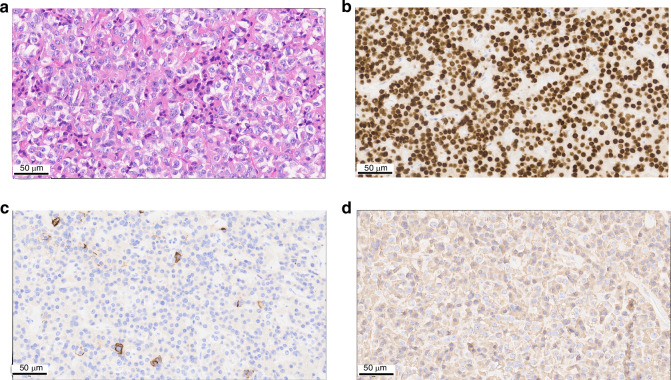
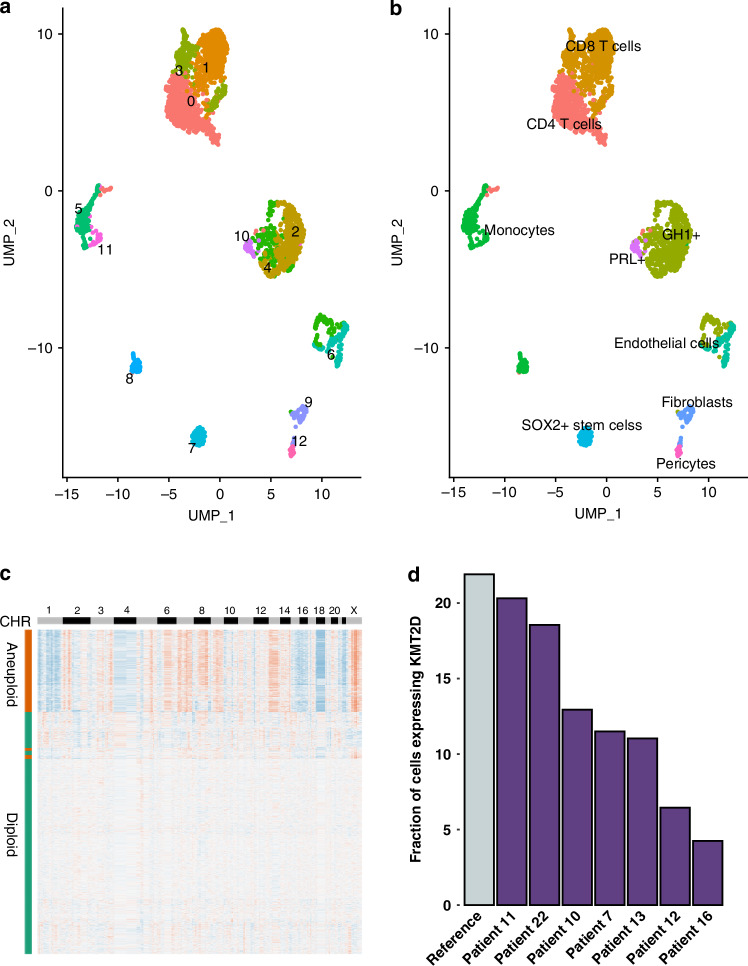
The pituitary gland is a main component of the endocrine system and a master controller of hormone production and secretion. Unlike neoplastic formation in other organs, Pituitary Neuroendocrine Tumors (PitNETs) are frequent in the population (16%) and, for unknown reasons, almost never metastatic. So far, few genes have been identified as drivers for PitNETs, such as GNAS in somatotroph tumors and USP8 in corticotroph tumors. Using whole genome sequencing, we uncover a potential novel driver, the histone methyltransferase KMT2D, in a patient in his 50s suffering from a mixed somato-lactotroph tumor. Coverage ratio between germline and tumor revealed extensive chromosomal alterations. Single-cell RNA sequencing of the tumor shows up-regulation of known tumorigenic pathways compared to a healthy reference, as well as a different immune infiltration profile compared to other PitNETs, more closely resembling the profile of carcinomas than adenomas. Genome-wide DNA methylation analysis identified 796 differentially methylated regions, including notable hypomethylation in the promoter of SPON2, an immune-related gene. Our results show that tumors considered quiet and non-aggressive can share drivers, features, and epigenetic alterations with metastatic forms of cancer, raising questions about the biological mechanisms controlling their homeostasis.
© 2025. The Author(s).
Conflict of interest statement
Competing interests: The authors declare no competing interests. Ethical approval: The study has been performed in accordance with the Declaration of Helsinki and approved by the Commission cantonale d’´ethique de la recherche sur l’ˆetre humain (Vaud) ref. 2019-02033. All patients have signed the informed consent.
Figures



References
-
- Ezzat S, Asa SL, Couldwell WT, Barr CE, Dodge WE, Vance ML, et al. The prevalence of pituitary adenomas: A systematic review. Cancer. 2004;101:613–9. - PubMed
-
- Ludecke DK, Buchfelder M, Fahlbusch R, Quabbe HJ, Petersenn S, Saeger W. Pathohistological classification of pituitary tumors: 10 years of experience with the German Pituitary Tumor Registry. Eur J Endocrinol. 2007;156:203–16. - PubMed
-
- Molitch ME. Diagnosis and treatment of pituitary adenomas: A review. JAMA - J Am Med Assoc. 2017;317:516–24. - PubMed
Grants and funding
- 310030 185292/Schweizerischer Nationalfonds zur Förderung der Wissenschaftlichen Forschung
- 310030 185292/Schweizerischer Nationalfonds zur Förderung der Wissenschaftlichen Forschung
- 310030 185292/Schweizerischer Nationalfonds zur Förderung der Wissenschaftlichen Forschung
- 310030 185292/Schweizerischer Nationalfonds zur Förderung der Wissenschaftlichen Forschung
- 847941/Horizon 2020 Framework Programme
LinkOut - more resources
Full Text Sources
Miscellaneous