


Frailty is a prognostic marker of mortality and sepsis in patients ≥ 70 years with acute left-sided colonic diverticulitis
- PMID: 40523988
- PMCID: PMC12170690
- DOI: 10.1007/s00384-025-04933-7
Frailty is a prognostic marker of mortality and sepsis in patients ≥ 70 years with acute left-sided colonic diverticulitis
Abstract
Background: Acute left-sided colonic diverticulitis (ALCD) has a more complicated course in older patients. Rather than age, frailty may be crucial in ALCD prognosis in this heterogeneous population. This study aims to define the influence of the Clinical Frailty Scale (CFS) on mortality and clinical outcomes in patients aged 70 or older with ALCD.
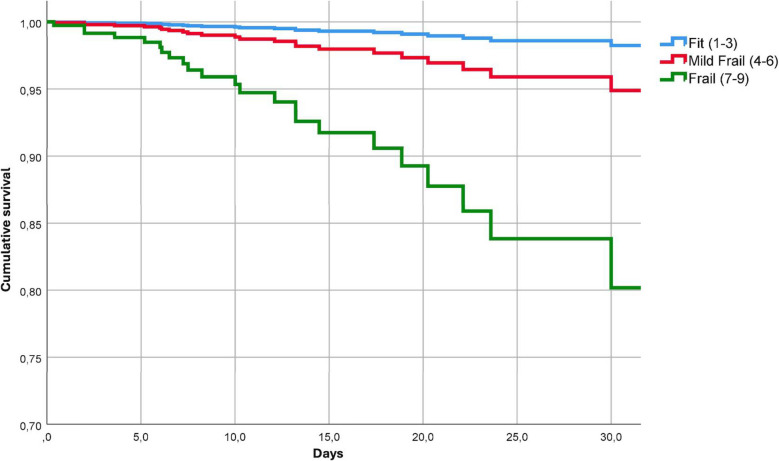
Methods: All patients aged ≥ 70 years admitted to the emergency department for ALCD between January 2018 and December 2022 were included. Frailty was assessed through the CFS, and three groups of patients were identified accordingly: non-frail patients (CFS 1-3); moderately frail patients (CFS 4-6); and severely frail patients (CFS 7-9). The endpoints were: 30-day mortality, sepsis onset, 30-day readmission, and length of hospital stay (LOS).
Results: A total of 1127 patients were enrolled. Severely frail patients had a significantly higher rate of sepsis onset, mortality, and longer LOS at univariate analysis. Higher CFS scores were significantly associated with mortality, both as a continuous (OR 1.42) and discrete variable (OR 12.47), and sepsis, both as a continuous (OR 1.5) and discrete variable (OR 6.52) at multivariate analysis.
Conclusion: A higher CFS score, rather than age, is associated with higher rates of mortality, sepsis, and longer LOS. After adjusting for covariates, higher CFS scores were significantly associated with increased risk of 30-day mortality and sepsis. A comprehensive frailty assessment using the CFS should be considered to predict the need for closer monitoring and guiding appropriate care goals for older patients.
Keywords: Clinical frailty scale; Complicated diverticulitis; Diverticulitis; Elderly; Frailty.
© 2025. The Author(s).
Conflict of interest statement
Declarations. Ethics: All procedures followed the ethical standards of the responsible committee on human experimentation (institutional and national), and with the Helsinki Declaration of 1964 and later versions. Competing interests: The authors declare no competing interests.
Figures


References
-
- Laurell H, Hansson LE, Gunnarsson U (2007) Acute diverticulitis--clinical presentation and differential diagnostics. Colorectal Dis 9:496–501; discussion 501–492. 10.1111/j.1463-1318.2006.01162.x - PubMed
-
- Schena CA, Covino M, Laterza V, Quero G, La Greca A, Cina C, de'Angelis N, Marchegiani F, Sganga G, Gasbarrini A et al (2024) The role of procalcitonin as a risk stratification tool of severity, prognosis, and need for surgery in patients with acute left-sided colonic diverticulitis. Surgery 176:162–171. 10.1016/j.surg.2024.02.032 - PubMed
-
- Fugazzola P, Ceresoli M, Coccolini F, Gabrielli F, Puzziello A, Monzani F, Amato B, Sganga G, Sartelli M, Menichetti F et al (2022) The WSES/SICG/ACOI/SICUT/AcEMC/SIFIPAC guidelines for diagnosis and treatment of acute left colonic diverticulitis in the elderly. World J Emerg Surg 17:5. 10.1186/s13017-022-00408-0 - DOI - PMC - PubMed
-
- Shahedi K, Fuller G, Bolus R, Cohen E, Vu M, Shah R, Agarwal N, Kaneshiro M, Atia M, Sheen V et al (2013) Long-term risk of acute diverticulitis among patients with incidental diverticulosis found during colonoscopy. Clin Gastroenterol Hepatol 11:1609–1613. 10.1016/j.cgh.2013.06.020 - DOI - PMC - PubMed
MeSH terms
LinkOut - more resources
Full Text Sources
Medical
