


Multi-omics analyses of the heterogenous immune microenvironment in triple-negative breast cancer implicate UQCRFS1 potentiates tumor progression
- PMID: 40524231
- PMCID: PMC12172350
- DOI: 10.1186/s40164-025-00672-1
Multi-omics analyses of the heterogenous immune microenvironment in triple-negative breast cancer implicate UQCRFS1 potentiates tumor progression
Abstract
Background: Triple-negative breast cancer (TNBC) is commonly characterized by high-grade and aggressive features, resulting in an augmented likelihood of distant metastasis and inferior prognosis for patients. Tumor immune microenvironment (TME) has been recently considered to be tightly correlated with tumor progression and immunotherapy response. However, the actual heterogenous TME within TNBC remains more explorations.
Methods: The thorough analyses of different cell types within TME were conducted on the self-tested single-cell RNA sequencing dataset which contained nine TNBC treatment-naïve patients, including subclusters classification, CellChat algorithm, transcription factors (TFs) expression, pseudotime analysis and functional enrichment assay. The malignant epithelial cluster was confirmed by copy number variations analysis, and subsequently LASSO-Cox regression was carried out to establish a Malignant Cell Index (MCI) model on the basis of five crucial genes (BGN, SDC1, IMPDH2, SPINT1, and UQCRFS1), which was validated in several TNBC cohorts through Kaplan-Meier survival and immunotherapy response analyses. The public spatial transcriptome, proteome data and qRT-PCR, western blotting experiments were exploited to corroborate UQCRFS1 expression in RNA and protein levels. Additionally, functional experiments were implemented to unravel the impacts of UQCRFS1 on TNBC cells.
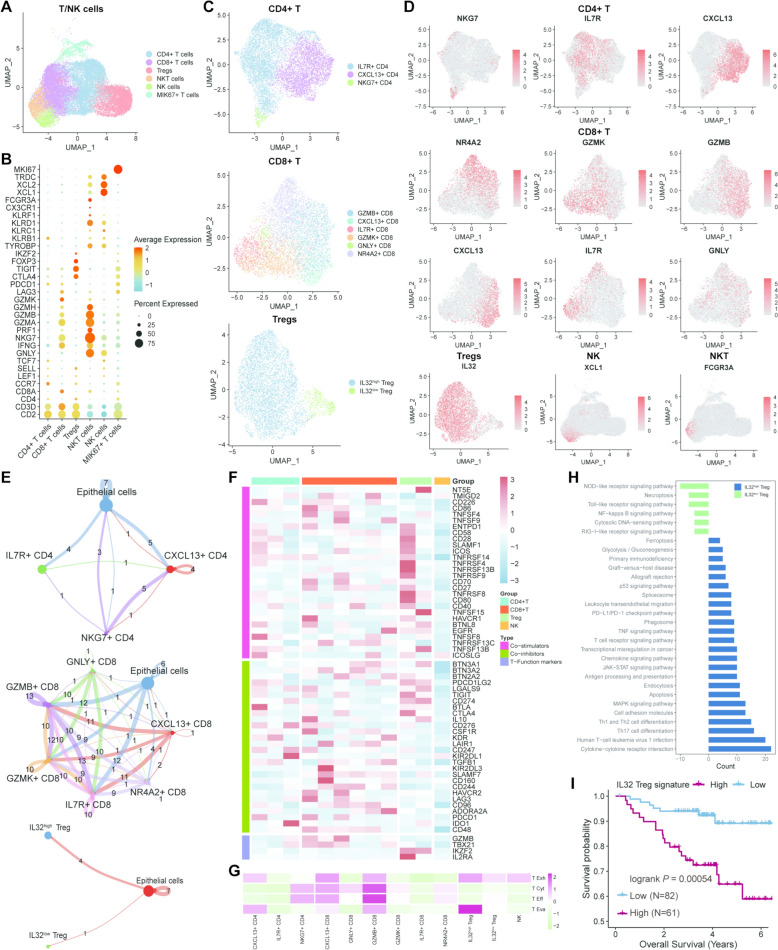
Results: The diverse subclusters of TME cells within TNBC were clarified to display distinct characteristics in cell-cell interactions, TFs expression, differentiation trajectory and functional pathways. Particularly, IL32high Treg imparted an essential effect on tumor evasion and predicted a worsened prognosis of TNBC patients. Furthermore, MCI model enabled to notify the inferior prognosis and immunotherapy resistance in TNBC. Ultimately, UQCRFS1 knockdown dampened the proliferative and migratory competence in vitro as well as tumor growth in vivo of TNBC cells.
Conclusions: Our study offers innovative perspectives on comprehending the heterogeneity within TME of TNBC, thereby facilitating the elucidation of TNBC biology and providing clinical recommendations for TNBC patients' prognosis, such as IL32high Treg infiltration, MCI evaluation, and UQCRFS1 expression.
Keywords: IL32high Treg; Immunotherapy resistance; Multi-omics; Triple-negative breast cancer; Tumor immune microenvironment; UQCRFS1.
© 2025. The Author(s).
Conflict of interest statement
Declarations. Ethical approval and consent to participate: All procedures in this study concerning human participants were executed in accordance with the ethical standards of the National Research Committee and the 1964 Helsinki Declaration. And the study was approved by the Ethics Committee Board of Guangdong Provincial People's Hospital. All the animal experiments were conducted by approvement of The Animal Care and Use Committee of Guangdong Provincial People's Hospital. Consent for publication: All patients for scRNA-sequencing in this study have provided informed consent for the utilization of biopsy specimens. Competing interests: The authors declare no competing interests.
Figures





References
-
- Sung H, Ferlay J, Siegel RL, Laversanne M, Soerjomataram I, Jemal A, et al. Global cancer statistics 2020: GLOBOCAN estimates of incidence and mortality worldwide for 36 cancers in 185 countries. CA Cancer J Clin. 2021;71(3):209–49. - PubMed
-
- Bianchini G, De Angelis C, Licata L, Gianni L. Treatment landscape of triple-negative breast cancer—expanded options, evolving needs. Nat Rev Clin Oncol. 2022;19(2):91–113. - PubMed
-
- Yang F, Xiao Y, Ding JH, Jin X, Ma D, Li DQ, et al. Ferroptosis heterogeneity in triple-negative breast cancer reveals an innovative immunotherapy combination strategy. Cell Metab. 2023;35(1):84-100 e8. - PubMed
Grants and funding
LinkOut - more resources
Full Text Sources
Miscellaneous
