


Nemabiome sequencing reveals seasonal and age associated patterns of strongyle infection and high prevalence of Strongylus vulgaris in Alberta feral horses
- PMID: 40524829
- PMCID: PMC12167826
- DOI: 10.1016/j.ijppaw.2025.101091
Nemabiome sequencing reveals seasonal and age associated patterns of strongyle infection and high prevalence of Strongylus vulgaris in Alberta feral horses
Abstract
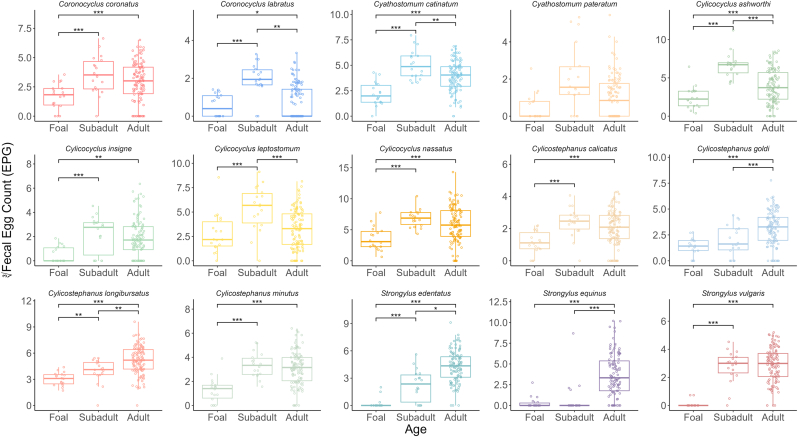
Unmanaged feral horses, naïve to dewormers, offer a unique opportunity to study natural communities of equine parasites. These communities may include parasites that are rare in managed populations, and these may be transmitted to domestic horses in areas where there is contact between feral and domestic equine populations. There have been only a few studies of gastrointestinal parasite populations in horses, and very few from North American equine populations. This study aimed to gain insights into parasite biology through identification of the strongyle parasite species infecting feral horses in Alberta, Canada, and to test for species-specific infection patterns across season and horse age. Fecal samples (N = 149) were collected from unique individuals in the Sundre Equine Management Zone (EMZ), Alberta, across two years: 2021 (N = 62) and 2022 (N = 87). In 2021, samples were collected in summer (N = 31; 8 foals, 5 subadults, 18 adults) and fall (N = 31; 5 foals, 1 subadult, 25 adults). In 2022, samples were collected in spring (N = 36; 4 subadults, 32 adults), summer (N = 41; 4 foals, 8 subadults, 29 adults), and fall (N = 20; 1 foal, 2 subadults, 17 adults). Fecal egg counts showed that these horses shed high numbers of strongyle eggs relative to domestic horse populations (mean = 1337.01 ± 961.81 epg), and nemabiome analyses identified a total of 34 strongyle species. Species richness and aggregate strongyle FECs were highest in subadults and during the summer, while lowest in foals and during the fall. There was a high prevalence of large strongyle species, especially Strongylus vulgaris (85.91 %), with strongyle species-specific prevalence and FECs strongly associated with age and season. Understanding the factors driving species-specific parasite infection provides important information on strongyle parasite ecology and may aid the development of targeted parasite control strategies.
Keywords: Cyathostomins; DNA metabarcoding; Equine; FEC; Parasite ecology.
© 2025 The Authors.
Conflict of interest statement
The authors declare that they have no known competing financial interests or personal relationships that could have appeared to influence the work reported in this paper.
Figures




References
-
- Abbas G., Ghafar A., Bauquier J., Beasley A., Ling E., Gauci C.G., El-Hage C., Wilkes E.J.A., McConnell E., Carrigan P., Cudmore L., Hurley J., Beveridge I., Nielsen M.K., Stevenson M.A., Jacobson C., Hughes K.J., Jabbar A. Prevalence and diversity of ascarid and strongylid nematodes in Australian Thoroughbred horses using next-generation sequencing and bioinformatic tools. Vet. Parasitol. 2023;323 doi: 10.1016/j.vetpar.2023.110048. - DOI - PubMed
-
- Brooks M.E., Kristensen K., Van Benthem K.J., Magnusson A., Berg C.W., Nielsen A., Skaug H.J., Mächler M., Bolker B.M. glmmTMB balances speed and flexibility among packages for zero-inflated generalized linear mixed modeling. Rom. Jahrb. 2017;9:378–400.
LinkOut - more resources
Full Text Sources
